
27 April 2023
Planning your silage strategy – factors affecting silage quality
As part of a three-part series on planning your silage strategy, Teagasc Beef Specialist Martina Harrington discusses the factors that affect silage quality on your farm.
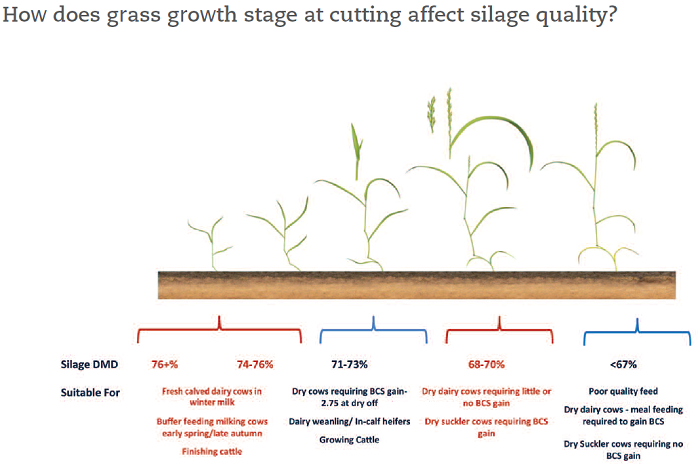
The biggest factor affecting silage quality is heading date. Looking at the diagram (figure 1) below, we can see the Dry Matter Digestibility (DMD) of silage at each stage of growth. As mostly 70-72+ DMD silage is required, silage will have to be cut before the heading date. This can be influenced by the varieties of grass we sow. Late-heading perennial ryegrasses can be harvested approximately eight days later than intermediate heading varieties, giving more flexibility. If you are consistently cutting your silage in late May / early April, you should ensure all the varieties in the mix are late heading.
Figure 1: Stage of growth and DMD
Lodging
Lodging is another factor that can cause a drop in silage DMD, resulting in a loss of 7-9% DMD. It is very important with silage crops on good fertile soils – especially reseeds – that you take into account the nitrogen in slurry and what was applied for grazing; excess nitrogen can cause heavy-yielding crops to lodge.
Slurry applied in spring has between 6 and 9 units of available nitrogen per 1,000 gallons. A rule of thumb is to allow 25% of the nitrogen applied for grazing to be available for silage. Say 20 units of nitrogen was applied on the 14th of February and 2,500 gallons of slurry was applied the 25th March, reduce the nitrogen applied to silage by ~15 units per acre (5 + 10). Watch the crop from late April, contact the contractor and have them ready to go as soon as weather allows.
Dead butt (not grazed) reduces DMD by 6-7%
This spring has been particularly tricky for grazing, leaving many farms with grazed and non-grazed silage fields. This will make decisions around cutting a little more complicated this year; you may have to amend fertiliser allowances and cut silage fields at different times with differing yields to avoid that dead butt and a huge cut to your DMD.
Un-grazed fields (covers >2,500kg DM/ha)
Do you apply 40-50 units of nitrogen and cut the first week of May? You don’t want to have a dead butt, but you have to balance this with a very low yield. Remember our rule of thumb is grass silage takes up 2 units of nitrogen per day, so apply 40 units and cut in 20 days. Then get your slurry out onto these fields ASAP and close for a good second cut.
Grazed fields
Perhaps it is late for slurry and silage fields have too much of a cover. Now you need to apply phosphorous and potassium in a chemical form instead of 2,500-3,000 gallons of slurry per acre. Do you apply 2-3 bags of 13-6-20 and 1.0-1.5 bags of pro-urea? Make sure to get your 12-15 units of sulphur per acre applied. Teagasc trials have shown a 39% increase in yield on light soils and a 23% increase in yield on heavy soils where sulphur deficiencies occurred.
Figure 2: Causes of DMD losses in silage
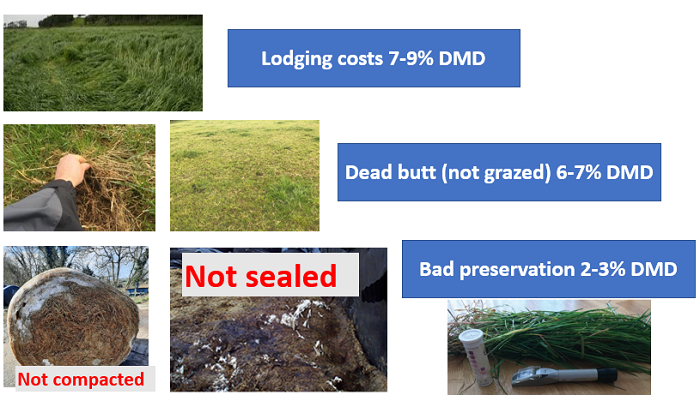
Bad preservation can reduce DMD by 2-3%
We are seeing more and more mould on bales and in silage pits. Perhaps this is due to the finer weather at cutting and bales are too well wilted, not chopped and the bales are not compact enough. It could be down to poor quality silage wrap and not enough of it or it could be the pit is not sealed properly. Below are some of the factors to consider and observe at harvest.
Check sugars and nitrates
When ensiling silage, the aim is to get the bacteria on the grass to convert the sugars available as quickly as possible to lactic acid to drop the pH of the silage to around 4. This is where the silage is stable. The higher the sugar content, the more food for the bacteria and the quicker the pH drops. The target sugar content to ensure good fermentation is 3% or higher and this is measured in Teagasc offices using a refractometer.
On the flip side, high nitrate levels in grass are bad; they increase the buffering capacity, making it more difficult to get the pH level down. As grass grows it uses 2 units of nitrogen per day. If you applied 100 units per acre, it will take on average 50 days for this fertiliser to be used up. However, this is dependent on how fast grass is growing, which in turn is dependent on many factors such as: is it old or new pasture; what is the soil fertility; is the weather cold or too dry etc. To know for sure, get the nitrate level tested using test strips and this will give you a very good indication of where the nitrate level is. If your nitrate test reading is high, the most likely cause is that not enough time has elapsed from the spreading date.
Exclude all air from the pit/bale
Anaerobic conditions are essential for initial fermentation and to prevent subsequent spoilage. Fill the silo quickly and roll well to exclude air. Chop length of 1.0-1.2cm promotes good compaction. Cover with two 0.125mm polythene sheets. Use vertical sheets along silo walls. Check for 3-4 days to ensure seal remains intact as the pit settles. Prevent bird damage.
Figure 3: An example of good fermentation
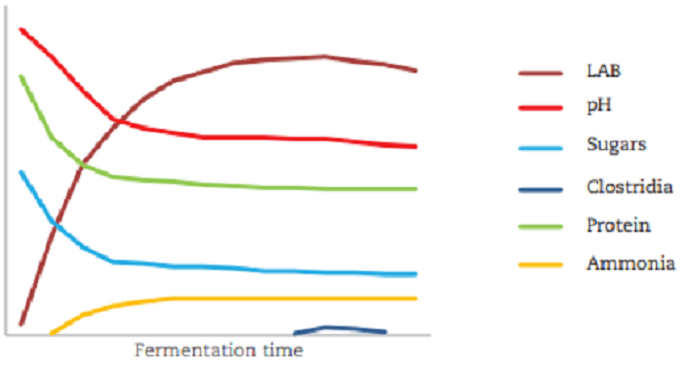
Fermentation begins after oxygen in the pit is depleted during the initial aerobic ensilage phase. Under good conditions, lactic acid bacteria (LAB), which are present on the grass, multiply rapidly and convert available sugars to lactic acid. This causes the pH to decline quickly. The optimum end point depends on silage dry matter. Some nutrient losses and protein degradation to ammonia occur during this phase; however, once target pH is reached, a clean forage with good intake potential is the result. The nutrient value of this silage is preserved until re-exposure to air at feed-out.
Figure 4: An example of poor fermentation
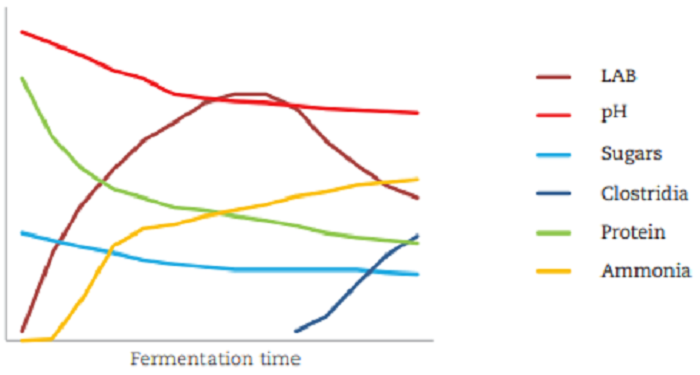
In contrast, a poor silage fermentation occurs where one or more of the necessary conditions (high sugars, low buffering capacity and air-free conditions) are not met. In the example shown above (figure 4), low initial available sugars restrict the growth of LAB, causing an insufficient drop in pH. This allows clostridia bacteria, also present on the crop but increased with soil contamination, to begin a secondary fermentation. Ammonia levels rise as protein is broken down. Clostridia bacteria convert residual sugars, lactic acid and protein to butyric acid, which results in a dark, foul-smelling silage with low feed value and poor intake characteristics.
Be careful with wilting time
The change to grass dry matter content due to wilting is affected by the duration of wilt and mechanical treatment of the sward. Dry matter of grass cut into large rows will change little in a 48 hour period. Tedded swaths wilted for >24 hours may become excessively dry. Pit silage dry matter (DM) over 33% will not improve animal performance and may have poor aerobic stability at feed out.
Figure 5: The effects of wilting

Tomorrow morning on Teagasc Daily, Martina will provide some pointers on quality bales of silage.
Also read: Planning your silage strategy – more to consider than just fertiliser