
26 April 2023
Planning your silage strategy – more to consider than just fertiliser
The old adage of ‘fail to plan, plan to fail’ always jumps to mind around silage time. Often, however, the only planning is around fertiliser and how much to apply.
In this article, as part of a three-part series on silage quality, Martina Harrington, Teagasc Beef Specialist, highlights some of the key questions we need to answer when developing a strategy to build next winter’s feed reserve.
What quality silage do I require?
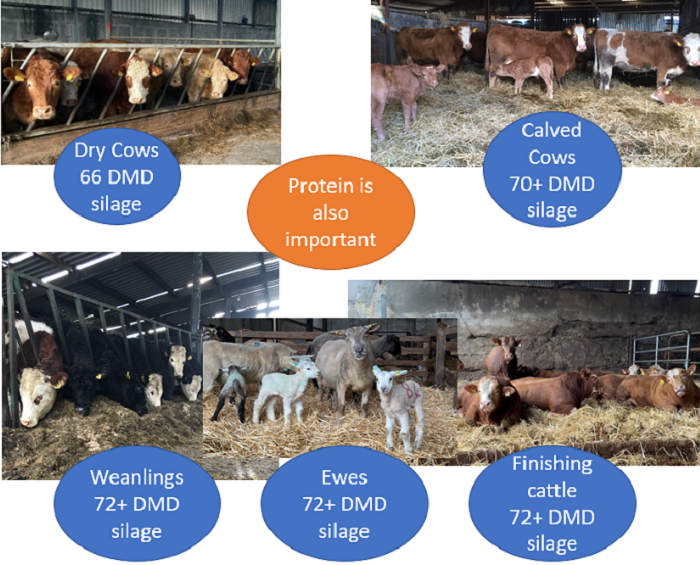
The first step is to look at the categories of stock on the farm and assess what silage quality you want for each. The reality is that the only category on any farm that requires average quality silage is suckler cows that are in good body condition pre-calving. All other categories require top quality silage to maximise performance, otherwise the feed value has to be made up with expensive concentrates to ensure the desired levels of animal performance are achieved. The impact of this balancing may seem small on a daily basis, but when stretched out over the winter period and put across a number of animals, it can be a significant cost to any farm.
Figure 1: What quality silage do you require?
How much do you need?
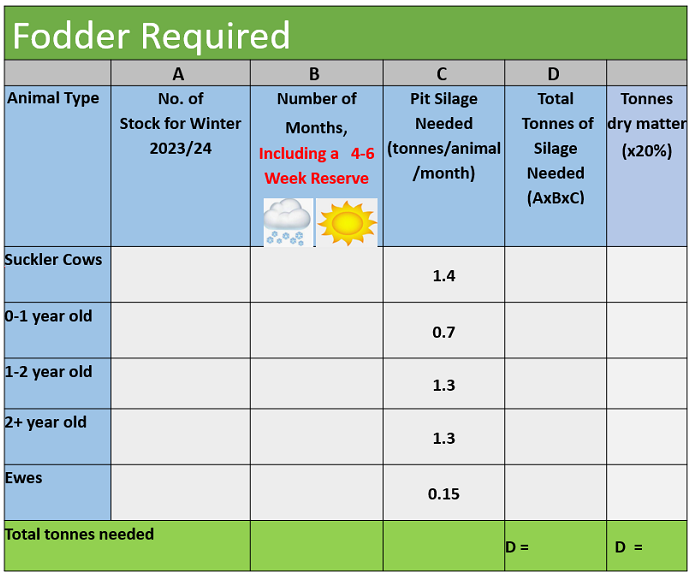
Once the silage quality requirement has been determined, the next step is to identify the quantity of silage required. Figure 2 is a simple fodder budget. However, with climate change, we do need to take into account a buffer for a long, wet spring and also are you in an area prone to summer drought?
My policy is to add in a month extra for the winter and a month for the summer, but each farm will have to look at their own situation. It may not be possible to build this whole reserve in one year, but a good attempt should be made, especially when concentrates are €400+/t.
Figure 2: Complete a fodder budget, building in a buffer for winter and summer
Quantity and quality – soil fertility is key
Many farmers leave silage grow on longer, thus getting poorer quality silage, as they want to maximise bulk. To achieve both excellent quality silage and bulk, you must have excellent soil fertility.
As can be seen from Figure 3, if you are targeting a yield of 5t DM/ha or 9 bales/ac (depending on dry matter of the bale), if you have good soil fertility (pH >6.3, P and K indexes at 3 or higher) and apply the correct fertiliser, you can reach your target yield by the 26th of May and have 72 Dry Matter Digestibility (DMD) silage.
On poor soil fertility, you will not reach the same yield for another three weeks when the DMD will be in the low 60s. Looking at it another way, swards on high fertility soils have earlier recovery and three weeks more growth for the second cut.
Figure 3: Soil fertiltiy date of cutting and DMD
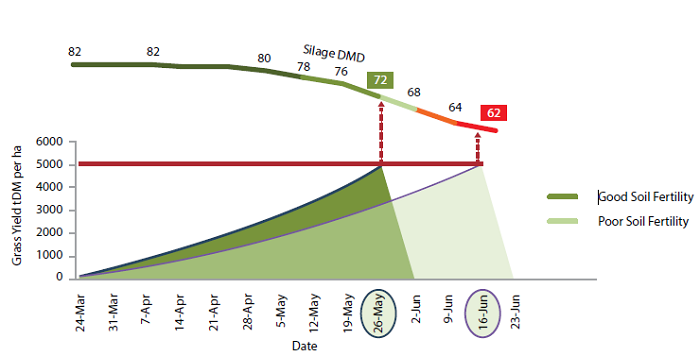
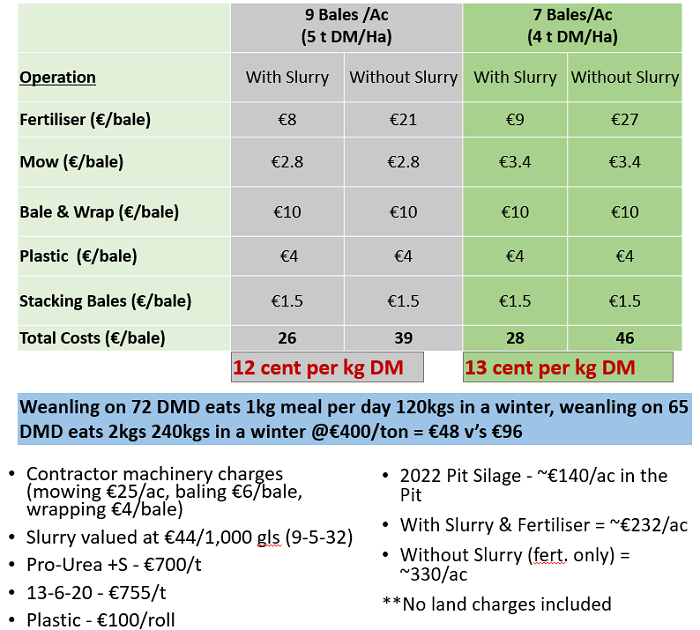
Figure 3 also tells you if you want 76 DMD silage, you will have to sacrifice quantity; cut on the 19th of May, get 4t DM/ha or 7 bales/ac – is this an option on your farm and if so what are the costs? Below shows two differing scenarios – you can use your own costs if you disagree with these, but looking at the silage made with 3,000 gallons of slurry, there is a €2 difference in the cost of the bale. Or to be more technical, if estimating 220kg of dry matter in a bale, per Kg of DM there is a 1 cent difference in the cost.
Figure 4: The cost of making silage
Tomorrow morning on Teagasc Daily, Martina Harrington will also outline the factors within your control that effect the quality of silage on your farm.
Also read: Rebuidling of fodder stocks a priority