
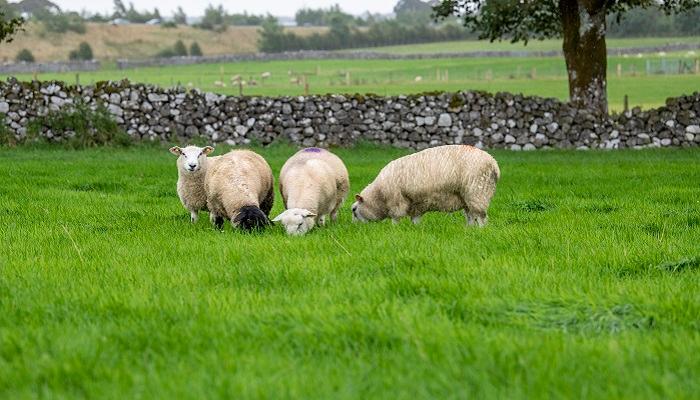
For early March lambing flocks weaning time has arrived and it is important to have a plan in place. Damian Costello, Sheep Specialist, gives his advice.
The recommended age to wean lambs in most cases is at 14 weeks or 100 days of age. Weaning should not be unduly delayed beyond this timeframe as it can have a negative impact on both ewes and lambs. For later lambing flocks, count on 14 weeks from the mean lambing date to work out your optimum date for weaning.
Reasons to wean lambs at 14 weeks of age
Twin rearing ewes milk yield has peaked when lambs were 5 weeks old and has been in decline since. When lambs are 12 – 14 weeks of age, ewes are producing very little milk and milk is contributing little to the lamb’s overall diet. The lambs grass requirement is rising sharply at this stage and is up around 1.2kg grass dry matter per head per day at 14 weeks of age while ewe’s requirement for grass is in decline. On higher stocked farms, grass supply has been running tight but on almost all sheep farms grass quality has proven difficult to maintain in recent weeks. Weaning should be planned around having quality grass available for lambs such as silage aftermath or areas that have been topped post last grazing to reset grass quality.
Benefits to ewe from timely weaning
From the ewe’s perspective, once lambs reach 14 weeks of age they are within 16 to 17 weeks of the next mating season. If we take a two week drying off period, we are down to 14 to 15 weeks for ewes to recuperate and get ready for a new breeding season. It’s estimated that it can take the average lowland ewe around 10 to 12 weeks to build one body condition score (eg BCS 2.5 up to 3.5) leaving no time to play with for thinner ewes if weaning is delayed.
Planning for the weaning process
At farm level there is sometimes a reluctance to wean until one or two drafts of lambs have been taken due to a perceived drop off in performance post weaning. Yes there will be an initial setback for the 3 to 4 days when lambs will be unsettled and calling for their mothers but after this the main group of lambs will perform much better long term when given priority access to the best quality grass available. Weaning should be planned around a draft of all lambs fit for market with the remaining lambs also weaned on that day. The aim is to wean abruptly and ideally put ewes and lambs out of sight and sound of each other. As previously mentioned lambs should be moved onto a good quality grass sward. It is good practise to take a faecal sample from lambs and treat for stomach worms if needed as well as addressing any other health issues to minimise stress on lambs. In practical terms returning the ewes to a field that is reasonably well grazed out with low grass cover is the simplest way to complete the drying off process. It is not necessary to over restrict ewes as they will be drying off naturally at this stage and after two weeks on lower grass covers the process will be complete. Thinner ewes should be separated out at this stage and put on good grass to regain body condition while remaining ewes in good condition can be used to graze out paddocks after the lambs in a leader follower system. Once lambs have settled down post weaning it is a good time to take stock of how lambs have performed and put a plan in place for marketing lambs. This can include separating out forward lambs into a finishing group to facilitate a controlled level of concentrate supplementation.
When to consider early weaning
The following are among the situations where weaning lambs from 10 weeks of age can benefit overall flock performance:
- Where grass supply or quality is limited, weaning to reduce demand can be justified. Pre weaning ewe demand will be around 2.5kg dry matter per ewe per day and this can be cut in half post weaning hence reducing overall demand.
- Yearling ewes that have reared lambs benefit from weaning at 10 – 12 weeks as it allows them more time to recover body condition and it should be acknowledged that these animals are still growing also. On Irish farms it is common to start to lamb yearlings 2 – 3 weeks after the mature ewes meaning they should be all weaned about the one time.
- On farms that tend to always struggle with ewe body condition, early weaning can help break the cycle and allow building ewe body condition to commence a few weeks earlier.
Sheep 2025
The highly anticipated Sheep 2025 event offers an unparalleled opportunity for farmers, industry professionals and the general public to explore the latest innovations and trends in the Irish sheep Industry. The event will feature a huge range of attractions, technical presentations and engaging demonstrations, making it an essential event for anyone involved in the Irish sheep sector.