
23 February 2024
Prioritise actions to improve water quality
The Irish agricultural sector, encompassing both farmers and the wider industry, must prioritise actions to bring about an improvement in water quality, Dr David Wall, Enterprise Leader at Teagasc Johnstown Castle, told the recent Teagasc Water Quality Conference.
“Actions on water quality are needed to protect and retain our pasture-based and tillage farming systems, which are predominately family farms that achieve the highest environmental standards. All farming systems have a role to play in protecting water quality and to avoid Ireland’s environmental policy having perverse outcomes,” he told the delegates in attendance.
Dr Wall’s presentation was set against the backdrop of the European Commission’s decision to tighten Ireland’s nitrates derogation. Many parts of the country are now constrained within a 220kg N/ha upper limit for organic nitrogen, as opposed to the 250kg N/ha limit which was previously available to all farmers availing of a derogation.
Dr Wall provided clarity from the European Commission as to the requirements in securing future nitrates derogations, noting that water quality trends will be critical during negotiations in the future, with a reduction and stabilisation of nutrient and sediment losses to water being key.
“Areas with moderate or less water quality need to show improvement and areas with good or high water quality status need to at least remain stable,” he said.
He also warned that some additional areas, currently remaining at 250kg/ha of organic N, will potentially be subject to a max of 220kg/ha of organic N from 2025.
Making these improvements
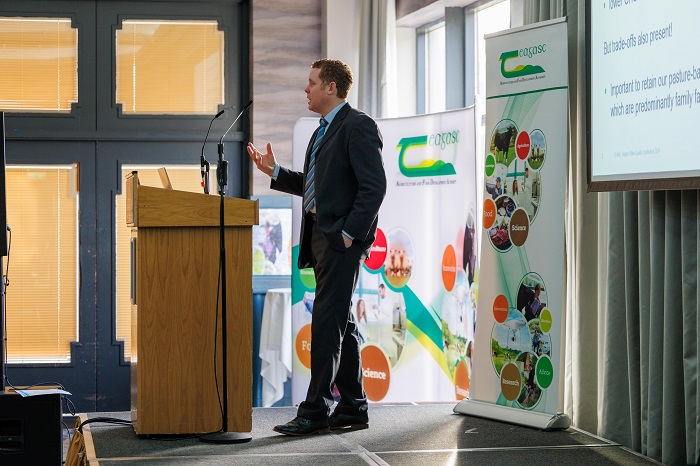
To ensure the above is achieved, Dr Wall (pictured above) said that a significant step in action – both within regulation and voluntary/industry initiatives is required. The former encompasses the regulations in play under Ireland’s Nitrates Action Programme, the CAP Strategic Plan and the National Fertiliser Database, while voluntary/industry initiatives include programmes such as the Agricultural Sustainability Support and Advisory Programme (ASSAP) – to which industry support has trebled – and the €60 million Water EIP.
The Enterprise Leader at Teagasc Johnstown Castle also touched on the role of the Agriculture Water Quality Working Group, which have made recommendations in the areas of: reducing nutrient load/loses; sustainability measures with other environmental benefits; improving compliance and enforcement; advisory support and nutrient use efficiency; and research and policy development.
As part of its remit, Teagasc researchers have been tasked with assessing dairy soiled water and slurry volumes. A nationwide study is ongoing to examine how slurry and soiled water production and management practices have evolved on Irish dairy farms.
Additionally, Dr Wall touched on a number of strategies that can be implemented to improve the nitrogen use efficiency on Irish farms. When put in practice, these can reduce the quantities of N required within the system, thus limiting nitrate losses to water.
Strategies and solutions to improve N use efficiency:
- Soil testing – balanced soil fertility for pH, N, P, K and S leads to an increase in N use efficiency.
- Correcting soil fertility through liming reduces nitrous oxide (N2O) emissions. The release of background N from soils in an adequate soil pH also leads to a reduction in the quantities of N required by 60kg N/ha;
- Moving from splash plate to low emission slurry spreading (LESS) can reduce the N required by 20kg N/ha, thus reducing costs by €45/ha;
- Changing to protected urea as the main artificial nitrogen source can allow for the rate to be reduced by 10%, reducing N costs by ~25%;
- Adapting clover/MSS swards can fix 50-150kg N/ha/year, reducing N costs by ~€60-180/ha.
- Distributing the managed sources of N (i.e. slurry N, fertiliser N and N excreta) more evenly across the farm in line with grass and crop uptake demand.
For more on the Teagasc Water Quality Conference 2024 and to access the presentation, click here.