
Profitable and environmentally efficient pasture-based dairy-beef production systems
New research from Teagasc, published in the Journal of Agricultural Science has studied the profitability and environmental efficiency of pasture-based dairy-beef production systems.
Beef produced form the non-replacement progeny of the dairy herd forms an integral part of beef supply chains globally. However, issues around the beef genetic merit of the progeny exist. In addition, a reduction in slaughter age has been identified as a key greenhouse gas mitigation strategy from beef systems.
New research from Teagasc, published in the Journal of Agricultural Science has studied the profitability and environmental efficiency of pasture-based dairy-beef production systems. The objective of this study was to quantify the economic and environmental performance of three dairy-beef genotypes differing in beef genetic merit and managed under three contrasting pasture-based feeding treatments, using a farm-level systems model and data from an animal systems experiment.
The three steer genotypes modelled were:
- High beef-merit Angus sires (HA)
- Low beef-merit Angus sires (LA) and
- Holstein-Friesian (HF) sires.
Each genotype was evaluated across one of three feed treatments:
- Control (CTL), grass-only during both grazing seasons;
- Low concentrate (LC), supplemented with concentrate during the first grazing season, pasture only during the second grazing season; and
- High concentrate (HC) supplemented with concentrate during the first and second grazing season; amounting to nine scenarios. The HC scenario was designed to potentially allow slaughter of steers from pasture, without the need of a second indoor finishing period.
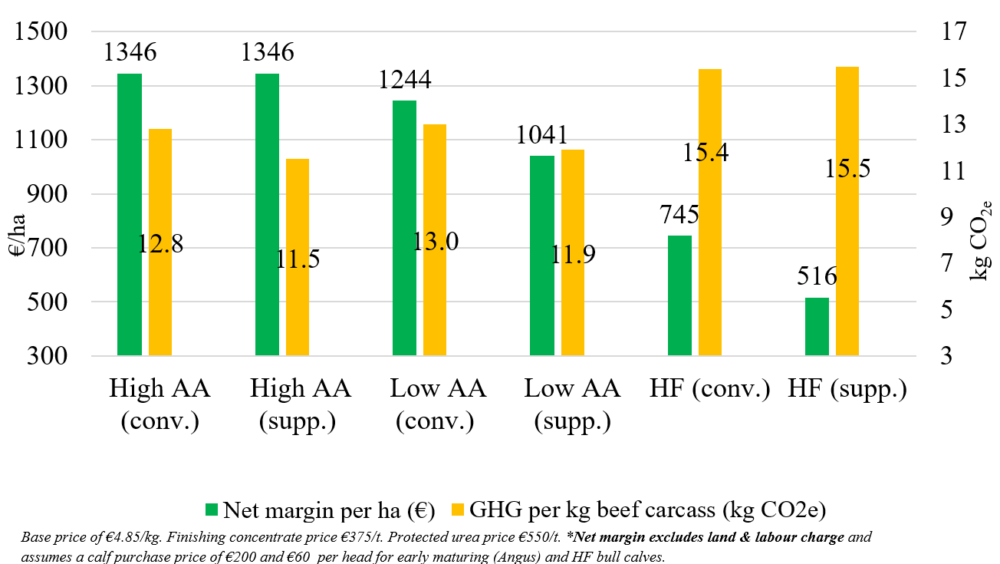
High Angus steers were most profitable (€424/animal, €1,362/ha), (Beef price €4.85/kg carcass weight) followed by LA (€337, €1,126) and HF (€188, €659). The CTL treatment had the highest profit per head due to having the lowest cost per kg carcass produced due to lower concentrate input costs. High Angus systems had the lowest greenhouse gas emissions between genotypes, and concentrate use reduced emissions per kg of beef, but CTL had the lowest total emissions per ha and per farm due to greater forage use within the diet. In conclusion, this study demonstrates the financial and environmental benefits of high beef genetic merit sires in dairy herd for dairy-beef systems and producers.
What do these results mean?
The results bring together a clear message for farmers looking at dairy-beef systems.
Choosing sires with high beef genetic merit improves carcass weight, reduces finishing age and boosts profitability. This decision is made by the dairy farmer, but its impact runs right through the end of the beef production system.
At the same time, keeping systems simple and grass-focused remains key. While concentrates can help performance, they need to be carefully managed to avoid eroding margins.
To read more about Climate and Biodiversity research in Teagasc, visit the Teagasc Climate Centre.