
10 January 2024
Protecting Farmland Pollinators
Saorla Kavanagh’s paper in the Journal of Pollination Ecology explores the success of the Protecting Farmland Pollinators Scorecard Project, revealing how close collaboration with farmers and the implementation of a whole farm pollinator scoring system can effectively restore biodiversity.
Research Officer Saorla Kavanagh recently published a paper in the Journal of Pollination Ecology on the Protecting Farmland Pollinators Scorecard. The Protecting Farmland Pollinators Project was about identifying small actions that farmers can take that will allow biodiversity to coexist within a productive farming system. Farmers in Ireland recognise the importance of pollinators, but farmland has experienced wide-scale loss of wild pollinators over the last fifty years.
By working closely with 40 farmers, management practices that benefit bees and hoverflies on Irish farmland were identified, and a whole farm pollinator scoring system was developed. Using a whole farm pollinator scorecard, farmers receive ‘pollinator points’ each year based on the amount and quality of pollinator friendly habitat on the farm, and each year, farmers receive a results-based payment that relates to the points. Using the pollinator scorecard, farmers have the flexibility to bring biodiversity back into their farm in a way that works with their production system and that suits them.
Farmers were willing to engage with all actions on the scorecard and 31 farmers increased their farm score. When farmers are incentivised to take action to protect nature, they want to see that these actions work. The creation and occupancy of the solitary bee nests is a clear example of where farmers can instantly see the results of their labour. During this project, 300 nest sites for mining solitary bees and 130 sites for cavity nesting solitary bees were created. Within the first four months, the exposed areas of bare soil were successfully colonised by mining bees.
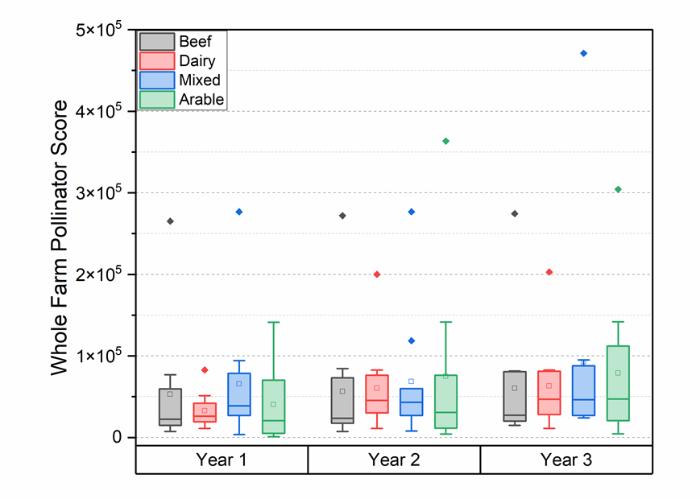
Farm scores within each farm type, beef (black), dairy (red), mixed (blue) and arable (green) for year one (2019/2020), year two (2020/2021) and year three (2021/2022). The maximum (top line outside the box) excluding outliers, minimum (bottom line outside of the box), median (line inside the box) and mean (small square inside the box) whole farm pollinator score for the four farm types are represented. The diamonds outside the box are outliers.
The pollinator scorecard is scalable to all farm types and could be directly linked to sustainability accreditation schemes in a way that is transparent and measurable. This project has helped farmers better understand and engage with nature on their land and has created a measurable system for improving habitats for biodiversity on farms that is accessible to all and has the potential to be rolled out on a wider scale.
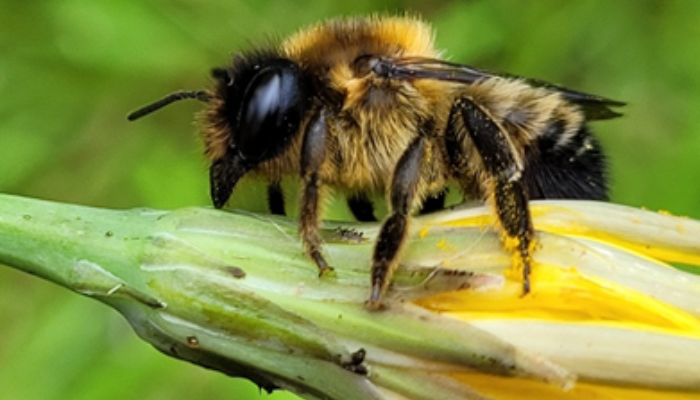
Featured image caption: Gwyne’s mining bee (Andrena bicolor) pictured by Saorla Kavanagh