
Protecting water quality this November – 5 key tips

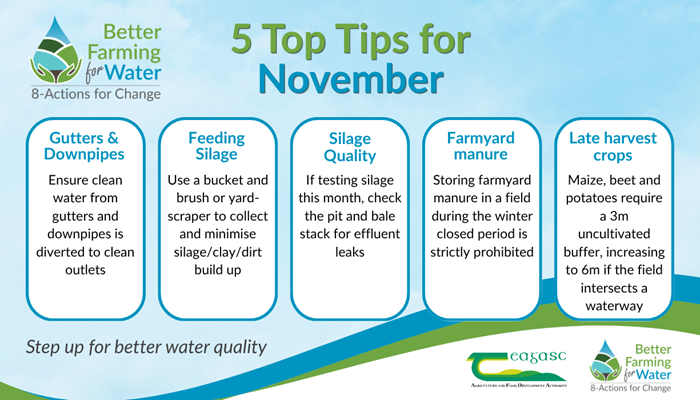
Focusing on aspects of the National Agricultural Inspection Programme (NAIP), silage quality testing and ways to reduce sediment on your farm, this month’s Teagasc Better Farming for Water Campaign 5 top tips outline practical actions that can be adopted on your farm.
1). Gutters and downpipes
This month’s first Top Tip is to check that all gutters and downpipes are working properly. Faulty or broken gutters and downpipes are one of the most common non-compliances (43%). This was found during the national Good Agricultural Practice (GAP) initial inspections 2025.
Gutters and downpipes should collect clean rainwater from the roofs and transport it to clean outlets in the ground and never across a sullied yard.
For example, if a concrete yard is used for moving silage from the pit to the feed barrier, the yard will become dirty with silage and clay as the tractor moves around. Clean water from gutters and downpipes cannot mix with this material.
The good news is that 48% of follow-up visits after the initial inspection were found to be compliant. This means there are changes happening on farms that are improving water quality, but the best approach is prevention. So, take this Top Tip and inspect all the gutters and downpipes on your yards this month and see would they pass the inspection.
2). Feeding silage
The best practice for concrete yards used for feeding silage is to regularly use a front-mounted bucket and brush or yard-scrapper to collect and minimise the dirt and silage build up. This material may need to be heaped in a covered dung-stead as the winter goes on.
Settlement tanks can be used also to collect the runoff from the yard. The combination of organic material and sediment can be quite harmful to invertebrates living in the waterways nearby. Preventing this material from entering the local streams or rivers is a significant benefit to the local ecology.
3). Silage quality
If you are taking silage quality samples this month as part of a scheme or otherwise, it’s a good opportunity to see if there is any effluent leaking from the silage pit or bale stack. Silage effluent is highly acidic (pH 3.5-5.0) and cuts through concrete overtime leading to leakages.
If the silage was baled ‘wet’ and before it was wilted properly, it may result in higher volumes of effluent runoff. This effluent must be collected and stored to prevent it entering – directly or indirectly – waterways.
Silage effluent is potentially 200 times more damaging than raw sewage due to its extremely high Biochemical Oxygen Demand (BOD) which causes fish kills in streams and rivers.
Collection channels around a silage pit, for example, must be clear and working to transport the effluent to a suitable tank. The plastic for the pit can be laid over the channels to prevent clean water entering the channels.
4). Farmyard manure
Use enough straw or other bedding to keep farmyard manure solid and ‘dry’ this winter. Make sure the dung-stead/storage heap is in a sealed area that is structurally sound and ideally has a roof over it.
The more room available for storing farmyard manure, the more flexibility you have to apply it when the valuable nutrients are maximised.
Always collect seepage and prevent dirty water or runoff escaping by keeping rainwater and other clean water away from the manure store to preserve capacity. Don’t forget, storing farmyard manure in a field during the winter closed period is strictly prohibited.
5). Late-harvested crops
Maize, fodder beet and sometimes potatoes are harvested late in the year and bring a risk to water quality when most grassland farms have animals housed and the risks are lower.
Late-harvested crops tend to have much more difficult field conditions to deal with due to rainfall at this time of the year. As a result, bare soil areas of fields or deep wheel ruts from machinery in the field become a source and a pathway for sediment to flow overland to streams and rivers.
That’s why it’s so important to have an uncultivated 3m buffer area – preferably well vegetated – to prevent some of the sediment entering a waterway, acting as a barrier to minimise the impact.
Furthermore, if the field is adjacent or ‘intersecting’ a waterway, the vegetated buffer needs to be increased to 6m. This is because with a slope heading towards the waterway, the momentum of the runoff is greater and so it’s harder to slow down and stop.
And that’s your final Top Tip for November. Which one is most relevant to your farm?
For more on the Teagasc Better Farming for Water Campaign, visit here.