
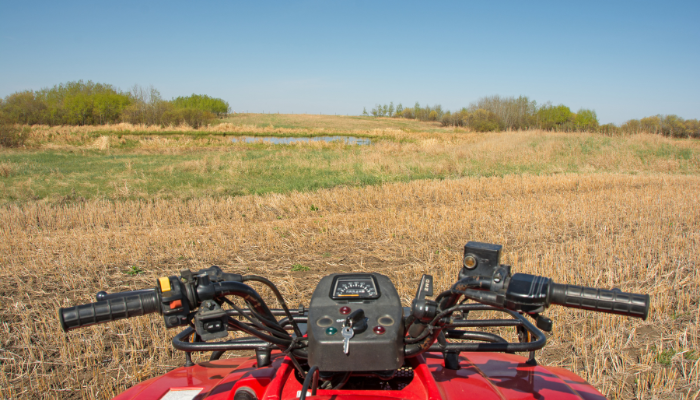
As part of Farm Safety Week, Thursday highlights quad bike safety. Francis Bligh, Teagasc Health and Safety Specialist, warns that while quads are useful for farm work, misuse can lead to serious injury.
A Quad Bike is a fantastic aid for farm work as it is designed to cope with a wide variety of terrain types, but if it is operated in an unsafe manner it quickly creates significant risks of death or severe injury to the operator.
The Health and Safety Authority report that the common underlying causes of accidents with quads include lack of formal training and experience; poor maintenance; poor physical mobility; carrying a passenger; tipping over on a bank, ditch or rut; loss of control on steep slopes or towering excessive loads.
Quad bikes can help to improve the efficient completion of many tasks around the farm but operates must take time to think and use their head. Time must be taken to make decisions on speed of travel, risk assessment of each task before and during the job and stay alert is vital to avoid injury.
Health and Safety Authority data for the period (2013 – 2022) shows that there were 10 farm fatalities involving quads, of which two were under 18 and six were over 65 years of age. Many more have been left with life changing injuries.
Watch Teagasc-FBD-H.S.A video focusing on tips to operate ATV/Quad bike safely.
Tips to operate ATV/Quad bike safely
Training and experience
Under Regulation: S.I. No. 619 of 2021 all operators using an ATV/quad for work must have undergone an ATV training course provided by a registered provider to a QQI standard or equivalent before using the quad/ATV. The law also places a requirement on the operator to carry out a risk assessment of ATV operation and wear personal protective equipment (including a helmet).
Read more about ATV regulations and how to find a qualified training provider on the Health and Safety Authority website.
Benefit of training
Knowing and understanding how to manage your ATV in different situations will help you develop the skills to operate it safely. Engaging in training and gaining experience are very important tools to help you understand the dangers and learn how to operate your ATV safely.
Helmet
Head protection is very important. It is a legal requirement that everyone using an ATV should wear a helmet at all times. Check ATV manufacturer’s handbook for information on Helmets.
ATV maintenance
Regular maintenance of an ATV will keep it in a safe condition. Brakes and drive lines must be regularly maintained. Tyres that are poorly inflated can lead to instability and if they are overinflated braking force and ability to corner safely can be reduced. The manufacturer’s handbook will state recommended tyre pressure and maintenance routines.
Speed
Many ATV’s can travel at speeds in excess of 30km/hr. On farms there can be an urge to drive faster to save time but inappropriate speed will increase the likelihood of losing control and sustaining serious injury.
Operator mobility
ATV’S can help to increase a farmers ability to move around the farm but to operate an ATV safely, one must be capable of moving bodyweight around the ATV to maintain stability. If this is difficult for the operator then due to pain or poor mobility then operation of a Quad/ATV becomes very dangerous.
Knowledge of the terrain
Travelling across a bank, rut or bump should only be attempted when speed is appropriate and time is taken to determine if it can be done safely. Coming in contact with electric fences, hidden field posts, rocks or pieces of machinery can have devastating consequences. It is important to stay on familiar routes.
Slopes
Travelling downhill requires skill and agility. The rider must move to the back of the bike to increase stability. The operator must ensure that any load being carried is appropriate. Excessive weight or slippery ground will have an impact on stability and control.
Excessive loads
An ATV towing a trailer must be managed very carefully. Many ATV trailers do not have independent braking which means all the braking force is transferred to the ATV. The force may become excessive if hard braking takes place and this may lead to loss of control.
Passengers
Carrying passengers on ATV’s is not advised. When carrying a passenger or an unbalanced load the centre of gravity of the ATV changes. This can destabilise the machine and lead to loss of control. Many serious injuries have occurred when passengers have fallen off ATV’S.
For more information the following videos are very informative: