
Red clover silage: The beef performance benefits
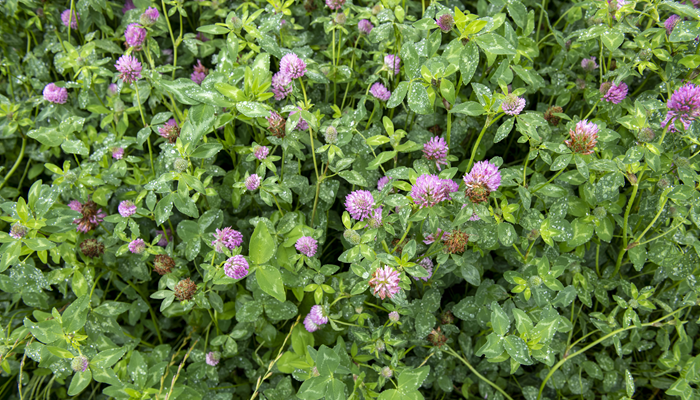
Growing in popularity on Irish farms, numerous studies have been undertaken at Teagasc Grange to quantify the impact of offering red clover silage over the winter housing period on beef cattle performance.
Providing a flavour of these research findings on the recent Future Beef webinar ‘The Role of Clover on Beef Farms’ was Dr. Peter Doyle, a Grassland Researcher in Teagasc Grange. The Future Beef webinar was chaired by Pearse Kelly, Teagasc Head of Drystock Knowledge Transfer and featured contributions from Shane Keaveney, a Future Beef Programme participant from Co. Roscommon.
Through his presentation, Dr. Doyle shared findings from his work in the Derrypatrick Herd and insights from colleagues Dr. Nicky Byrne, Dr. Paul Crosson and Dr. Mark McGee under respective studies in the areas of dairy beef and organic feeding systems.
“Higher average daily gains have been consistently seen from second cut red clover grass silage than conventional grass silage under both dairy beef and suckler beef research trials,” Dr. Doyle said, noting that this arises only where there is sufficient red clover content in the silage, leading to increased intake rates.
Summary findings:
- First cut silage – ~15% red clover content – no difference in animal performance
- Second cut silage – ~50% red clover content – improves animal performance
- Third cut silage – ~80% red clover content – improves animal performance
Most of this benefit has been researched on cattle over the first-winter housing period. Although under an organic feeding study, individual carcass weight gain differences of 22kg were witnessed between finishing cattle receiving red clover silage + 3 kg bi-crop grain dry matter vs. those on grass-only silage + 3 kg barley-based concentrate dry matter.
For suckler weanlings carried in the Derrypatrick herd, Dr. Doyle noted average winter weight gains of 0.8kg/head were achieved, for those on red cover grass silage + 1.5 kg concentrate/day. This is in excess of the first winter target of 0.5-0.6 kg live weight/day for weanlings. Stemming from this, a future area of research will examine the impact on weanling performance over the winter months when this supplementation is removed from second cut red clover grass silage.
For the most part, Dr. Doyle coincided that most of the additional weight gain was coming from increased intakes from cattle offered red clover over conventional silage. Given this, he advised farmers considering going down the red clover silage route to budget an extra 20% of red clover silage over conventional grass silage in order to feed the same amount of cattle.
Management practices for red clover silage swards were also discussed, with Dr. Doyle noting that soil fertility is of the utmost importance before contemplating establishment. Ideally, soil pH should be 6.5, with phosphorous (P) and potassium (K) indexes of 3.
Spring reseeding is also preferred, providing more opportunities to apply red clover safe post-emergence herbicides, using varieties ranking highly on the UK recommended lists.
Importantly, to ensure that red clover persists within swards, he noted that careful management of fertiliser applications is required.
“We want to limit the amount of [chemical] nitrogen as much as possible and we try to operate a zero-nitrogen system because that increases the persistence of red clover,” Dr. Doyle noted.
However, as red clover is a seasonal producer, with lower growth rates in the spring, Dr. Doyle pointed to work from Sinead McCarthy in Teagasc Moorepark which has indicated that a springtime application of 25 units of N per acre can boost overall production by 1.4t DM/ha. Practically, at farm level, Dr. Doyle noted that this could stem from either half a bag of protected urea or an application of 3,000 gallons of cattle slurry.
Although not having an appetite for chemical nitrogen applications, Dr. Doyle comment that red clover silage crops are P and K hungry.
“For our typically three cut yields in Teagasc Grange of 15t DM/ha, that’s going to need 35 units of P to the acre and 300 units of K to the acre. If you cannot apply it through slurry, products like 0:7:30 are very good, provided you stay within your chemical P allowance.”
It was highlighted that where red clover grass swards are being grazed in the back end of the year, it is very important to abide by the relevant bloat pre-cautions including, 24-h breaks, bloat oil, adding a fibre source to the diet and not offering large areas to hungry cattle.
Shane Keaveney’s experience
Carrying both white and red clover swards on his suckler farm in Co. Roscommon, Shane Keaveney said the spike in fertiliser prices in 2022 first prompted his interest in red clover.
“I basically wanted to grow a crop of silage with as few bought-in inputs as possible. From what I had read about red clover, it was a very good feed and could produce top-quality silage for weanlings. In 2023, I sowed my first paddocks in red clover,” he said.
Achieving three-cuts per year, yielding 17-18 bales/ac, Shane is happy with the performance his seeing from his finishing bulls on red clover silage. On a diet of red clover silage and 8kg of concentrate, these animals are achieving a daily weight gain of 2kg/head/day at a recent weighing.
All the red clover paddocks established, Shane explained, were sown in late April or early May, which gives the crop a good chance to establish and allows time in June to apply a post emergence spray.
On his fertiliser programme, Shane outlined: “In March just gone, I spread half a bag of 46% protected urea on the clover sward, along with 3,000 gallons/ac of watery slurry – not thick slurry.”
After that, subsequent applications will just be slurry, with 3,000 gallons/ac applied after the second and third cuts.
“Once you have your sward there and growing, it’s pretty straightforward: apply slurry, shut the gate and six weeks later come back in to mow it. Take off your bales, apply slurry again and shut the gate,” Shane added.
A full recording of the webinar is available to view below:
For more insights from the Future Beef Programme’s series of webinars this spring, visit here.