
17 September 2023
Reducing gaseous emissions from manure management in Ireland
Farmers, policy makers and regulators require support to ensure Ireland is capable of meeting both its greenhouse gas and ammonia emissions reduction targets.
These comments were made by Dr Karl Richards, the recently appointed Head of Teagasc Climate Centre, at the 18th international RAMIRAN Conference held in Cambridge, UK.
With agriculture being responsible for 98% of ammonia emissions and 34% of total greenhouse gas emissions in Ireland, action is required from both the farming sector and the wider agricultural industry to ensure that targets set out under both the Climate Action and Low Carbon Development Bill and the Clean Air Act are achieved.
The former requires the agricultural sector to reduce total greenhouse gas emissions by 25% by 2030, before transitioning to carbon neutrality by 2050. The Clean Air Bill necessitates a 1% reduction in ammonia emissions between 2020 and 2030, followed by a 5% reduction from 2030 on.
“If we look at ammonia emissions from agriculture in Ireland in 2020, 47.7% of the ammonia produced stemmed from the management of animal manures, while another 33% came directly from animal manure.
“Apart from enteric fermentation, which was responsible for 59.1% of total agricultural greenhouse gas emission sources in 2020, the next largest contributors to emissions were: nitrous oxide (N2O) released directly from managed soils, accounting for 25% of the total; and emissions of methane and nitrous oxide released during the management of manure, which accounted for 9.5% of total emissions for that year.
“In order for the Irish agricultural sector to meet its reduction targets for both ammonia and greenhouse gases, the implementation of scientifically-proven methods are required,” Dr Richards said.
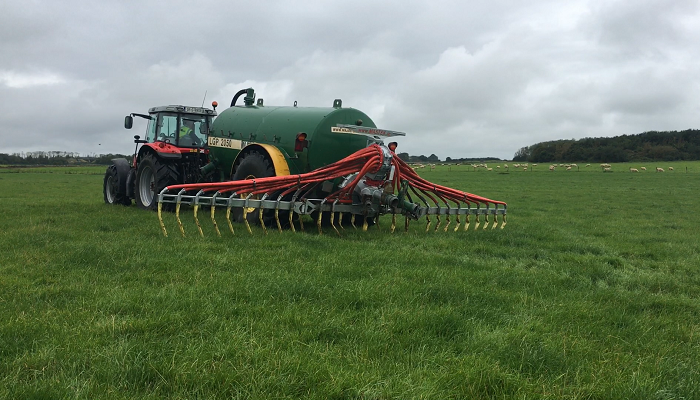
Dr Richards also presented some of the extensive research undertaken at the Teagasc Johnstown Castle Environment Research Centre, which has examined manure management technologies and the impact of grazing to identify measures to reduce the emissions associated with the management of livestock excreta. Such technologies include the use of manure amendments and low emission slurry spreading, which has the benefit of reducing both methane and ammonia emissions.
On strategies to reduce ammonia emissions, Dr Richards explained how farm management practices can increase or decrease ammonia emissions and care is needed to avoid pollution swapping. Citing research on hardstandings, he noted that ammonia emissions are reduced by 78% when scrapping is carried out within one hour of cattle manure being deposited as opposed to when no scraping occurs. This benefit falls to just 56% if a three hour time period is left between the depositing of cattle manure and scrapping. Research findings on the use of slurry additives were also presented, which indicated that ammonia released from stored slurry can be reduced by 92% when a treatment with ferric chloride is undertaken.
Support
Commenting on the supports available to farmers and policy makers, Dr Richards pointed to the Teagasc Climate Centre, which is built on the key pillars of the Signpost Advisory Programme, AgNav – a sustainability digital platform – and the National Centre for Agri-food Climate Research & Innovation. Serving eight purposes, this centre aims to: enhance climate adaption; increase diversification; enhance biodiversity; increase carbon capture; reduce methane emissions; reduce nitrogen emissions; support policy; and create a circular food system.
In his concluding remarks, Dr Richards said: “Manure is an important source of ammonia and greenhouse gas emissions, but we have many technical measures to reduce emissions, increasing fertiliser replacement value but there is a need to increasingly target reducing both methane and ammonia emissions from manure.
“Policy makers and regulators need support to identify and target the best approaches to take in reducing these emissions, while farmers need technical and financial support to implement emission reducing measures on their farms.”
Also read: Dr Karl Richards appointed Head of Teagasc Climate Centre