
Reducing losses at lambing
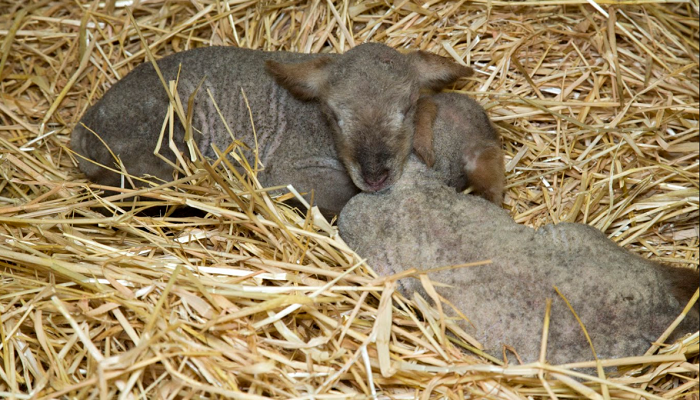
Lambing is one of the most important events on any sheep farm. In this article, Bernadette Bennett, Teagasc Portlaoise, reflects on some of the key messages shared at a recent pre-lambing workshop which prepared farmers in the Teagasc Laois/Offaly/Kildare Advisory Region for the season ahead.
Good preparation for lambing lowers veterinary costs, reduces farmer stress and improves animal welfare. In the Teagasc Laois/Offaly/Kildare Advisory Region, we recently held a lamb mortality workshop. on the sheep farm of Gerard Delaney, New Inn, Emo.
In Ireland, the main causes of lamb mortality are infection, lack of colostrum, difficult lambing, hypothermia and starvation. Target losses are less than 12% lamb mortality from scanning to weaning (lower is achievable with good management). Over half of lamb mortality is due to infection and difficult lambing – both can be limited by appropriate actions on sheep farms.
Pre-lambing nutrition
Pre-lambing nutrition programmes, Teagasc Advisor Adam Harney explained, serve two purposes. For the lamb, it’s essential for the birthing of vigorous and lively lambs of the correct birth weight (table 2 below), while for the ewe, it’s necessary for the production of colostrum and to minimise body condition loss in the lead into the lambing period.
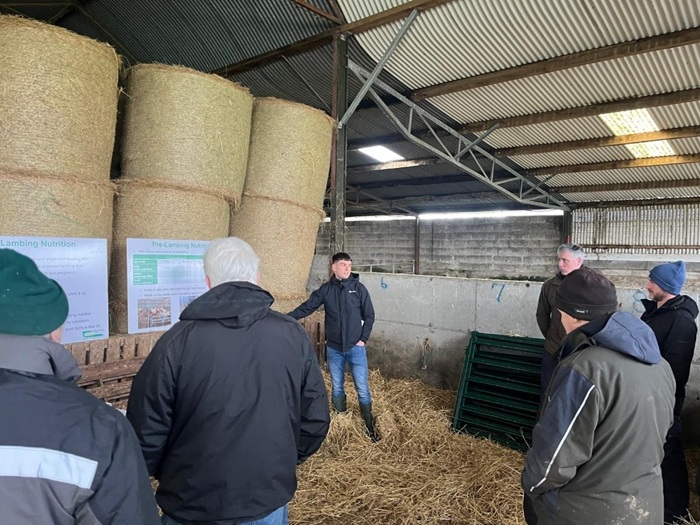
Adam Harney presenting pre lambing nutrition advice on the farm of Gerard Delaney
To do this and to formulate balanced diets, the quality of the forage available needs to be assessed through forage testing. Dry matter digestibility (DMD) drives intake and how much supplementary feed is needed (see table 1 below). Scan ewes and group according to litter size. Check Body Condition score of ewes, thin twins may need triplet‑level feeding.
Adam provided a feeding plan for ewes. This feeding plan assumes a 70kg ewe in good condition and carrying twins. Use a high‑energy pre‑lambing ewe ration (18–19% crude protein) with the main ingredients being cereals and beet pulp for energy and soya as a protein source. When feeding greater than 0.5 kg/day, split into two feeds. Maintain consistent feeding times and adequate trough space, at least 600mm per ewe.
Table 1: A concentrate feeding plan for twin-bearing ewes based on silage quality
| Silage DMD | Weeks pre-lambing
Concentrates kg/hd/day* |
Total Kg | ||||
| 10-9 | 8-7 | 6-5 | 4-3 | 2-1 | ||
| 75% | 0 | 0 | 0.2 | 0.4 | 0.6 | 20 |
| 70% | 0 | 0.2 | 0.3 | 0.5 | 0.7 | 28 |
| 65% | 0.2 | 0.2 | 0.4 | 0.6 | 0.8 | 35 |
| 60% | 0.2 | 0.3 | 0.6 | 0.8 | 1.0 | 46 |
| 55% | 0.4 | 0.5 | 0.8 | 1.1 | 1.4 | 65 |
*30% more for ewes carrying triplets. Adjust upwards for thin ewes.
Table 2: Target Lamb Birthweights
| Lowland | Hill | |
| Singles | 6 kg | 5 kg |
| Doubles | 5 kg each | 4 kg each |
| Triplets | 4 kg each |
Correct birthweight = easier lambing & stronger lambs. Very small lambs: weak, poor survival
Very big lambs: difficult lambing, higher losses
Feeding the newborn lamb
Feeding the newborn lamb is essential for lamb survival. Lambs are born with no immunity and every lamb needs 50ml/per kg birthweight of colostrum within the first hours of live. Give every lamb some ewe colostrum. If the ewe is short colostrum, then you can mix ewe colostrum with cow/artificial colostrum and divide evenly so all lambs get ewe antibodies. One stomach tube feed is not enough as most stomach tube syringes are only 50ml. Clean and disinfect all equipment after every use.
Hypothermic lambs
Hypothermic lambs can be saved. Invest in a thermometer for the lamb shed so that you can accurately assess how cold a lamb is. If lamb temperature is below 37°C, over 5 hours old and can’t hold its head up then it is important not to stomach tube but instead to firstly give an intraperitoneal (IP) glucose injection, then warm the lamb and then feed lamb 30 to 60 minutes post injection, once it can hold its head up. Your vet can teach you how to give an IP injection. However, there is a guide on how to do this procedure below.
When to give IP injection?
- Lamb is cold, flat and weak
- Cannot hold head up or suck
- Usually over 5 hours old
Equipment needed
- 20% glucose/dextrose solution (available at vet shop or supermarket)
- Sterile syringe (20–50 ml)
- 1‑inch sterile needle
- Iodine/disinfectant
- Lamb heat box
Dose rate
- 10 ml per kg bodyweight
- Example: 5kg lamb requires 50ml glucose solution
Injection site
- 1 inch to the side of the navel
- 1 inch down
- Clean area thoroughly
Method
- Hold lamb upright
- Insert needle at 45° angle towards tail
- Push needle fully in
- Pull back slightly:
- If blood or urine appears – withdraw and try again
- Inject glucose/dextrose slowly
- Withdraw needle and disinfect site
After Injection
- Place lamb in warming box or under heat
- Lamb should stand within 30–60 minutes
- Once warm and alert → stomach tube colostrum
Never stomach tube before IP glucose injection – milk can kill the lamb
Hygiene
Patrick Farrell, Teagasc shared key insights into how to keep hygiene levels as high as possible even when working under busy conditions. He recommends plenty of clean straw, as this creates a barrier from bugs, the use of lime or disinfectant in lambing pens, good ventilation – dry air reduces bacteria survival and having enough lambing pens: 1 pen per 8 ewes.
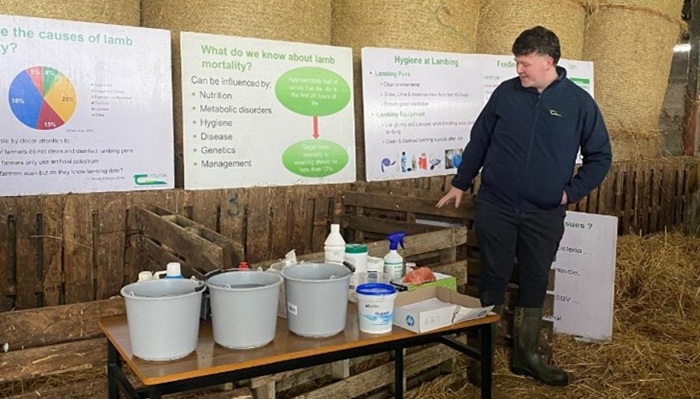
Patrick Farrell pictured on the right demonstrating best practises around hygiene at lambing
When moving lambs, he advised farmers to hold lambs by their front legs with their navels pointing away from you. Other key advice was to always wear clean gloves for lambing assistance and change and dispose of gloves between ewes. Keep lambing ropes, pullers, stomach tubes clean & disinfected. For those with no sink in the shed, Patrick outlined a simple system to ensure that equipment is kept as clean as possible – the 3-bucket system
The 3‑Bucket System
- Wash- hot water and detergent
- Rinse- clean water
- Sterilise- soak in disinfectant (e.g.: Milton) for a minimum of 15 mins
- No need to rinse after sterilising
- Change solutions daily
Flock health issues
Teagasc Sheep Specialist, Ciaran Lynch walked the participants through the primary health issues that occur in and around lambing time, namely toxoplasmosis, enzootic abortion, salmonella, listeria, campylobacter, etc. Where issues occur, he advised farmers to make use of the Regional Veterinary Laboratory services and submit samples for post-mortem and further testing; this is the first step in establishing control programmes for the following year.
Some of the key metabolic diseases – such as twin lamb disease, milk fever and prolapse – were also discussed, with Ciaran highlighting the need for action if occurring. These conditions are often nutrition and stress related.
The importance of maintaining adequate hygiene and proper colostrum management practices were also detailed, with both being critical in limiting lamb infections such as joint ill, watery mouth or scour.
Summary
To sum up, farmers lambing ewes keep the following in mind
- Stomach tubes, bottles, gloves, lube, disinfectant
- Plenty of straw
- Lime and disinfectant available and used
- Colostrum for every calf and lamb
- Forage tests
- Safe working practices
Special word of thanks to our host farmer Gerard Delaney, New Inn, Emo for opening up his farms and allowing us to use his facilities to host our lamb mortality workshop. Without all our host farmers, events such as these wouldn’t be possible.