
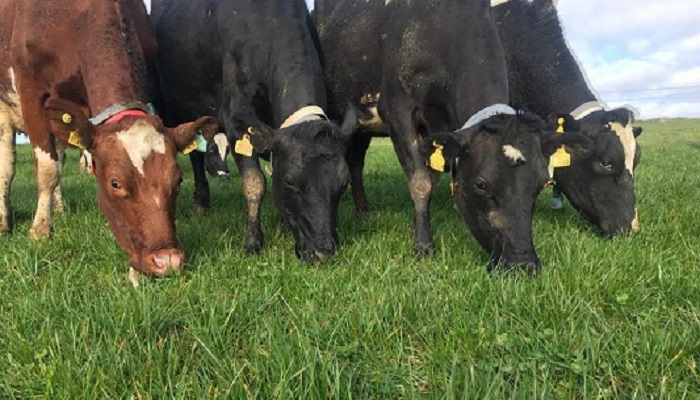
It is core to the dairy sector’s competitiveness but, on average, grass output is lagging behind demand, Dr. Michael O’Donovan and Dr. Michael Egan from Teagasc Moorepark tell us more.
Irish dairy farms have experienced major changes in relation to grassland over the past decade. Stocking rates have increased; nitrogen (N) fertiliser allowances and levels used have reduced; milk yields per cow have increased significantly. Also, wetter springs and drier summers are reducing pasture production.
The consequence is increased levels of concentrate and forage supplementation while cows are at grazing. However, grazed grass/clover swards continue to be the cheapest feed source available on farms. They deliver nutrients 2.7 times cheaper that grass silage and 3.8 times cheaper than concentrate.
Data from PastureBase Ireland (PBI) shows that dry matter (DM) production on farms has not advanced in line with increased grass demand. Grass DM production has averaged 13.2t DM/ha/yr from 2014 – 2024.
There needs to be a refocus on increasing grass DM production on farms. There are many factors that influence pasture DM production, the main factors are: soil fertility, grazing management, using grass clover swards and nitrogen input.
Soil fertility
To achieve high levels of grass growth – adequate soil fertility is essential. Phosphorus (P) and potassium (K) are very important nutrients and should be at Index 3 or 4. However if soil pH is not optimal, the plant cannot make efficient use of applied or soil P and K. Soil pH should be higher than 6.3 and preferably closer to 6.5 (for clover establishment and fixation).
The most recent report suggests that in 2024, soils on dairy farms were significantly below the levels required for optimum pasture growth and nutrient use efficiency.
- Only 24% (about a quarter) of soils are at optimum pH, P and K,
- Only 60% of soils have soil pH >6.3,
- More than half (53%) of soils are only at Index 1 and 2 for P,
- Just under half (47%) of soils at K levels at Index 1 and 2.
Clover is widely considered as a replacement for chemical N in grassland systems; however clover will not establish, or persist, in soils with a pH below 6.3.
Dr. Michael Egan shares some key tips on establishing grass/white clover swards in the below video:
Grazing management targets
There are a number of key grazing management targets which must be achieved to maximise herbage production during the grazing season:
- Early February (Opening Farm Cover) >1,000 kg DM/ha,
- Early April (start second rotation) 600 – 650 kg DM/ha,
- April to August 150 – 180 kg DM/LU,
- Mid-September (Peak farm cover) 1,100 kg DM/ha,
- December 1st (Closing farm cover) >750 kg DM/ha.
These targets are not achieved on many farms. Opening farm covers were < 850 kg DM/ha on average over the past three years. This has a major influence on the level of grass growth and supplementation needed in early spring.
Table 1: Target blueprint to grow 15.0 t DM/ha
| Growth period | Target grass production | Current PBI Farms Performance (2013-2024) | Top 100 Farms in PBI |
|---|---|---|---|
| Spring | 2,000 | 1,810 | 2,090 |
| Autumn | 7,100 | 6,157 | 7,083 |
| Summer | 5,900 | 5,264 | 6,112 |
| Total | 15,000 | 13,232 | 15,286 |
Peak farm cover (mid-September) on farms has also been behind target at 850 kg DM/ha compared with the target of 1,100 kg DM/ha. If farmers are to increase overall DM production (>14.5 – 15.0 t DM/ha), the above targets need to be achieved in combination with seasonal grass growth targets (See table 1). The top 100 farms on PastureBase Ireland are reaching these goals and as a result the DM production on this cohort of farms is averaging 15.2 t DM/ha.
Dr. Áine Murray outlines the key steps in maintaining white clover swards in the below video:
Nitrogen input
It is important that chemical nitrogen (N) fertiliser input and paddock clover content are aligned. Individual paddock sward clover content is a key factor when implementing a strategic fertiliser programme. White clover can fix up to 100kg N/ ha, but only if sufficient levels of clover in the sward (>20% – average across the year) are present. If chemical N fertiliser is removed in the absence of adequate clover content, overall herbage production declines. Table 2 illustrates a N strategy developed based on paddock sward clover content. Nitrogen input is based on the April paddock clover content.
Table 2: N strategy based on paddock sward clover content
| April clover content % | Mid Feb | Mid March | Mid April | Mid May
(2 rot) |
Mid June
(2 rot) |
Mid July
(2 rot) |
Mid Aug | Mid Sept | Total |
|---|---|---|---|---|---|---|---|---|---|
| Chemical Fertiliser (kg N/ha) | |||||||||
| Grass sward | 24 | 36 | 20 | 32 | 28 | 28 | 21 | 23 | 212* |
| 5% | 20 | 35 | 20 | 20 | 20 | 20 | 20 | 20 | 175 |
| 10% | 20 | 35 | 20 | 15 | 15 | 10 | 15 | 20 | 150 |
| 15% | 20 | 35 | 20 | 15 | 10 | Soiled water | 10 | 20 | 130 |
| 20% | 20 | 35 | 20 | 15 | Soiled water | Soiled water | Soiled water | 15 | 105 |
*Chemical N fertiliser can be increased to 230 kg N/ha, in paddocks with no clover, as long as whole farm N does not exceed 212 kg N/ha. Soiled water used whenever zero chemical N application. +25kg organic N applied.
Paddocks which have an adequate sward clover content have their N input reduced from mid-April; chemical N is replaced by targeted soiled water usage.
As part of a recent Dairy Edge podcast, Dr. Michael Egan outlines the key management decisions for the performance of grass/clover swards:
To conclude, farm dry matter production needs to be refocused and increased on dairy farms. Grazing management, ensuring seasonal grazing targets are achieved; using a precision N fertiliser programme; and clover incorporation, and maintaining optimum soil fertility will help to increase overall grass/clover production.
The above article first appeared in the May-June edition of Today’s Farm, which can be accessed here.
Moorepark Open Day
Taking place on Wednesday, July 2, the Moorepark Open Day will feature demonstrations and workshops on grazing management, reseeding, low emission slurry spreading, fertiliser type, white clover swards, calibration of fertiliser spreaders, farm infrastructure, manure storage options, body condition scoring, milk quality, calf rearing, genetics, and health and safety.
Find out more and plan your visit to the Moorepark Open Day here.