
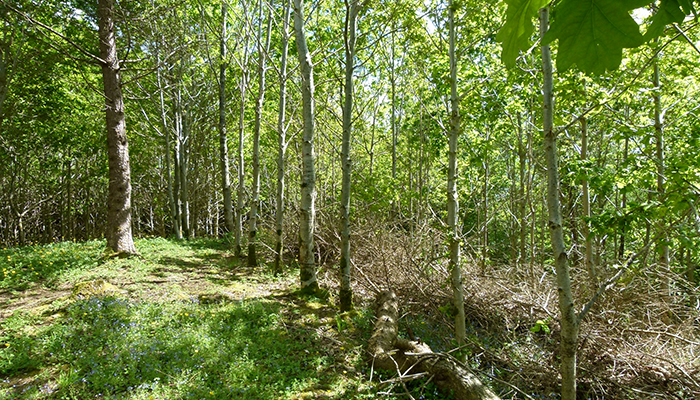
Ireland's forest sector continues to evolve and represents an increasingly important resource for our economy, environment and society.
Since 1980, 24,203 individual private forest owners have accessed grant aid to establish their forests (DAFM, 2025). Eighty two percent of the area afforested since 1980 has been established by farmers.
In terms of sectoral value, the 2024 Gross Value Added (GVA) of the Forestry and Logging sector at factor prices was €158.7 million while the equivalent value for the Wood and Wood Products sector was €540.0 million. Together, these sectors produced €699.2 million of GVA in 2024 (Eurostat, 2025). The comparative figure for 2023 was €717.9. Ireland’s forest sector supports an estimated 9,400 direct and indirect jobs, the majority in rural areas (Forestry Services and Phillips, 2022).
By far the most significant challenge to the Irish forest sector in 2025 was navigating the impact of severe weather events, namely Storm Darragh in December 2024 and particularly Storm Éowyn in late January 2025. These combined events resulted in devasting impacts to over 26,000 ha of both private and stated-owned forests. This equated to over 2.5 times Ireland’s annual timber harvest. Overnight, it presented many logistical and financial challenges for forest owners. The extent of storm damage necessitated substantial re-planning of forest operations over the short and medium term to facilitate the harvest, recovery and marketing of windblown timber. These challenges will continue to require major support, planning and collaborative efforts during 2026.
Based on completion levels in the first three quarters of 2025, dwelling completions in Ireland for the full year of 2025 are forecast at 32,500 units. Forecasts by the Central Bank predict that housing output will rise to 36,000 in 2026 and 40,000 in 2027 respectively (Central Bank, 2025).
According to the Standard and Poor’s Construction PMI, output levels for November in in the UK, our main timber export market, was reported as the lowest since May 2020, reflecting a challenging timber market environment. In its autumn forecasts for 2025, the UK Construction Products Association (CPA, 2025) indicated that growth expectations for construction output have been revised substantially down amid growing risks and uncertainty surrounding the UK government’s impending tax rises in the autumn budget and the impact on the wider UK economy.
The immediate challenge for the forestry sector is to resolve the oversupply of windblown trees at the start of the timber supply chain in a timely and efficient manner. The National Windblow Taskforce has identified mitigation measures that can be employed at the various stages of the timber supply chain to adjust the supply chain to downstream users while minimising, as a whole, the impacts on stakeholders and on Ireland’s forest health status. The optimisation of harvesting and sawmilling capacity in Ireland as appropriate, combined with continued building of market share for Irish timber, a focus on promotion of modern methods of construction incorporating timber technologies and continued timber export penetration into new markets will be important in addressing some of the key ongoing post-storm challenges during 2026.
In line with Ireland’s Climate Action Plan 2025, an expanded and sustained afforestation programme of 8,000 ha or more per annum is necessary to improve the future sink capacity of the forest estate (DCEE, 2025). Based on planting levels to date, the projected total area that will be planted (paid at first grant stage) in 2025 is forecast to approach 2,800 ha. This reflects welcome progress in planting uptake during 2025. Further progression of forest planting rates towards national planting targets in 2026 remains a key sectoral challenge. The increase Government budget allocation €93 million for forestry measures in 2026 includes supports for new forest creation, support measures and proposed support for forest owners through a reconstitution scheme for those affected by storms and ash dieback.
Further insights are available in the proceedings of the recent Teagasc Outlook Conference.
Read more
- Central Bank (2024). Quarterly Bulletin QB3 – September 2024.
- CPA (2025). Construction Slowdown due to pre-autumn Budget Uncertainty.
- DAFM (2025) Forest Statistics Ireland 2025. Prepared by the Department of Agriculture Food and the Marine.
- DCEE (2025). Climate Action Plan 2025, We’re Taking Climate Action. Government of Ireland.
- Eurostat, (2025). NACE Rev. 2 Statistical classification of economic activities. European Commission.
- Forestry Services Ltd., Phillips, H (2022). Economic activity and employment levels in the Irish forestry sector. COFORD, Dublin, Ireland.