
Reviewing bull finishing performance with the McCarthys

Future Beef and Signpost Programme participant, Eamon McCarthy reflects on the performance of his spring-born bulls, noticing significant variation in the performance of progeny from five-star sires.
As we move into October, it’s time to look back at the performance of the finishing stock to date and see what improvements we can make for the coming season. The bulls we choose for the autumn herd will be selected with two things in mind – improving both the maternal and terminal traits of the herd.
We always find it interesting to look back at the carcass performance of the finished stock and see what changes we can make to improve the performance of these animals going forward.
From the spring 2024 young bulls that were finished this year, the difference in carcass performance is striking in terms of age of finish and also carcass weight. By reducing our age of finish, we will reduce our carbon footprint. Additionally, if carcass traits can be improved upon or maintained, we should increase our net margin from these animals.
This year, the 5-star animals were finished at 15.9 months of age, with an average carcass weight of 439 kg versus the 2-star animals, which were finished at 17.3 month of age with a carcass weight of 393kg (see Table 1). The 5-star animals were sired by terminal sires CH8571, CH7503, LM4217 and CH8535. The 2-star animals were sired by the maternal sires used SA4604, SI4250 and SI2469.
As we breed our own replacements from within the herd, we have to select bulls suitable for both maternal and terminal traits. We will use enough maternal bulls to generate replacements; the rest will be artificially inseminated to high terminal index Charolais and Limousin bulls.
Table 1: Carcass finishing performance of young bulls based on Carcass Beef Value (CBV)
| Star rating | CBV (€) | Age in months | Weight (kg) | Price (€/kg) | Sale price (€) | Life time €/day |
| 5-star | 327 | 15.9 | 439 | 7.84 | 3,445 | 7.15 |
| 4-star | 286 | 16.6 | 414 | 8.03 | 3,319 | 6.60 |
| 3-star | 257 | 16.2 | 401 | 7.95 | 3,184 | 6.46 |
| 2-star | 221 | 17.3 | 393 | 8.07 | 3,171 | 6.03 |
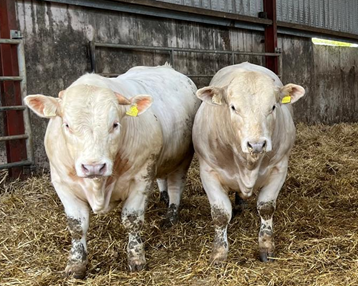
Figure 1 shows two of the 5-star bulls that we finished. The bull on the left, tag number 826, was sired by CH8535 and was finished at 15.3 months of age at a carcass weight of 442kg grading U-3+. The bull on the right, tag number 846, was sired by CH8571 and was finished at 14.8months of age and graded U+3-.
Autumn calving herd
The autumn-calving herd finished calving on the 31st of August and calving went well. All cows calved down without any major difficulties and the focus will now turn to getting these cows back in calf soon.
The breeding season for the autumn herd generally starts around the 10th of October to commence calving around the 20th of July. The spring born calves have now received their booster pneumonia vaccine and are being prepared for weaning.
Grassland management
This year’s grass growth has been behind 2024. This time last year, we had an average farm cover of over 950kg DM/ha versus a cover of 792kg DM/ha this year. Our grass growth up until the end of July was back by 1.8t DM/ha. This was due mainly to a lack of rainfall. At the moment, our stocking rate is 2.43 LU/ha which is higher than last year when it was 1.99 LU/ha. We had to take out ground for a third cut of silage and we are also waiting for the 5.9ha of reseeds to come back into the rotation. We grew over 5.5 tonnes of grass in the period from August to the end of December last year. The high levels of rainfall made cattle unsettled, but the forecast is positive for the week ahead. The plan is to use the autumn planner to extend the grazing for as long as we can. We will start closing paddocks from the 10th of October onwards and plan to graze 60% of the farm in October, this grazed ground will provide the grass next spring when growth rates are too low to support demand.
About the farm
Eamon and his son Donnchadh farm in Carrigeen, Glendine, Youghal, Co. Waterford and are part of the Teagasc Future Beef Programme with the Signpost Programme. They carry a suckler to beef enterprise of 55 suckler cows, split into spring (60%) and autumn (40%) calving. The males are finished as under 16-month bull beef, while the heifers, not retained for breeding, are finished at 18-20 months. Own heifers are kept for breeding.
Find out more about the Teagasc Future Beef Programme here.
Learn more about the Teagasc Signpost Programme here.
The above article first appeared in the Farming Examiner.