
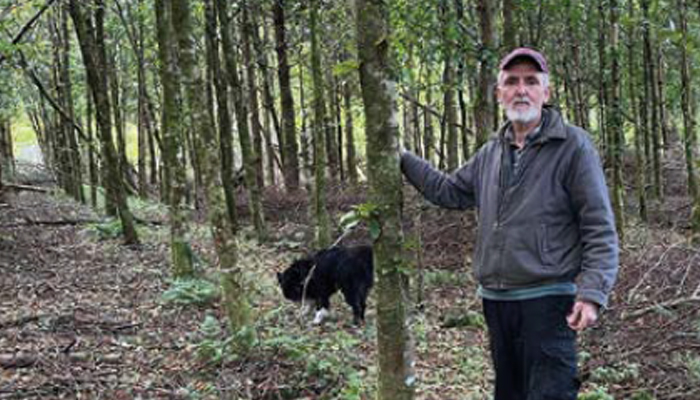
Co. Sligo farmer John Normanly shares his journey from sheep farming to becoming a dedicated forest owner and manager of Hawthorn Farm with Christian Fitzgerald, Teagasc Forestry Development Officer.
Forestry in Ireland is experiencing a quiet transformation. Once considered the preserve of large estates or state-owned lands, trees are now taking root on family farms across the country. More and more farmers are recognising forestry not just as a land use, but as a long-term investment in biodiversity, climate resilience, and farm income.
Among these forward-thinking landowners is John Normanly who, along with his life partner Maria McDonnell, has transformed part of his county Sligo farm into a thriving, biodiverse woodland – and was recently honoured as the winner of the Silvicultural Excellence Forestry Award from the Royal Dublin Society (RDS).
“I’ve always been close to the land,” John says. “I come from a traditional farming background here in Sligo. We ran an intensive sheep farm for many years, but around the early 2000s I started looking for alternatives that could improve biodiversity and offer long-term income.”
Forestry offered the ideal combination. In 2004, he and Maria planted 40,000 trees on their land, establishing what is now a richly diverse broadleaf forest with over 45 different tree species, including oak, beech, ash, alder, and Scots pine. They named their new enterprise Hawthorn Farm – a nod to both the natural landscape and the ecological vision they had for the land.
From sheep to trees
The decision to move into forestry wasn’t taken lightly. “We’ve always liked trees,” John says. “We’d plant a few in the corners of fields, just to see them grow. It helped enormously that establishment grants were available at the time, which made it financially possible.” But grants alone don’t create healthy forests – passion and commitment are essential.
From the outset, John took a hands-on approach to woodland management. “Since planting, we’ve carried out all the pruning, thinning, and tending ourselves,” he explains. “I’ve had great advice over the years, particularly from Stephen Meyen, a retired forester and Teagasc advisor. I’ve also been involved in local forestry groups and Teagasc events.”
“Forestry – like any type of farming – is a learning curve,” John adds. “There’s always something new and the activity never really stops. But it’s enjoyable, fulfilling work.”
John’s dedication and skill in managing his forest were formally recognised when he won the Silvicultural Excellence Forestry Award from the RDS, celebrating his outstanding commitment to sustainable forest management and biodiversity enhancement.
A legacy in trees
For John, forestry is not just about income – it’s about stewardship. “We are only part of nature,” he reflects. “To establish a broadleaf forest in one’s lifetime feels good. It’s a legacy worth leaving behind.” That future legacy is bearing fruit today. Hawthorn Farm is already a flourishing woodland ecosystem.
“Biodiversity is the word that really captures what we’re doing here. Over the years, we’ve seen big changes: new fungi species, a huge increase in birdlife, animals like foxes and badgers – and red squirrels returning.”
It’s not just wildlife that’s benefiting. The local community is involved too. Hawthorn Farm has become a destination for educational visits, walking trails, and eco-tourism, with schools from both near and far visiting the site for forest learning days. “We also run holiday cottages on the farm, and our guests love the forest walks and the natural setting,” says John. “People really value that kind of experience now – somewhere quiet, full of life, and close to nature.”
Energy independence & sustainability
One of the more innovative aspects of the farm’s setup is its approach to heating. “We use a wood gasification boiler as the sole heating system for our house,” John explains. “It’s part of our effort to make the forest work in practical ways. We use wood from our thinning cycles, so it’s sustainable and cost-effective.”
Sustainability, in fact, is a recurring theme. John and Maria’s forest is managed to enhance long-term environmental health, not just short-term gains. That means careful attention to species diversity, soil protection, and future resilience.
“It’s not a quick-return enterprise,” John cautions. “Forestry takes time. But if you care about the land, and you’re willing to take the long view, it’s one of the best things you can do for both the environment and your farm’s future.”
Advice for new foresters
When asked what advice he’d give to farmers considering forestry, John is clear: “Do your homework. Talk to people who’ve done it. Join local groups. Go to events. Learn about what works and what doesn’t. And most importantly – don’t rush the decision.”
He also stresses that forestry isn’t the right fit for everyone. “You have to be interested in it. It’s a different pace and a different mindset from traditional farming. But for those it suits, it can be incredibly rewarding.”
John believes that as the climate crisis deepens and farming practices evolve, more Irish farmers will look seriously at integrating trees into their systems – whether through agroforestry, shelter belts, or full-scale plantations.
“Trees are part of the answer,” he says. “Not just for carbon or income, but for the health of the land. Our forest has changed how we live and farm. It’s added a whole new dimension to what we do here.”
Looking to the future
Now more than two decades into their forestry journey, John and Maria remain deeply committed to the land and its future. They continue to manage their woodland themselves, adapting as they learn, and finding new ways to share it with others.
“There’s a lot of talk these days about climate and biodiversity,” John says. “But it’s not just talk here – it’s action. Planting that forest was the best decision we ever made for the land, for our community, and for ourselves.”
As Ireland looks ahead to a more sustainable rural future, stories like that of Hawthorn Farm offer inspiration – and proof – that farmers can lead the way.
Quick Facts: Hawthorn Farm, Co Sligo
- Established: 2004
- Trees planted: 40,000 (45 species, mainly oak, ash, beech, alder, Scots pine)
- Land use: Forestry, organic farming, eco-tourism
- Heating system: Wood gasification boiler
- Community use: School visits, forest walks, group tours
- Awards: Winner of the Silvicultural Excellence Forestry Award from the RDS.
- Support and advice: Teagasc, local forestry groups, Stephen Meyen (retired forester).
This article first appeared in the November/December 2025 edition of Today’s Farm