
05 June 2023
Save money and reduce GHG emissions switching from CAN to protected urea
Vincent Macken, Signpost Programme Tillage Farmer, has saved money by switching from CAN to protected urea, while also reducing his GHG emissions on the farm.
Here Vicent gives us an update on his farm.
Fertiliser calibration
Earlier this spring, I wrote about getting to grips with calibrating my new Amazone fertiliser spreader and how I had switched to using protected urea as my main chemical nitrogen source. Like all farmers you wait with some trepidation for peak crop growth in May to show up all your mistakes and see where striping has occurred, but thankfully the time I invested in using the Amazone calibration mats and app seems to have paid off.
I am happy that I have saved money switching from CAN to protected urea, while also reducing my GHG emissions on the farm. I am also happy with my winter crops, which are showing a lovely even growth pattern over the past few weeks since the weather finally dried and warmed up.
Spring beans
As I am finally up to date now with work and am enjoying listening to the birds and nature in full song when out crop walking, it is hard to believe that it has been such a difficult season. The weather certainly played havoc with tillage farmer’s work plans all spring, where we seemed to be constantly fighting for a weather window to complete each task at the ninth hour.
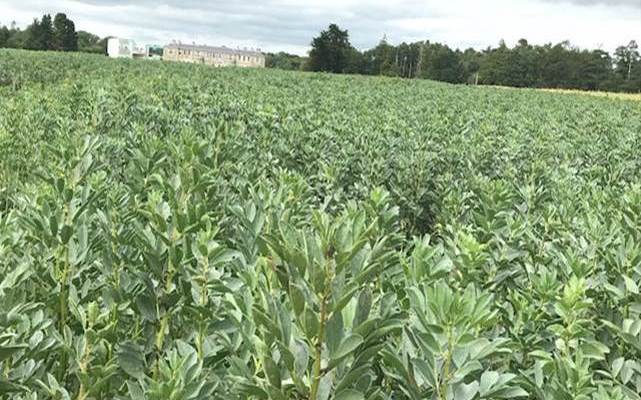
The spring beans were established by min-till into excellent seedbeds at the beginning of March, but the incessant rain that began the following week have left any low lying parts very sparse on plant counts. Some late arrivals have begun to appear through the cracks in the ground since it dried out, but I wouldn’t be hopeful for a big yield this year to match last years.
Hopefully the Department of Agriculture will look favourably on these areas for the Protein Aid Scheme, as it makes sense that Irish farmers are encouraged to grow as much protein crops as possible in Ireland to replace some of the protein being shipped from South America, and also because protein crops help reduce chemical nitrogen use on the farm, as they have a zero nitrogen requirement. With climate change I think we have to make every effort we can, and I certainly will continue to grow beans despite this year’s poor establishment.
Spring barley
The small area of spring barley I have was eventually sown on 22nd April after several attempts. This has since received an aphicide and 0.5L/ha of 75% CCC to help tillering. The Signpost Programme’s aphid yellow-traps in my field dictated the use of an aphicide this year due to numbers and the lateness of sowing. I don’t like using insecticides on the farm, but sometimes science dictates we have to. Those of you who were at the Signpost crop walk on my farm in February will recall how my winter wheat beside the yard had some slug damage after oilseed rape as I had not applied slug pellets, but happily the problem didn’t get any worse and I feel I made the right decision.
Fungicide
On the fungicide side, the winter wheat to date received no T0, it received full rate Revysol + Folpet @ 1.5lt/ha at T1, and has just received its T2 of full rate Inatreq + Croton@ 1.0lt/ha + Folpet @ 1.5lt/ha. I will wait and see the weather pattern before deciding on T3, as I feel it is not adding much to my margin and could be an area where I might reduce my pesticide spend.
The winter barley looks ok after a difficult season. It got its T2 final fungicide a few weeks ago (Revystar @ 1.0lt/ha + Folpet @ 1.5lt/ha), and will be walked for grass weeds in the coming weeks to ensure I am not building up a grass weed seed bank.
My winter oilseed rape received Filan @ 0.4lt/ha at petal fall for sclerotinia control and 20lt/ha of Efficie-N-t 28 foliar liquid nitrogen which I am trialling to see if this late N application will help with pod-fill.
The spring beans have been sprayed with Augusta @ 0.5lt/ha + Vitomix @ 2.0lt/ha and will most likely get Signum as the T2 fungicide treatment.
My thoughts now are beginning to turn to pulling out the combine for a service, what cover crops mixes I should be ordering and where I might take a break in June before we are thrown into the heat of battle again with the harvest in July. The tillage farming year happens so fast.
Find out about other Signpost Programme Tillage Farmers