
Second glyphosate-resistant Italian ryegrass found as ACCase/ALS resistance rises

Rising Italian ryegrass resistance threatens post-emergence herbicide control options, warns Vijaya Bhaskar, Teagasc Research Officer.
The confirmation last year of the first glyphosate-resistant Italian ryegrass population raised serious concerns across the tillage sector. Testing of 2025 resistance-suspect Italian ryegrass samples to post-emergence foliar herbicides has now been completed, with the detection of a second glyphosate-resistant strain representing a significant escalation in resistance risk.
Of the 19 suspect Italian ryegrass populations tested with glyphosate at 720 and 1080 g/ha, IRG-19 survived both application rates (Figure 1). Unlike the first confirmed glyphosate-resistant population, which exhibited resistance to ACCase, ALS, and glyphosate-based herbicides, IRG-19 is resistant only to ALS herbicides (Pacifica and Broadway) and glyphosate. A target-site mutation at EPSPS Pro-106, associated with glyphosate resistance, was detected in 2025-IRG-19, similar to the mutation detected in the first confirmed case. Further investigation is ongoing.
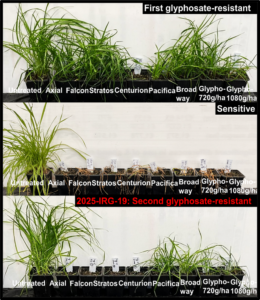
Figure 1: Symptoms of glyphosate-resistant (first case, 2024; second case, 2025-IRG-19 highlighted in red) and glyphosate-sensitive Italian ryegrass populations, 28 days post-treatment with ACCase (Axial, Falcon, Stratos Ultra, Centurion Max), ALS (Pacifica Plus, Broadway Star) and glyphosate. ACCase and ALS herbicides were applied at recommended label rates, while glyphosate was applied at 720 g/ha (ie. 2 L/ha of 360 g/L glyphosate) and 1080 g/ha (3 L/ha ) to plants at the 2- to 4-leaf stage. Where treated-plants are absent or foliage is brown/desiccated, full control was achieved.
Alongside this alarming development, testing of the remaining 18 suspect Italian ryegrass populations (IRG-01 to IRG-18) with ACCase and ALS herbicides revealed widespread resistance, with 13 populations confirmed as resistant (Figure 2).
- IRG-01 to IRG-05: Resistant to all ACCase and ALS herbicides
- IRG-06 to IRG-08: Resistant to both ACCase and ALS herbicides; only the ACCase herbicide Centurion provided effective control.
- IRG-09: Resistant to ACCase and ALS herbicides; the ACCase graminicides Stratos and Centurion remained effective.
- IRG-10 to IRG-12: Resistant only to ALS herbicides; all ACCase herbicides provided effective control.
- IRG-13: Resistant only to ACCase herbicides; fully sensitive to ALS herbicides.
- IRG-14 to IRG-18: Sensitive to all ACCase and ALS herbicides.
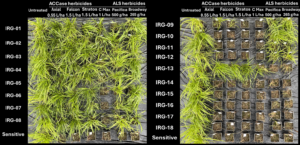
Figure 2: Symptoms of sensitive and resistance-suspect (IRG-01 to IRG-18) populations of Italian ryegrass, 28 days post-treatment with ACCase (Axial, Falcon, Stratos Ultra and Centurion Max) and ALS (Pacifica Plus, Broadway Star) herbicides. ACCase and ALS herbicides were applied at recommended label rates to plants at the 2- to 4-leaf stage. Where treated-plants are absent or foliage is brown/desiccated, full control was achieved.
To date, Italian ryegrass has been identified in 67 fields, of which 53 (79%) are confirmed as resistant. Italian ryegrass remains a serious and growing threat to crop production. This situation serves as a wake-up call, as the spread of complex multi-resistant populations threatens future production capacity and the wider industry.
Improved on-farm biosecurity is essential to contain these issues, alongside the adoption of integrated weed control strategies, including extreme but necessary measures such as crop destruction, hand rogueing, or whole-cropping, even where infestations are small. Such actions are critical to reducing reliance on herbicides, slowing the development and spread of resistance and preventing further replenishment of the seedbank.