
Seeing the value of clover in a dry year

Advisor on the Teagasc / Lakeland Dairies Joint Programme, Sean Callan visits Julie Mullarkey in Monaghan to see how clover inclusion is benefiting the farm, and he provides an update on how the demonstration farmers are managing through the extended dry spell.
Farmer update – Julie Mullarkey
Happy with overall performance, Julie Mullarkey’s herd is averaging 2.05 Kg/MS. Breeding finished after a 9-week season in 2026, although the plan had been to breed for longer. Julie monitored heats closely towards the end of the season and is pleased with the non-return rate. With the herd due to be scanned in two weeks, she is confident of achieving a compact calving season in 2027.
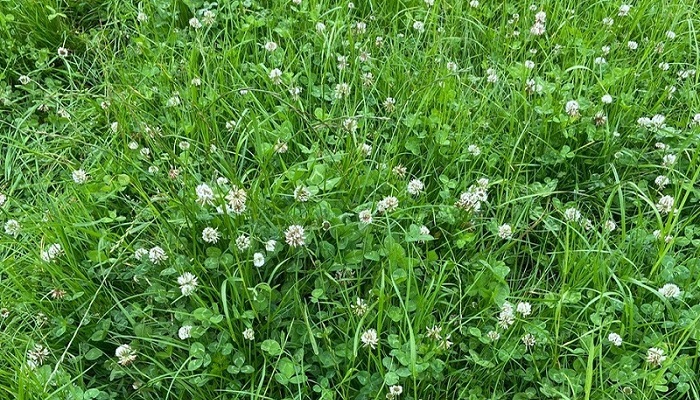
During the recent dry weather, Julie was glad to have a high proportion of the farm in high-clover swards, along with several paddocks in multi-species swards.
Having stopped applying fertiliser two weeks earlier due to the soil moisture deficit, these paddocks continued to grow enough grass to support the herd during challenging conditions.
To manage grass supplies, Julie extended the grazing rotation to 25 days and increased the size of the milking platform by grazing paddocks that would normally have been taken out as surplus. Three cuts of silage have already been completed, and all remaining silage ground will now be used for grazing or zero grazing.
Julie has also sprayed off some silage ground for reseeding and plans to sow a high-clover mix.
She has found clover beneficial during both dry spells and in wetter parts of the farm, reducing the need for chemical nitrogen. High-clover swards receive just 80–90 units of N/acre annually along with some watery slurry.
The plan is to apply up to a further 30 units of N on most of the grazing platform before the closing date, along with one round of slurry on clover paddocks and up to two rounds on non-clover paddocks to help maintain soil P and K levels.
Milk performance update
After what proved to be a particularly challenging month of July due to the ongoing weather conditions, our demo farmers managed to maintain a good level of milk production.
The group average now stands at 1.97 kg MS, which is down 7% from the previous month. Average butterfat increased from 4.36% to 4.62%, while protein rose from 3.67% to 3.76%. These results highlight the importance of regularly monitoring feed levels and adjusting the diet as required to ensure cows continue to receive a high-quality diet of grass, silage and concentrates, helping to maintain milk solids throughout challenging conditions.
Table 1: Milk production on the Teagasc/Lakeland demo farms (week starting August 3, 2026)
| Farmer | Location | Litres/cow | Fat % | Protein % | Kg MS/cow | SCC ‘000 | Meal kg |
| Julie Mullarkey | Monaghan | 24.0 | 4.54 | 3.74 | 2.05 | 152 | 4 |
| Cian Jobe | Longford | 21.8 | 4.44 | 3.57 | 1.80 | 81 | 5 |
| Killian Brennan | Cavan | 23.0 | 4.68 | 4.03 | 2.07 | 124 | 4 |
| Sean Murtagh | Westmeath | 24.0 | 4.39 | 3.67 | 2.00 | 229 | 4 |
| Eoin Corrigan | Meath | 22.0 | 5.04 | 3.88 | 2.02 | 200 | 5 |
| Andrew Cluskey | Louth | 21.5 | 4.65 | 3.69 | 1.85 | 150 | 5 |
| Average | 22.7 | 4.62 | 3.76 | 1.97 | 156 | 4.5 | |
Grass performance update
With grass growth rates dropping significantly throughout July, our demo farmers walked their farms regularly to assess the situation on a week-by-week basis. Anticipating grass deficits, the priority was to reduce demand on the grazing platform and extend the grazing rotation.
To help maintain pre-grazing covers above 1,000 kg DM/ha, high-quality silage was introduced into the diet, while zero-grazed grass from out blocks was brought back and fed to the milking herd. Rotation lengths were also extended to 25 days or more.
Average grass growth is currently 32 kg DM/ha/day. Once growth rates fell below 35 kg DM/ha/day, fertiliser applications were paused. Based on current on-farm growth rates, fertiliser will be applied again once growth exceeds 50 kg DM/ha/day consistently (2 walks). Maintaining high-quality silage in the diet over the coming weeks will be important to reduce grazing demand and allow grass covers to recover and build for the remainder of the season.
Table 2: Grassland performance on the Teagasc/Lakeland Demo farms (week starting May 18, 2026)
| Farmer | Location | Average farm cover | Cover/LU | Pre-grazing yield | Demand/ha | Growth rate/ha | MP stocking rate
LU/ha |
Silage or zero grazed grass being fed |
| Julie Mullarkey | Monaghan | 696 | 133 | 1,433 | 94 | 45 | 5.22 | 7 kg/DM silage |
| Cian Jobe | Longford | 662 | 197 | 1,200 | 34 | 44 | 3.36 | 5kg DM silage |
| Killian Brennan | Cavan | 615 | 196 | 1,450 | 58 | 37 | 3.13 | 5kg DM silage |
| Sean Murtagh | Westmeath | 452 | 210 | 1,200 | 43 | 30 | 2.15 | 3kg DM silage |
| Eoin Corrigan | Meath | 161 | 45 | 500 | 11 | 4 | 3.59 | 12kg DM silage |
| Andrew Cluskey | Louth | 2.92 | 12kg DM silage | |||||
| Average | 517 | 156 | 1,157 | 48 | 32 | 3.40 |