
24 February 2023
Seeking higher profits from dairy beef in Co. Cavan
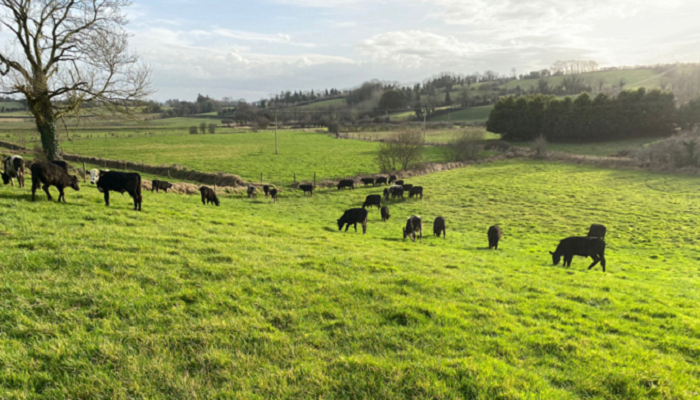
Charlie Smyth joined Teagasc’s DairyBeef 500 Campaign in 2022 and is on a journey to improve the profitability of his beef system through a combined focus on animal sourcing, animal performance, grassland management and livestock output. His DairyBeef 500 advisor Fergal Maguire explains more.
Farming 60ha of mainly Drumlin-type land just outside Virginia, Co. Cavan, 90 calves were purchased on the farm in the spring of 2022 – 75% of these were male and 25% were female. In terms of calf breeds, Holstein Friesians accounted for over 50% of the calves sourced, but the focus on the farm is turning to buy more beef breeds and calves with higher Commercial Beef Values (CBV) in the years ahead. 2022 marked a new venture for the farm, as a number of Aubrac calves were purchased, with the remainder being early-maturing breed types.
An improved calf sourcing policy will be employed, targeting purchasing calves at three weeks of age – to limit scour – from a maximum of five source herds. Charlie had previously purchased calves from a number of different sources, including marts and dealers, but attention will now switch to buying directly off farm to bring about change in terms of the genetics of the calves being purchased. A target has been set to bring the average CBV of animals sourced to a minimum of three stars; this will be a vast improvement on the current range of genetics currently present on the farm, with over 81% of all animals only being one or two stars in terms of CBV.
Calf feeding policy
Along with improving the quality of calf purchased, Charlie will also make improvements to his calf rearing protocol in a bid to reduce costs. Calves are currently offered two bags of milk replacer over the milk rearing period on farm – fed from 14-70 days – but plans are in place to reduce this back closer to one bag of milk replacer per calf, which will save the farm approximately €90/ha in terms of variable costs, while also encouraging an increased intake of concentrates prior to weaning.
If finances allow in the future, a new calf rearing shed will also be constructed. The slatted shed used to carry the weanlings over the winter months is repurposed every spring to facilitate the rearing of calves. This poses challenges in a late spring, as calf purchasing can often be delayed until yearling animals can be turned out to grass.
Improvements in animal performance
Another key area that needs addressing on the farm is the levels of daily liveweight gain that are being achieved from grass. Over the first season at grass, 2022-born animals achieved 0.59kg/head last year, which falls short of the 0.7-0.8kg/head/day target. Second season animals are also falling behind, gaining just 0.67kg/head/day at grass, 0.3kg/head/day behind what they need to achieve in an efficient calf to beef system.
To achieve this, a focus will be placed on improving grassland management on the farm – taking a three-pronged approach of soil fertility, grazing infrastructure and reseeding. Soil fertility will be one of the key areas targeted, with an aim of improving the lime, phosphorous (P) and potassium (K) status of the farm. As it stands, 57% of the farm is optimum for lime, 30% is at the optimum P index and 66% at the optimum K index.
To improve the performance achieved from grazed grass, Charlie has become focused on measuring grass on a weekly basis; he has also taken advantage of the excellent grazing conditions this spring and has commenced his grazing year almost two months earlier than the spring of 2022, with yearling animals turned out to grass in early February. Changes to the size of the grazing paddocks will also be implemented – moving from week paddocks to three-day paddocks. Charlie has an excellent opportunity to do this through the introduction of grant aid for bovine fencing under TAMS 3.
Liveweight output
Through improved animal performance – achieved through an animal with higher genetic gain for beef production by focusing on CBV values and improved weight gains from grass – the aim is to improve the beef output produced per livestock unit from the current level of 444kg/LU closer to 500-600kg/LU. Plans are also in place to improve the beef output generated per hectare, moving from 746kg/ha to 1,000-1,100kg/ha, by reassessing the need for some of the leased ground currently included in Charlie’s farming system. This will also bring about improvements to the gross output in monetary terms – at €1,678/ha in 2022 – bringing it closer or past €2,000/ha.
On an individual animal basis, the changes to grassland management and animal sourcing will also lead to higher beef sales per animal. Currently many of the animals being produced for slaughter off the farm are failing to achieve a 300kg carcass at over 24 months of age. By improving the levels of animal performance achieved during the respective grazing seasons, animals will be slaughtered at heavier carcass weights at younger ages. Benefits will also be witnessed in the variable cost spend on farm, which stood at €1,034/ha in 2022, as less meal will be required over the animals lifetime to bring them to finish.
Charlie is already operating a profitable calf to beef system, although the levels of profit being achieved are small at €154/ha. By implementing the key changes outlined above, he will generate more beef, of higher quality, from grazed grass and this will contribute greatly to him achieving the targeted net margin of €500/ha excluding subsidies by the end of the DairyBeef 500 Campaign.