
Shared land, shared heritage
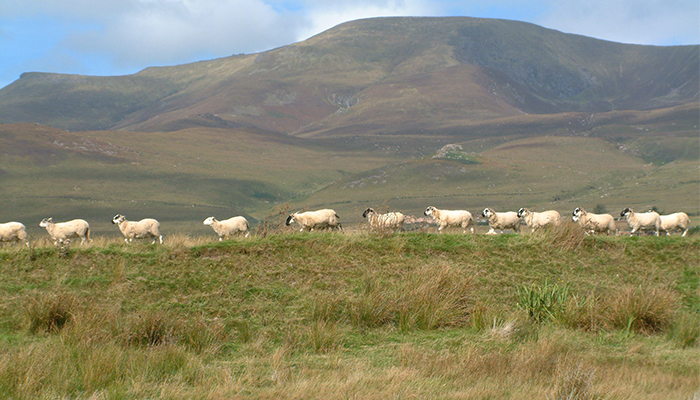
Commonage farming is practised in virtually every county, often on uplands. Collaboration between farmers is key. Ivan Kelly, Teagasc Environment Specialist, and Mark Moore, Editor of Today's Farm, tells us more.
In a small hotel room in Kilcar, Co Donegal, farmers lean forward, eyes fixed on a laptop screen, arguing about sheep. Not real sheep, at least, not this time. They are playing ‘Age of Commons’, a game developed by Dr Colas Chervier of the University of Limerick. The game was produced as part of the BIOFIN-EU Project to mirror the challenges faced by farmers managing Ireland’s 4,500 or so commonages encompassing nearly a million acres.
“The game shows how even a small choice by one shareholder can affect everyone,” says James Cannon as he leans back in the chair and smiles. “Cooperation works best, but it requires trust,” agrees Dr Chervier. The game has been used with commonage farmers across the country, including during Teagasc courses and Knowledge Exchange Groups.
Local Teagasc advisor, Carolyn Patterson, initiated and facilitated the meeting.
“Donegal contains one of the largest areas of commonage land in the country,” she says. “Around 200,000 acres are shared between farmers. Much of it is uplands where the soil is peaty and the terrain is rough. It has traditionally been used for grazing livestock, especially sheep.”
Commonage landscapes, across the country contain habitats such as blanket bog and heathland that support a wide range of wildlife.
“Where shareholders communicate and agree management approaches, commonage land can be farmed sustainably, while protecting valuable habitats,” says Carolyn.
Connemara
Farmers from across Connemara recently gathered in Recess as part of an Uplands Farmers Pilot Course, organised by Teagasc and the Wild Atlantic Nature project.
Led by Teagasc advisors Marion Fox and Joanne Masterson, and student Sarah Lily James, the course focused on sustainable upland management and the future of commonage farming. Most farmers have sheep that graze ‘at home’ as well as on the commonage. Nationally, commonages are a key source of lamb supply, with many animals sold to lowland farms either for finishing or as breeding replacements.
As the evening progressed, farmers broke into smaller groups and reflected on how farming in Connemara has evolved over time. They agreed that the commonage landscape remains a defining part of farming in Connemara, and that active hill farming keeps these areas of rural Ireland open.
They also highlighted the importance of preserving local knowledge, such as the traditional “beaten paths” livestock use to move safely across boggy ground.
In Cork, Teagasc advisor Michael Connolly says changing work patterns are reshaping hill farming: as off-farm jobs rise, time on the hill falls. Larger crossbred ewes are less suited to upland commonages than traditional mountain breeds, and mixed grazing with cattle is often beneficial.
Teagasc advisor in Co. Kerry, Kevin O’Sullivan, highlights that many commonages in Kerry are in good ecological condition.
“As farming systems evolve, maintaining the right balance of grazing, alongside other management practices, is becoming increasingly important. Undergrazing is an issue in places. Traditional practices such as mulching and controlled burning have long been used to manage encroaching scrub, although wetter seasons in recent years have made this work more difficult.”
Traditional knowledge
Tomas O’Reilly farms sheep, cattle and horses on the Cooley Peninsula in Co Louth. He has 100 acres of lowland and 70 acres of Glenmore commonage, a landscape he knows intimately.
Pointing to Eagle Rock, where his forebears carved their names, Tomas says: “I think of them every time I pass it.”
He points at the remains of houses abandoned in the 19th century, during the famine and he knows people have been on the hill for millennia.
“A visiting archaeologist told me there’s evidence of ancient settlements on the highest ground,” adds Tomas. “Previous generations had Gaelic names for every feature of the landscape. I know a lot of them but my only regret is that I didn’t write them all down.”
One feature absent from the landscape, and all commonage, is fences. In a hefted flock, sheep have learned to remain within a particular area of the hill. Lambs follow their mothers from an early age, gradually learning the natural boundaries of the landscape – ridges, streams and changes in vegetation.
“It’s getting harder to find young people to farm the commonage,” says Teagasc advisor Colm Barry. “So it’s great to see young people like Tomas (who is in his thirties with a young family), who spent time in Australia choosing to return home to farm and become an active member of the thriving Cooley Sheep Breeders Association, which is at the heart of the local farming community.”
A unique commonage
Larry Murphy farms land at Rathangan in Co Kildare. He also has rights to graze around 200 sheep, mostly Wicklow Cheviots, on the Curragh commonage. Larry has a deep understanding of the land and its association with the army, current and previous, and the history of horse racing there.
He describes rare plants on the land which has never seen artificial fertiliser and points to barely perceptible mounds in the landscape. “They are the remains of ancient raths used as cattle pens millennia ago,” says Larry, his pride in the landscape plain to see.
“The Curragh is unusual in that it extends across 5,000 largely flat acres in Co Kildare,” says Larry’s Teagasc advisor Rachel Taylor. “The Department of Defence is responsible for the preservation and management of the Curragh lands; farmers holding grazing rights submit them to the DOD annually and are then granted permission to graze with sheep. The Curragh rangers patrol this to ensure over-grazing is not occurring.
“Grazing is limited to two ewes per acre which preserves the Curragh’s rich grassland habitats, which support rare plants, diverse birdlife and an exceptional variety of fungi.” Larry is a part of an informal group of farmers who meet several times a year to discuss issues on the commonage. “We do get a lot of leisure walkers, but there are rarely problems,” he concludes.
Names and landscape
“Names on commonages have been preserved because the mountains didn’t attract incomers such as the Normans and English planters due to the harsh environment,” says Waterford Teagasc advisor Catriona Foley.
“The vast majority of the place names on the Comeraghs come from Irish. Our forebears were fascinated by the natural and supernatural world. Many of the names on the
mountains refer to things in nature – rocks, rivers, birds, animals etc, and to fairies, mythical characters etc.
“Seefin, for example, is the name of the highest point on the southern ridge of the Comeraghs. It comes from “Suí Finn” and means Fionn MacChumhail’s seat. It is a name seen in many Irish mountain ranges across the country. It shows how enchanted our Celtic ancestors were by mythology.
“Another recurring name is Boolaclochagh – comes from ‘Buaile Clochach’ and means the stony herding place. Again, an apt description of what you see on the ground below the Booleys – all those huge boulders, while at the same time hinting at the medieval farming practice of booleying or transhumance.
“This is the summer grazing of mainly dairy cows in upland areas of rough grazing commonage, usually involving young people, often young women, who would live in huts on the hills while tending to the animals.”
Catriona was part of the large team which operated and facilitated the Comeragh Upland Communities European Innovation Partnership (EIP) with local farmers. The EIP finished in 2022 after generating a large body of reports and satisfaction among the participating farmers.
A recently established EIP, the Coimín Beo is a four-year agri-environment project led by South West Mayo Development Company in partnership with Cairden a hEara gaile, working with partners and farmers to improve management and restore upland commonages in the Nephin area of Mayo and the Earagail region of Donegal.
The project focuses on practical measures including improved grazing management, peatland restoration and habitat monitoring. Farmers will record wildlife and track change on their own land. As Nephin farmer Pat Chambers puts it: “The hill belongs to all of us. If we want to improve it, we have to work together. No one farmer can fix a commonage on their own.”
To finish, we return to the Kilcar House in Donegal where the ‘Game of Commons’ is concluding. James Cannon speaks for all when he says: “It confirms what farmers have known for centuries: if you collaborate with your neighbours and work in harmony with the landscape everyone wins.”