
Signpost update: Changing the post-weaning protocol in Co. Cork
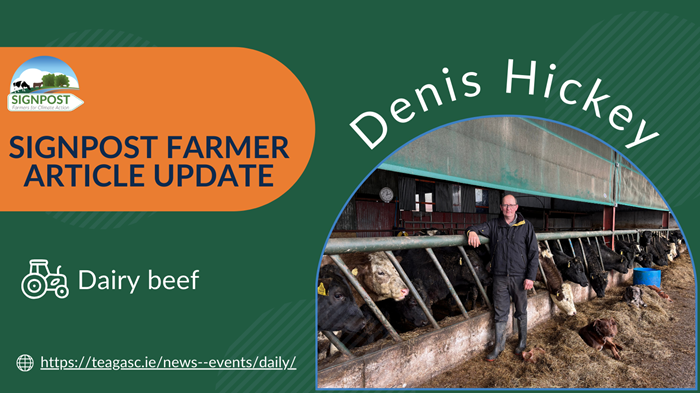
DairyBeef 500 and Signpost Programme participant, Denis Hickey brings us up to date from the happenings from his farm in Co. Cork, including an update on weaning, calf performance and grassland management.
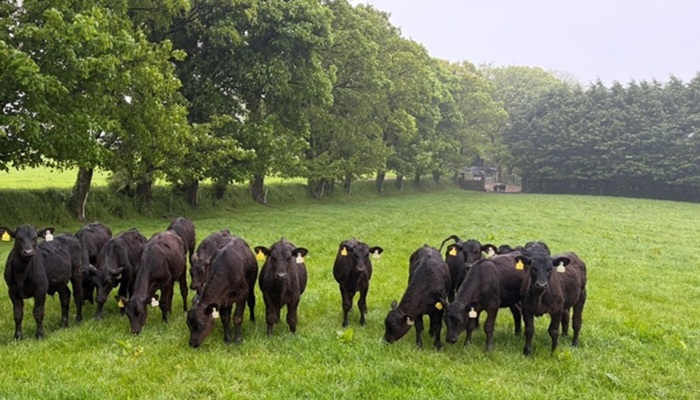
To further develop their rumen and hopefully avoid any issues when transitioning them to grass, I have decided to hold all calves in the shed on a diet of straw and concentrates for two to three weeks after weaning this year. The weaned calves indoors are flying through concentrates and are consuming up to 3.5kg per day.
Some weaned calves are already out at grass and have been reduced to 2.5kg of concentrate plus straw. They will be gradually reduced to 1.0-1.5kg as their grass intake increases.
They have received their first vaccination shots for both pneumonia and clostridial diseases and will get their second shots three to four weeks after their first shots. However, I will leave time between giving the pneumonia and the clostridial vaccinations.
Calf performance
Calves were weighed in early May, with the heifer calves averaging 113kg and the bull calves 107kg. The table below outlines the minimum and maximum weights of each group. Like any group of stock, there is quite a range in weights and performance, but in general I am happy with how the calves have gone so far.
Table 1: Calf weights from the first week of May 2026
| Animal | Min. | Average | Max |
| Heifer calf weight (kg) | 91 | 113 | 128 |
| Heifer calf ADG since birth (kg) | 0.62 | 0.87 | 1.10 |
| Bull calf weight (kg) | 90 | 107 | 126 |
| Bull calf ADG since birth (kg) | 0.47 | 0.73 | 1.01 |
Grassland management
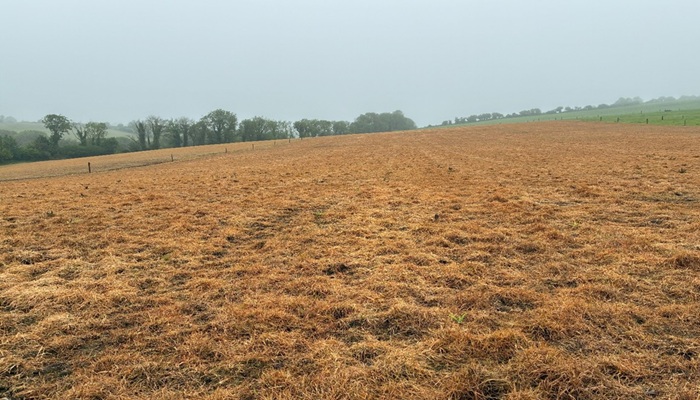
Some fields that I reseeded last year and grazed late into last winter weren’t grazed this spring. As they had been grazed out well, they were fertilised for silage. I cut them three weeks ago and they averaged 11 bales per acre. This silage was made in good condition and fingers crossed it should be high quality.
Grass is growing well on the farm at the moment. My average farm cover is a bit high at just over 1000kg DM/ha. A number of paddocks have covers over 2,000kg DM, so they will not be grazed and will be cut for bales.
The aim is to get grass covers corrected and back on track with an average farm cover of 650kg DM/ha. Achieving that will mean cattle going into grass covers of 1300-1500kg DM/ha, making sure that high quality grass will be available for animals to maximise performance. At these covers, graze outs should also be better and reduce the need for topping.
My paddock sizes of 4 acres are currently too big for my steer and heifer group sizes, so I am using temporary reels to split them. This means I can get in and get them grazed out in three days, without affecting regrowths. It also allows me the option to cut out half paddocks if they become too strong before grazing.
At present, I have two paddocks (8 acres) sprayed off for reseeding. Having been sprayed a few weeks ago, they are well burnt off now, two tonnes of lime per acre has been applied, and the plan is to till them this weekend and sow at a rate of 15kg grass/clover seed per acre.
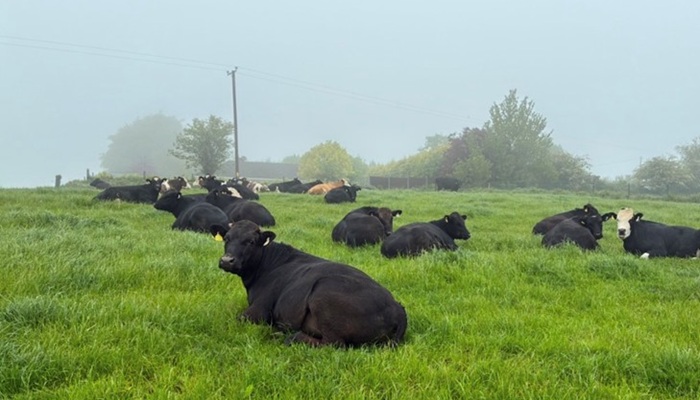
Yearling cattle are currently grazing in two groups, 48 steers and 45 heifers. They were weighed in mid-April, when steers averaged 410kg and heifers 380kg. They will be weighed again in mid-June as a mid-season weight to see how they are performing. These cattle look to be doing well, but I will do a faecal egg sample soon to ensure that there are no worms etc. that might affect their performance.
The above first appeared in the Farming Examiner as part of a Signpost Programme update. Denis Hickey is a participant in the Teagasc DairyBeef 500 Campaign, working closely with Teagasc Advisor, Gordon Peppard.
For more on the Teagasc Signpost Programme, visit here.
For more on the Teagasc DairyBeef 500 Programme, visit here.