
Signpost update: Harvest 2026, cover crop establishments and AgNav
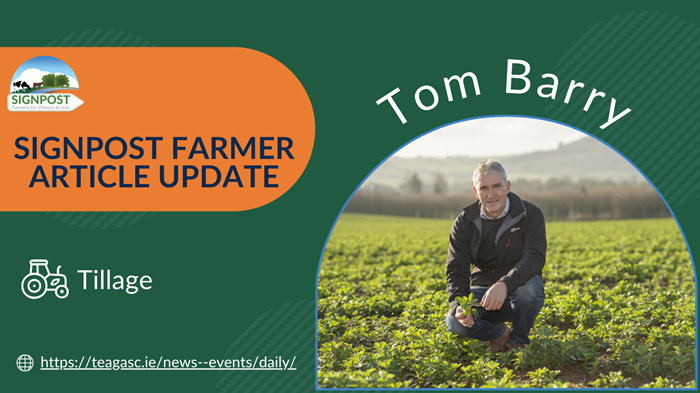
Tom Barry, Signpost Programme Tillage farmer, brings us up to date with the latest happenings from his farm in Cork, focusing on the performance of winter crops, cover crop establishments and the carbon footprint of his oat crops.
Harvest 2026 started for me on July 3rd. I harvested Integral and SY Canyon winter barley which yielded well, averaging around 10 t/ha, due to having a strong crop rotation and high soil fertility from years of organic manure application. Straw yield was between 25 to 30 round bales/ha.
Winter oats were cut on the 10th of July and yielded 9 t/ha.
Harvesting of winter rye has begun on the 21st of July and seems promising. I was worried that the long dry hot weather might reduce yields by prematurely ripening crops, however the yields so far, and quality, are good.
One interesting feature is that crop rotation and high soil fertility are delivering yield ahead of continuous crops this year. Crop rotation is essential and I think the effects of ‘take all’ are not being taken seriously enough.
On July 2nd, Teagasc arranged a farm visit for around twenty of their researchers. These researchers were experts in many areas including water quality, sustainability in agriculture, soil science, climate mitigation, education, social and behavioural science along with sheep, beef, dairy and tillage enterprise specialists.
This farm visit provided an opportunity for researchers and policy advisors to evaluate how various schemes and measures are working at farm level.
This visit was also a valuable opportunity to discuss how schemes might be modified to help us reach our common goals especially with water quality and reduction of artificial fertiliser, with greater emphasis on organic manures and better co-operation between the farming sectors.
AgNav and a negative carbon footprint for oats
On July 8th, I did an information video and interview with John Mahon, Teagasc. John co-ordinates the tillage farmers in the Signpost Programme. The topic we discussed was AgNav and this interview was organised by Bord Bia.
AgNav is a free digital sustainability and carbon tracking platform for Irish farmers. It was developed by Teagasc, Bord Bia and ICBF (Irish Cattle Breeding Federation). AgNav is a very valuable tool in my farming business. For the first time, I am able to calculate the carbon produced from my farming operation on a per hectare and per tonne basis.
My winter oats crop in 2025 had a negative carbon footprint due mainly to chopping the straw in the SIM (Straw Incorporation Measure) which was a very interesting result. The practical use of this AgNav tool means I am now able to sell my grain with a carbon footprint included on the invoice. This hopefully will be of benefit to my local grain buyers in reducing the carbon footprint of their farming system.
Straw incorporation and cover crops
I have once again applied for the Straw Incorporation Measure (SIM) and as I write this, I am awaiting the acceptance letter from the Department of Agriculture, Food and the Marine. I also had to use my AgriSnap app to confirm a winter barley crop on two plots. This was a bit amusing as the barley was cut and the straw baled. I agree with good oversight and inspection, however adding this task in the middle of harvest was frustrating.
I have the winter barley stubble disked and ready for cover crop setting. This cover crop is part of the very successful Farming for Water EIP for water quality. The one unusual feature this year is that field cultivation took a few attempts as the dust was blinding and there was a safety issue with obscuring vision of local roads. Every year at farming it throws up a new challenge!
Finally, I would like to wish all involved a successful and safe harvest.
The above first appeared in the Farming Examiner as part of a Signpost Programme update.