
Signpost update: Monitoring animal performance and multi species benefits
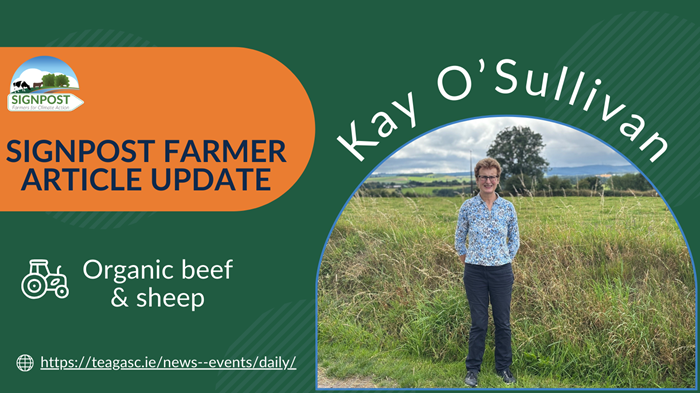
Spring is always a very busy time on the farm for Kay O’Sullivan, organic farmer and participant in the Teagasc Future Beef and Signpost Programmes, who shares the latest happenings from her farm in Mourneabbey.
Lambing
Lambing started on the 20th of February and is almost finished at this stage. The main flock are commercial Charollais mated with a pedigree Charollais ram. Lambing went well with just one C-section on a hogget.
Calving
Calving has also started. Calves are born very lively and I put this down to the minerals I am using.
The herd is 100% Angus with 100% AI used on the farm. Some of the sires I am using this year are Delish Wingman, Nebo, Gabriel Pat, Swanky Valentino and Westellen Boss.
At birth, calves are weighed and tagged. I am also participating in the National Genotyping Programme, and it is great to get that job done early at the tagging stage.
This year, I decided to start weighing the calves at birth to improve the information being recorded for ICBF. I am using a sheep scales on the farm for carrying out the weighing process and it doesn’t take long. I then record the weighs on ICBF using the ICBF app on my phone. Calves will be performance monitored throughout the year.
Once the cows have calved, they are moved to grass where they have access to a high fertility, high magnesium mineral bucket. Prior to calving, the in-calf cows are on a low DMD silage as I find the Angus put on weight very easy.
Plans for grazing
At the time of writing, the young stock are still grazing redstart and they will finish grazing that very shortly. They are on high DMD red clover silage as well.
They will be faecal sampled shortly, with samples handed into my vets for in-house testing. Under the organic system, if there is a problem, the livestock can be treated but it is double the standard withdrawal and triple the standard withdrawal if they are destined for the factory.
Any cattle destined for the factory can only receive one treatment in the 12 months, with breeding stock allowed two treatments. If they receive additional treatments, they will lose their organic status. They can remain on the farm for two years when the organic status will be regained. If not, they can be sold conventionally.
I operate a clean grazing system, so I have very little problems with parasites. Cattle will be weighed coming off the redstart and moved onto the previous year’s multi species reseed. They will be performance monitored throughout the year.
Two grass walks are planned for March, then weekly from April. A benefit of grass measuring through the year: I can monitor poor performing paddocks and ear mark them for reseeding next year and paddocks with surplus grass can be taken out for silage.
Multi species swards
Multi species will be sown once the weather allows. I have been growing multi species since 2018. It is a brilliant crop for finishing cattle and sheep. Multi species contains chicory, plantain, clovers and grasses. In a year of a drought, it is the plantain that continues giving as it offers drought resistant.
I have also taken out a number of multi species sward paddocks for silage over the years, with the resulting silage testing very high for crude protein – up to 19%. As well as enhancing biodiversity on the farm it has also been shown to reduce parasitic burdens in grazing livestock through its anthelmintic properties.
The annual organic inspection took place in February with no issues arising.
The above first appeared in the Farming Examiner as part of a Signpost Programme update.