
Signpost update: Monitoring rising costs and adapting to more extreme climates
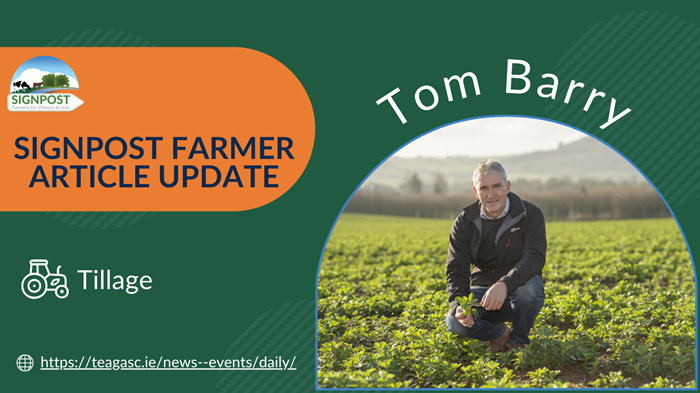
Tom Barry, a Signpost Programme Tillage farmer, writes on the latest happenings from his farm in Co. Cork, focusing on harvest reflections, crop establishments, the role of cover crops and how his farm is adapting to a changing climate.
The dust has now settled on harvest 2026. It will stand out in my memory as being the earliest harvest I have begun (3rd July) and the earliest harvest to complete (31st July).
The hot, dry weather was outstanding to get through work. Earlier sown winter and spring crops yielded very well. However, the severe drought did impact on the later spring bean crop which struggled to yield 1.5 t/ac.
Years ago, August was the primary harvest month, and it would have been unimaginable to believe that both winter and spring crops could be harvested by the end of July. There has been a shift in weather patterns over my 30 years involved in tillage farming and I now need to actively plan crop rotations, setting (sowing) dates and variety choices to combat the changing and more extreme climate events.
Early setting of winter crops by two to three weeks is one measure I use to help ensure the winter crops are sufficiently advanced to combat the damaging drought spells that can reduce yield. I have moved back to late September from early/mid-October. The excellent ground conditions this September has helped achieve optimum crop establishment. But it is a balance, as BYDV (Barley yellow dwarf virus) needs to be considered. Thankfully the newer crop varieties, especially those containing the Ryd2 and Ryd3 genes, are proving very effective in protecting the crop and lowering the incidence of BYDV.
Also read: BYDV tolerant varieties are risk reducers, not risk eliminators
This year, I started setting KWS Tayo hybrid winter rye on the 21st of September and then moved on to the winter barley on the 23rd of September. Next up is winter wheat when the weather settles again, hopefully on the first week of October.
Cover crops
This year, I set over 150 acres of cover crops containing kale and leafy turnip. These cover crops are part of two schemes, the agri-environmental scheme ACRES and the Farming for Water EIP.
I disked the fields immediately following straw removal and set the cover crop a week later using a precision applicator attached to the front of the tractor, with a flat roller behind. I am very pleased with my establishment as other methods I used over the years had mixed results.
By mid-September, I had a dense vigorously growing cover crop. Excess soil nutrients are being actively taken up by the cover crop which is now two feet high in places with a fabulous root structure. Once again, this year, Teagasc will monitor this cover crop, measuring nutrient uptake.
The intention is to incorporate this crop back into the ground ahead of setting spring barley, and not to apply any artificial phosphorous (P) or potassium (K) to the crop. This cover crop will also be available as a fodder source if a difficult spring occurs, given that many livestock farmer were forced to use winter reserves during the prolonged summer drought.
Input costs
I am very mindful of input costs this year, especially diesel which has skyrocketed. I measured the litres used to plough and set the winter grain to date.
Ploughing used 9.41 L/ac, and setting used 5.9 L/ac. This combined usage of 15.3 L/ac has increased my setting costs by almost €11/ac since December 2021. For the 2026/27 sowing season, this is an increase of €5,800 just to plant the crops, before any field work or harvesting is taken into account next year. The price of grain needs to increase to reflect the higher costs involved and certainly any government assistance such as the Fuel Income Support Scheme 2026 was very welcome and a recognition of the problem.
I must balance some of the extra costs with the savings made on the farm with the installation of a photovoltaic system last year. This was grant aided through TAMS 3 and has delivered approximately a €3,500 saving over twelve months. However, I, like all other farmers and workers, am highly exposed to future high fuel costs, and this is a worrying scenario.
Making the farm more sustainable, with measures such as the use of organic manures, crop rotations, correcting soil pH, reducing soil compaction, improving soil fertility, using less artificial fertiliser, setting cover crops and straw chopping and incorporation, along with increasing energy efficient measures (solar PV, batteries, LED lighting and electric car) I feel are helping to build resilience and protect the viability of my farm in ways I can influence, against external geopolitical factors which we have little or no control over.
Tom Barry is a participant in the Teagasc Signpost Programme, working closely with Teagasc Signpost Programme Tillage Advisor, John Mahon.
The above first appeared in the Farming Examiner as part of a Signpost Programme update.