
Signpost update: Recovering from this summer’s drought
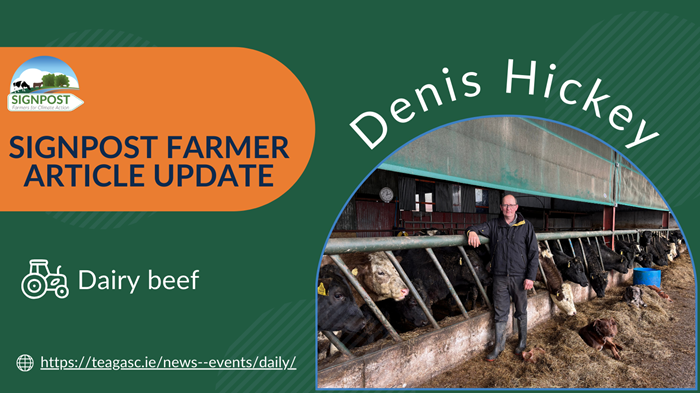
Focused on using nutrients efficiently, DairyBeef 500 and Signpost Programme participant, Denis Hickey writes on how his farm is recovering after this summer’s drought and his finishing plan for heifers and steers.
With little to no rain received here on the farm for 10 weeks, we were glad to get a nice bit of kind soft rain over the last fortnight.
Grass is greening up well and with fertiliser applied on 9th September, fingers crossed now for some nice weather to allow the grass to grow and be grazed for the next few months to shorten the winter. With full drought conditions here on the farm for approximately two months, I have used around 100 bales of silage that would normally be for winter fodder.
Slurry applications
After housing animals in July, slatted tanks were starting to fill back up again. After the rain came, the rainwater was diverted into the slatted tanks for ease of agitating. On the 3rd of September, my contractor managed to get the tank as good as fully emptied.
The slurry was nice and watery, and applied at 2,000 gallons per acre on seven paddocks across the farm, covering approx. 28 acres. Two of these paddocks were reseeded in the spring and looked hungry for nutrients and three of the other paddocks were reseeded last year. The other two paddocks were older grass paddocks that were close to the yard.
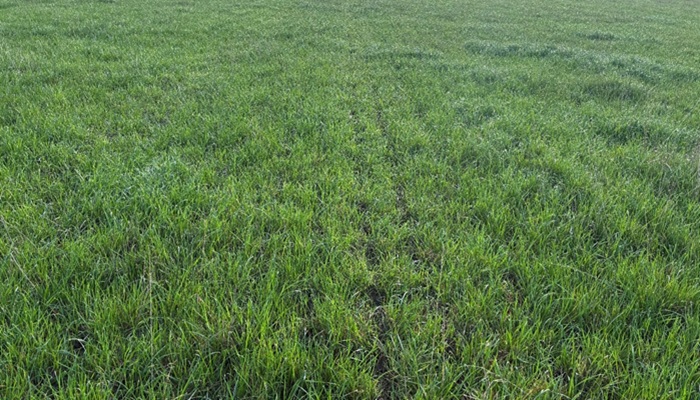
Slurry recently applied using dribble bar
Fertiliser applications
The rest of the farm received one bag of 29/0/14 per acre on the 9th of September. My chemical Phosphorus limit is very tight, so I use the product 29/0/14 at this time of the year for my last round of nitrogen, and it also supplies a nice top up of potash at the same time.
Later in the autumn, I will reassess my soil fertility and any fields that are low in Potassium (K) and that had silage cut from them this year will get 30 – 40 units of muriate of potash.
Cattle sales and finishing
Having mentioned it in the last article, I sold 10 heifers live in the mart on the 11th of August. The group were made up of three Hereford crosses, three Angus crosses and four Aubrac cross animals. Their average weight was 456kg. I was a bit disappointed with the price received for the Hereford animals, as they were a nice animal in good condition, but they returned over €100 less than the others.
The remaining 21 heifers are currently all housed and on their finishing diet. The heaviest 14 came in on the 25th of July and are now on 5kg concentrates plus silage. The other seven were housed on the 16th of August, were built up and are now also receiving 5kg concentrates per day. There should be some of the initial group of heifers coming fit for sale to the factory in the next couple of weeks. I will draft them based on weight and fat cover.
There are also 18 steers housed since the 9th of August and being finished on 6kg of concentrate plus silage. The remaining 30 steers are still at grass where they are getting a bale of silage per day.
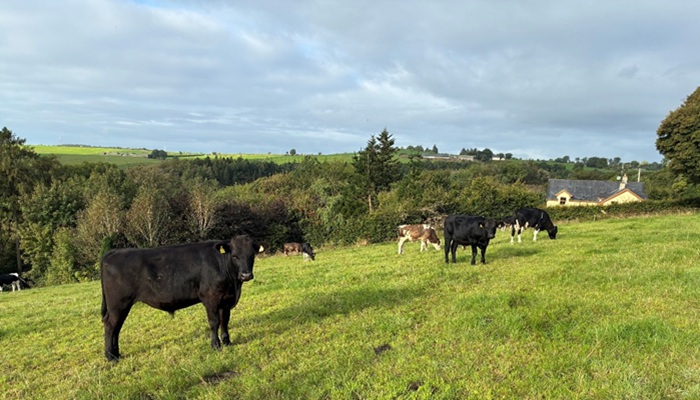
Steers at grass
Calf performance
The calves are now in three groups. The strongest and heaviest calves (49) and the middle bunch of calves (41) are both out on a small pick of grass, silage and 2kg of meal. The weakest calves (12) are on grass, hay and 2.75kg of concentrate at present.
As the grass returns, soon hopefully, I will pull the meal back but will leave hay/silage with them until they get accustomed to grazing grass again. Depending on the weather, grass could be of low dry matter with little stem following the drought and I want to ensure that they have an option of fibre in their diet for the first couple of weeks back grazing.
The next few jobs on the farm are to weigh all the calves and yearling cattle to see how they have performed. I will also dose the calves as they are starting to do a bit of coughing again. Hedges will also need to be cut in the next couple of weeks when the fields are dry to travel on the headlands.
The above first appeared in the Farming Examiner as part of a Signpost Programme update, and was adapted for use on Teagasc Daily.
For more on the Teagasc Signpost Programme, visit here.
Denis Hickey is a participant in the Teagasc DairyBeef 500 Programme, working closely with Teagasc DairyBeef 500 Advisor, Gordon Peppard.