
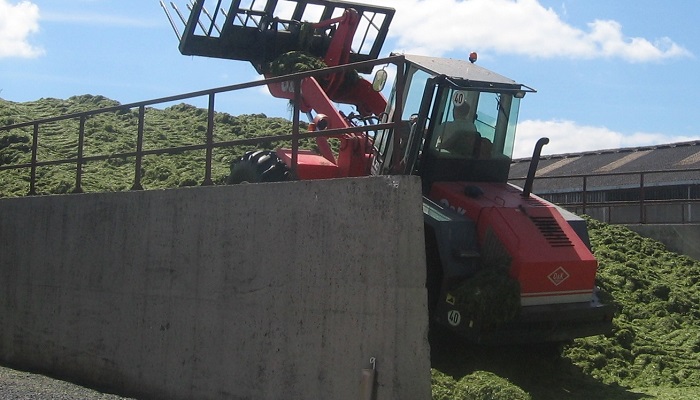
Silage quality and quality – Ruminant Nutrition Specialist, Dr. Aisling Claffey writes on the importance of striking a balance between dry cow feed and a quality buffer, the key parameters of quality grass silage and why chasing bulk isn’t necessarily a good thing.
Silage quality is often overlooked as a critical element to supporting herd performance on dairy farms, with dry cow forage only making up 10-12 weeks of total winter feed requirements.
Silage quality of at least 74 DMD is optimal to buffer the milking herd through the shoulders or during prolonged dry periods in the mid-season, if demand cannot be met by pasture growth.
While much of the focus is placed on DMD and crude protein as metrics of silage quality, it is important that silage has good fermentation characteristics to ensure palatability and support high dry matter intakes. Optimal fermentation will also minimise losses from the clamp during storage, exposure to aerobic conditions and at feeding out.
Table 1: Key parameters for assessing quality of grass silage
| Measure | Dry cows | Milking cows and young stock | Comment |
|---|---|---|---|
| Feed value metrics | |||
| DMD% | 68 to 70 | 74+ | Key determinant of overall feed value |
| UFL (energy) per kg | 0.72 to 0.75 | 0.83 to 0.88 | Higher UFL means more feed energy for milk solids and weight gain |
| Crude protein % (CP) | 12 | 14+ | Lower DMD and/or N application reduce CP. |
| PDIE g/kg (protein) | 75+ | 80+ | Determined by UFL and CP levels in silage |
| Intake value g/kg LW0.75 | 90 to 95 | >105 | Higher values indicate better intake potential |
| Potassium (K) content | <2.2% for dry cows | >2.4% no issue for milking cows | High K silage fed from two weeks pre-calving creates milk fever risk |
| pH | 4.0 to 4.2 (4.4 for drier crops) | Too high pH indicates poor preservation, too low may affect intake | |
| Ammonia | Less than 8% N | High ammonia indicates poor preservation and reduces intake | |
| Lactic acid | 8-10% of DM | Higher values indicate a stable, palatable silage | |
| Ash | <8% of DM | High ash indicates soil contamination | |
Cutting date has an important role to play in silage quality, with earlier cutting dates allowing a balance to be struck between the proportion of digestible green leaf in the sward and total dry matter yield.
Many farmers will have capitalised on good conditions through early-mid May to ensure high quality forage was reserved, but many farms are still chasing ‘bulk’ with late cuts. This negatively impacts on digestibility and protein supply from the forage as the proportion of stem increases.
More fibrous feeds also limit intake, thereby having a more pronounced impact on animal performance.
Silage quality nationally averages approx. 68 DMD with a range of 58-80 DMD observed, so there is much scope for improvement on farm. Testing silage stocks annually is a step not to be overlooked, to ensure you understand the nutritional implications of available feed on your farm (see parameters outlined in Table 1).
Surplus bales
With grass growth improved on many farms, surpluses should be removed to correct pasture quality where quality and/or utilisation has deteriorated on individual paddocks or to make high quality silage, in advance of turning our focus to building autumn cover.
Moorepark Open Day
Visit the silage demo in the Grassland village at the Moorepark Open Day on Wednesday 2nd July to observe the impact of cutting date on cumulative yield to date and subsequent silage quality.