
Small actions have big impacts – protecting water in June
From sprayer calibration and roadway management, along with tips on slurry storage and managing clean water, the Teagasc Better Farming for Water Campaign team share top tips to protect water quality on your farm over June.
Improving water quality is a key priority for Irish agriculture, and the Better Farming for Water Campaign highlights simple, practical steps that farmers can take to protect rivers and streams.
The ‘5 Top Tips for June’ focus on everyday farm management actions that can significantly reduce pollution risks while maintaining productivity.
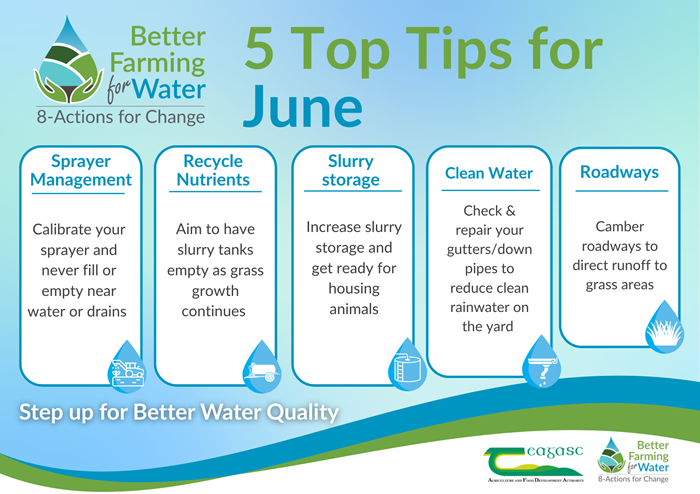
1). Sprayer checks
June is a good time to carry out some in-season checks of sprayers. If you have noticed any changes in spray pattern or think there is damage to any of the nozzles, it would be an opportune time to replace those nozzles and calibrate the sprayer again.
Carrying out a calibration will minimise losses to the environment and minimise losses to your wallet too!
Always make sure to empty the sprayer in a field, applying any of the remainder at a very low rate and without exceeding the label maximum/ha.
Know your buffers and avoid spray drift near waterways. Pesticides are devastating for stream and river ecology, take every precaution to prevent any overland flow or drift entering waterways or drains.
2). Recycle nutrients and use appropriate buffer zones
Like best practice for spraying, slurry applications require obeying appropriate buffers. Slurry for second-cut silage has been applied or will be applied soon. By obeying the 5m buffer (an area where slurry is completely absent) when an unexpected downpour occurs, the buffer will slow down the runoff and even attenuate some of the runoff too.
This will give the local stream and river ecology the best chance at being protected from any harmful material. And don’t forget that it is a requirement for derogation farms to have 50% of slurry applied by the 15th of June. All remaining slurry must be applied by the 1st of October.
3). Slurry storage
The options for managing slurry storage include investing in storage or matching stocking to current storage capacity. New tanks require design, planning permission and financing. All of which must be completed before the storage requirement deadline of 1st October 2028. Note that dairy washings, if stored with slurry, will take up more capacity than expected.
Always prevent clean water entering tanks too. Ultimately, it’s a good idea to keep a buffer of a few extra weeks storage to avoid the pressure of needing to spread slurry early in the year when the risk to rivers and estuaries is high. Keep an eye out for any leaks in the structures also.
4). Clean water
Prevent clean water entering tanks by making sure the roof water and anything that may wash across a clean yard is directed away from tanks or to the ground.
Are the gutters and downpipes all working correctly? Have a look during the next heavy rainfall. Always pipe roof rainwater directly to clean drains or soakaways and not across dirty yards, where it becomes contaminated and needs to be collected.
Additionally, camber or use channels on clean yards so rainfall does not flow into areas where animals have been standing or eating. Regularly check for and repair cracks/broken concrete that let dirty water mix with clean runoff.
5). Cambering farm roadways
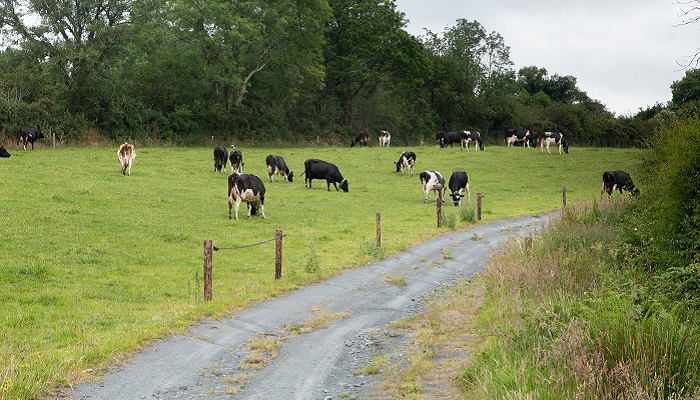
As they are used by animals regularly, livestock roadways are sources of organic manure and urine. Research has found that dairy cows can deposit up to 8 L of urine/manure per day on roadways. That’s technically not a problem for water quality provided there is no pathway for the material to travel. However, heavy showers of rainfall provide an avenue to transport the material to waterways or drains.
Cambering farm roadways is one potential avenue to mitigate this risk. There are two ways to camber a roadway with a cross-fall:
- One-sided slope: minimum 1:25 away from the watercourse.
- Two-sided slope (crowned from centre): minimum 1:15.
This will provide the best chance at steering the runoff material into a grass area or any vegetated area which will slow and attenuate the material and prevent it entering a waterway in substantial quantities.
For more on the Teagasc Better Farming for Water Campaign, visit here.