
Small-scale timber processing – creating new opportunities
Ireland’s forestry sector is evolving. Alongside the established large-scale and technologically advanced sawmilling industry, increasing attention is being given to the opportunities offered by small-scale timber processing, through a recent Today’s Farm Article, John Casey and Kevin O’Connell of the Teagasc Forestry Development Department tell us more.
Clós Adhamid Dhónal Teo
One example of this growing sector is Clós Adhamid Dhónal Teo (Donal’s Sawmill Yard Ltd) in Réidh na nDoirí, Macroom, Co. Cork. It was established in 2021 by the Ó Laoire family and named in memory of Dónal Ó Laoire.
“We recently invested in a modern Wravor sawmill imported from Slovenia, enabling us to process both hardwood and softwood timber for local builders, joiners, furniture makers and farmers,” says Noel O’Laoire.
“We source timber from Coillte, local GP Wood Sawmill and privately owned forests, with Douglas fir and European larch among the principal species.”
Like many small sawmills, the business challenges include securing consistent supplies of quality timber, particularly European larch. However, Douglas fir has become a more readily available resource and offers significant potential for future development.
“Looking ahead, we aim to increase our use of hardwoods from second-thinning forests and plan to invest in a timber drying kiln and moulder to expand value-added processing,” adds Noel.
For the Ó Laoire family, which Noel emphasises is a family business, the enterprise is about more than timber production. It is also about continuing a family legacy while supporting local customers and trades within their community.
Small-scale timber processing offers several advantages for farm forest owners and rural enterprises. Unlike large industrial mills, which depend on high-volume and standardised log supplies, smaller sawmills can process mixed species, irregular log sizes, specialty hardwoods and individual high-quality stems.
This flexibility is, and will be, particularly important in Ireland, where many private forests are relatively small and often contain a mixture of species.
Small sawmills can produce construction timber, cladding, furniture boards, outdoor structures, craft timber and biomass products. Mobile bandsaw mills are also becoming increasingly popular as they allow timber to be processed directly on-site, reducing transport costs and making it easier to utilise selected high-quality stems.
A number of operators are combining sawmilling with drying, woodworking or firewood enterprises, helping maximise timber value and minimise waste.
Irish Sawmillers Guild
An important development has been the establishment of the Irish Sawmillers Guild (ISG) in March 2026. Supported by the North East Forestry Group, the Department of Agriculture, Food and the Marine (DAFM) and Teagasc, the Guild brings together forest owners, sawmillers and timber workers with a shared interest in enhancing the use of Irish timber.
The Guild promotes small-scale sawmilling as a practical opportunity for private forest owners and rural communities. Its objectives include encouraging peer-to-peer learning, improving timber grading and processing standards, developing markets for Irish-grown hardwoods and specialty conifers, and supporting local timber supply chains.
The Guild is already helping to build skills within the sector. A recent two-week timber frame construction course in Gainstown, Co Meath provided hands-on training using locally sourced timber and highlighted the growing potential for value-added wood products.
The initiative builds on previous DAFM-supported projects such as Hardwood Focus, Woodland to Workshop and Adding Value to Our Hardwoods.
Research supporting better future value
Much of the growing interest in timber processing has been supported by research and advisory work carried out by Teagasc and its partners.
Studies have shown that relatively simple management practices such as formative shaping, pruning, final tree selection and timely thinning can have a major influence on future timber quality and value.
This work has highlighted the distinct difference between low-value firewood and higher-quality sawlogs suitable for furniture, joinery, flooring and specialist construction products.
It has encouraged forest owners to view broadleaf and diverse conifer forests not only as environmental assets but also as long-term resources capable of producing valuable timber products.
Ongoing research, such as the Fit Forests project, is also highlighting the adaptation potential of Douglas fir (Pseudotsuga menziesii), Scots pine (Pinus sylvestris), western red cedar (Thuja plicata) and European larch (Larix decidua) for future Irish climatic conditions.
Looking ahead
While challenges remain around timber supply, drying infrastructure, investment and market development, small-scale timber processing is increasingly recognised as an important contributor to rural enterprise, sustainable construction, climate action and forest profitability.
As technical knowledge, collaboration and market awareness continue to improve, small-scale timber processing is likely to become an increasingly important part of Ireland’s developing forest and bioeconomy sector.
“As one of a small cohort of compact sawmills in Ireland, our future is very much geared towards durable tree species and an off-spec service. Like the industry generally we need to continually improve on what we can offer to stay competitive,” concludes Noel O’Laoire.
To access the full edition of Today’s Farm, visit here.
For more from the Teagasc Forestry Development Department, visit here.
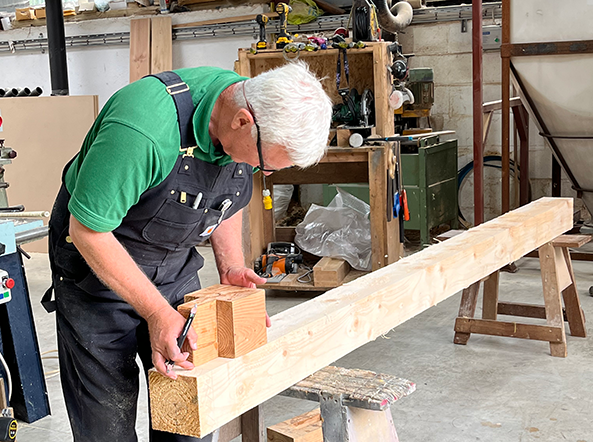
Featured image caption: James Thomson of Thomson Timber demonstrating joint construction to small-sawmill Guild members.