
SoilCycle: Increasing in-crop organic manure applications in tillage crops
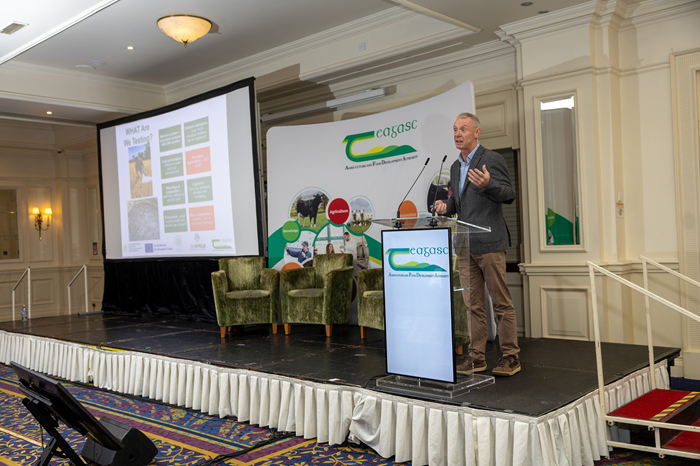
A Teagasc-led project will examine how the in-crop application of organic manures could reduce fertiliser costs, improve soil health and make better use of nutrients on tillage farms.
Launched at the Teagasc National Crops Forum on September 10, Project Leader and Teagasc Crops Specialist, Ciaran Collins provided an overview of the SoilCycle Project, a European Innovation Partnerships (EIP) funded initiative.
Reducing reliance on chemical fertiliser while improving soil health and nutrient-use efficiency are some of the key aims of the SoilCycle Project, Ciaran Collins told the gathered crowd.
“SoilCycle is all about the in-crop application of organic manures,” Ciaran Collins explained, adding: “This is a little bit different from what people would be used to seeing from Teagasc. This is very much a farmer-centred project, and we are building on what farmers are doing already.”
“Without in-crop application, approximately 50% of the cereal area is effectively excluded from organic manure use. In 2026, for instance, there were 135,000 hectares under winter cereals and 132,000 hectares under spring cereals,” Ciaran Collins added.
Leveraging the expertise of farmers who are already using in-crop applications, Ciaran Collins told the conference that a central element of SoilCycle was to capture their experience and make it available to the wider tillage sector. The project will also serve to highlight some of the challenges surrounding in-crop applications.
“The main question is: why isn’t everyone doing it? If you go to your local co-op and buy a bag of fertiliser, you know what you are getting. You spread 1,000 gallons of slurry – whether it is pig slurry, cattle slurry or digestate – and there is always a question mark over what is in it and what results you are going to get from it,” the SoilCycle Project leader explained.
Providing farmers with greater certainty around the nutrient value of different organic manures will therefore be a major part of the project. SoilCycle plans to carry out laboratory analysis on more than 800 organic manure samples.
“This will build a database that provides growers with more accurate data, depending on where the slurry was sourced and the diets of the animals from which it originated. It is about assessing the data and, from a growing point of view, providing information to growers to help them make the best use of organic manures.”
The project will also examine the practicalities of moving organic manures from areas where nutrients may be in surplus to tillage farms. Through the support of focus farmers, contractors, and project partners, Vantage and Vogelsang, SoilCycle will compare the performance of organic manures with conventional chemical fertilisers, and technologies such as yield mapping, precision technology and Near-Infrared Spectroscopy (NIR) to track yields, monitor applications and to provide information on slurry nutrient levels during application, allowing rates to be adjusted more precisely.
For more information, view the presentations from the Teagasc Crops Forum here.