
Spring barley establishment – achieving good plant establishment
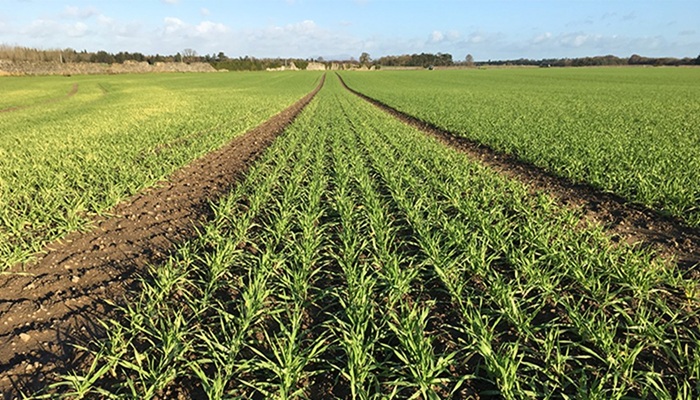
Eoin Lyons, Teagasc Tillage Advisor in Portlaoise, reminds us that paying careful attention to seed establishment is the single most cost-effective way to secure yield and quality in spring barley on Irish tillage farms.
Successful establishment depends on four interlinked elements: an appropriate seeding rate, a well-prepared seedbed, the right target plant population, and correct use of thousand grain weight (TGW) in seed rate calculations. Below I summarise practical guidance, illustrated with examples from Teagasc research and on‑farm experience.
Seeding rates and how to calculate them
Seeding rate should not be a fixed number but calculated each season using seed lot TGW and expected establishment. A simple, reliable approach is:
- Decide on a target plant population (plants/m2) for the variety (see below).
- Estimate establishment percentage (typical 80 – 85% under good seedbed conditions).
- Convert TGW to number of seeds per gram (seeds per kg = 1000/TGW).
- Use the formula: kg/ha = (target plants/m2 × TGW divided by expected establishment
Example: Target 300 plants/m2, TGW 45 g, expected establishment 80% (0.8): kg/ha = (300 × 45) / 0.8 / 100= 168.8 kg/ha.
Practical seeding rate guidance
Teagasc research trials reinforce that target populations vary by season:
- Spring feed and malting barley: target populations (approx. 290 –320 plants/m2) can increase total ear number and yield where lodging risk is low.
- These ranges reflect Irish on‑farm trials at Oak Park and regional sites where variety, soil and seasonal conditions were tested.
- Trials have shown that when establishment is reliable, modest reductions in seed rate (and therefore seed cost) do not always reduce yield.
Seedbed preparation
Seedbed quality drives establishment. Teagasc research emphasises the following principles:
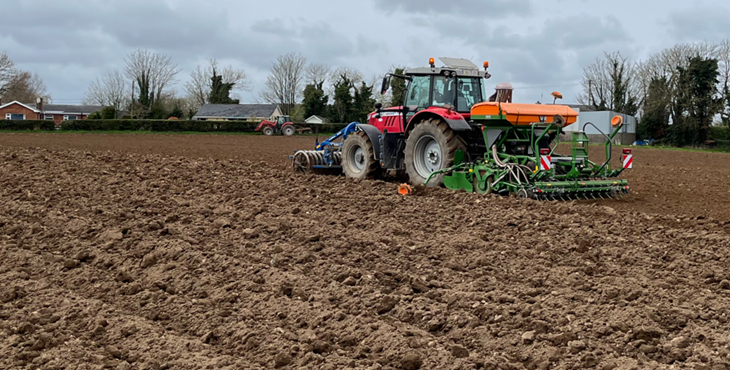
- Aim for a fine, firm, level seedbed with adequate moisture in the top 2–4 cm. This supports uniform sowing depth and rapid, even emergence.
- Avoid excessive tilth which can dry out or crust; consolidation after sowing helps maintain seed–soil contact and improves emergence.
- On heavier soils, a slightly coarser tilth with good consolidation is better than a very fine, loose surface that can crust.
- Time tillage to avoid creating dry surface conditions
Target plant populations and crop management
Decide target populations according to variety (tillering capacity), soil fertility and sowing date; Teagasc field experiments show that:
- Varieties differ in tillering and compensatory ability; newer varieties with strong tillering can be sown at lower rates without yield loss.
- On lighter, drier soils, or on the conservative (higher) target population to offset poor tillering.
- Manage nitrogen and PGRs in line with target populations—higher plant density typically needs careful growth regulation to avoid lodging.
Thousand grain weight (TGW) considerations
TGW varies between seed lots and years. Using the actual TGW of the seed lot (not the catalogue figure) is essential when calculating seed rate. Department of Agriculture, Food and the Marine (DAFM) seed testing services routinely measure TGW and germination for advisory calculations. TGW also influences sowing accuracy: very small seed requires calibration of drills and may be more susceptible to drift during sowing.
Conclusion
For Irish tillage farms, efficient spring barley establishment combines calculated seeding rates (using TGW and realistic establishment percent), an appropriate target plant population for the variety and end‑use, and disciplined seedbed preparation. Where possible, use Teagasc seed testing and variety trial results to refine TGW, establishment assumptions and target populations for your farm. Good establishment pays dividends in yield, grain quality and input efficiency. If you’d like, I can run a seed rate calculation with your TGW, target plants and expected establishment to give a precise kg/ha recommendation.
Eoin Lyons is a Teagasc Tillage Advisor working in the Teagasc Laois/Kildare/Offaly Advisory Region.