
Spring cereals – coping with herbicide resistance
Weed control in spring cereals is a key priority for growers, writes Michael Hennessy, Head of Crops Knowledge Transfer, who shares practical steps growers can take when coping with the challenge of herbicide resistance.
Over the last 30 years, we have had access to some excellent herbicides, which meant many farmers did not have to worry too much about product choice – just one or two key products usually did the job.
The backbone of that control has been the sulfonylurea/ALS group (HRAC Group 2) – products such as Ally Max, Cameo Max and Harmony M. Given how effective these products are, they were relied on to do the heavy lifting of control.
Products in this group act in a similar way, although there are small differences in their relative strengths and weaknesses on particular weeds. Because they share similar mode of action, it was always recommended to apply them with a partner product from a different chemistry group – typically a hormone type herbicide (MCPA, 2,4 D, MCPP, mecoprop, etc.). Some farmers implemented this strategy more consistently than others, and its effectiveness varies by weed species.
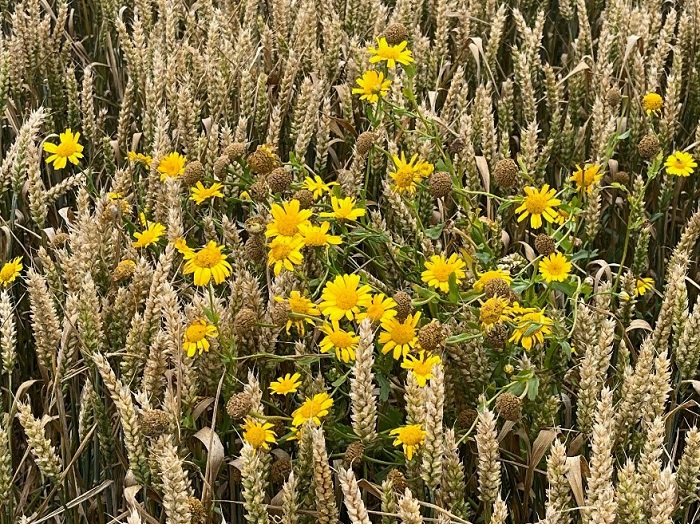
Resistance to the sulfonylurea/ALS products is now widespread. It is very common to find ALS resistant chickweed across many farms. Other resistant broadleaves include corn marigold, poppy, and there are suspected cases in speedwells and other weeds. Where resistance exists, weeds often survive and go on to set seed, making the problem worse year on year.
First steps to identifying resistant weeds in your tillage ground is to check your spray records and review which weeds were poorly controlled: Did you see them flowering or heading in the crop or at harvest? If you took time to identify those problem weeds previously, that knowledge is extremely valuable now. Use those records to build a herbicide programme targeted at the species you failed to control, with the aim of reducing seed return.
Adding a hormone based herbicide to a sulfonylurea can be important for controlling many resistant broadleaved weeds. Examples:
- For chickweed, consider add mecoprop-P(CMPP), fluroxypyr or Pixxaro.
- For resistant poppy populations, Pixxaro, florasulam or MCPA may give control (control is population specific to that field).
- For corn marigold, clopyralid (products such as Gartrel or Galaxy) can be effective.
A few important points
- If a population is already resistant to an ALS herbicide, do not assume another Group 2 product will work – cross resistance within the group is common.
- Confirm the resistance where possible: use bioassays or lab testing through your local diagnostic service or Teagasc advisor to understand the mechanism and likely cross resistance patterns.
- Integrate non-chemical measures (rotation, competitive crops, timely cultivation) and utilise herbicides with genuinely different modes of action rather than switching between similar products.
- Always follow product labels and legal requirements when selecting and mixing herbicides, and seek local advice for tailored control programs.
Further insights
On this episode of the Tillage Edge podcast, Ciaran Collins and Shay Phelan, Tillage Specialists at Teagasc, join Michael Hennessy to explain how to get good weed control in spring cereals, even where resistance is an issue.
Listen in below: