
Suckler breeding season commences
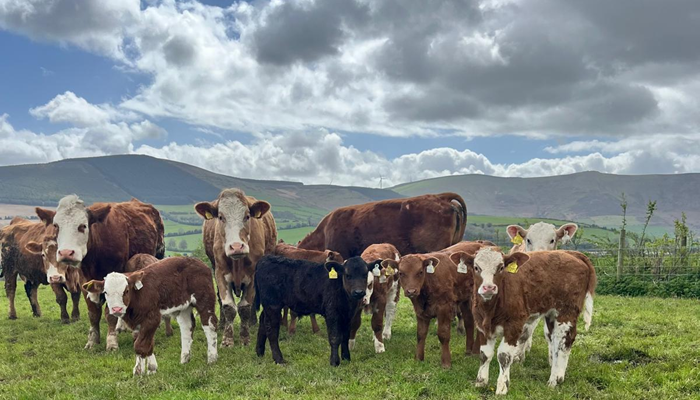
After careful planning this spring, the suckler breeding season on Future Beef Programme participant John Pringle’s farm in Co. Wicklow has commenced. Here, he gives an update on bull team.
The stock bulls began work on 10 May, with the aim of maintaining a compact calving season beginning again in mid-February next year.
Having cows settled at grass and on a rising plane of nutrition before breeding should help strong submission and conception rates. Prior to breeding, mineral testing had shown deficiencies in selenium, iodine and copper. To address this, all cows and heifers received two mineral boluses pre-breeding.
Bluetongue vaccination decision
Given our location on the east coast, I felt it was important to act early on Bluetongue vaccination. I have spent many years breeding the type of cow I want in the herd, and I was not willing to risk potential fertility losses if the disease becomes an issue. The timing of vaccine availability created some extra work, with cattle and sheep in separate groups requiring two doses, but protecting fertility is worth the effort.
AI programme delivered results
Last year, I synchronised the heifers and used fixed-time AI with easy-calving Limousin sires Grenache (6.45% Beef Heifer calving difficulty) and Powerful Proper (7.34% Beef Heifer calving difficulty). Importantly, both bulls had very high reliability figures of 97% and 99% on beef heifer calving difficulty when means I can be sure of an easy calving.
The synchronisation programme worked very well. Heifers calved early, calved down easily and were turned out to grass in small groups. I am going to repeat the synchronisation programme again this year, so the first call is to the AI technician to get the date he can inseminate them and I will work back from there.
Stock bull preparations
I have three stock bulls for the upcoming breeding season, two Simmental bulls and one Limousin bull. To prepare them for work, all three bulls were turned out to grass early to help acclimatise them, improve fitness and ensure they are ready for the breeding season ahead.
They were turned out together as one group. To help reduce fighting and dominance issues, the bulls were drenched in vinegar before turnout. After an initial few hours of sizing each other up, they settled well.
All three bulls are now in good health, moving freely, eating well and vaccinated for Bluetongue. This early management should help ensure bulls are fit, fertile and ready for a busy breeding season.
Stock bull team for 2026
As mentioned earlier, I have spent the last 15 years breeding the type of cow that suits my system. I want a functional, fertile cow that can rear a strong calf each year while also having a good cull value at the end of her productive life.
The key traits I focus on when selecting bulls are carcass weight, milk, daughter calving interval and docility. My target figures are 18–20 kg for carcass, 8 kg+ for milk, and ideally a negative daughter calving interval to help achieve the goal of one calf per cow per year.
The Limousin bull was purchased to introduce more conformation into the bull beef system, while also maintaining milk in the herd. The first of his daughters will be bred this year, so it will be interesting to see how they perform.
Leo is the older Simmental bull. While his figures have reduced somewhat in recent evaluations, he remains a three-star bull and continues to leave excellent calves. However, as I am in SCEP, maintaining star ratings is important, so Leo will be sold after this breeding season.
The newest recruit, Superstar, is a young Simmental bull with strong figures for milk, good carcass traits and, very importantly for my herd, a -2.92-day daughter calving interval, which should help drive fertility performance into the future.
Table 1: Replacement and Terminal Index values of stock bulls
| Replacement Index | Terminal Index | Calving difficulty (%) | Carcass | Milk | Daughter calving interval | Docility | Age at finish | ||
| € | € | Heifers | Cows | Kg | Kg | Days | Stars | Days | |
| Leo (SI) | 96 | 108 | 7.8 | 3.4 | 29.2 | 5.1 | 0.77 | 5 | -4.56 |
| Superstar (SI) | 166 | 103 | 8.2 | 3.2 | 27.1 | 7.70 | -2.92 | 4 | -3.68 |
| Trevor (Lm) | 146 | 131 | 9.1 | 3.9 | 26.4 | 5.6 | 2.82 | 5 | 2.92 |
To keep up to date with the latest happenings from the Teagasc Future Beef Programme, sign up to its monthly e-newsletter here.
Upcoming event
On Friday, 29 May at 6:30pm, John Pringle will host a Future Beef National Farm Walk on his farm at Kilacloran, Aughrim, Co. Wicklow. Eircode: Y14 PT99. John is a participant in the FutureBeef Programme and Signpost Programme.
Topics to be discussed on the evening include:
- Financial
- Breeding
- Calving heifers at 24 months
- Soil fertility and much more.
Refreshments will be served on the evening, kindly sponsored by ABP.
For more on this Future Beef event, visit here.
Watch the video below, where John tells us about his spring performance and outlines the plans for his farm walk on May 29 at 6.30pm: