
Sulphur improves efficiency of Fertiliser N
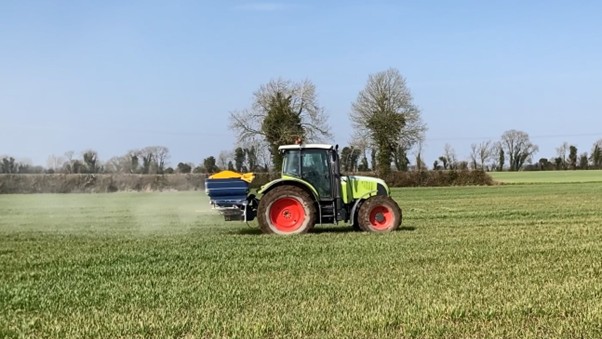
There is an ever increasing need to improve the return from applied fertiliser nitrogen (N) to reduce farm greenhouse gas emissions and improve farm profitability, Mark Plunkett, Specialist on the Teagasc Signpost Programme, tells us more.
With an energy war in progress, fertiliser costs have increased dramatically, as it is a key ingredient in the production process of N fertilisers. We are very dependent on imported chemical fertilisers to fuel both our productive grasslands and cropping systems.
Sulphur (S) is a secondary nutrient, and grass/crops do not have a large requirement compared to the primary nutrient nitrogen (N). Research would show that supplying adequate S can reduce nitrate leaching by up to 22 kg N/ha on grazed swards and up to 50 kg N/ha on silage swards. This results in a more efficient use of applied N while allowing the ability to tailor N rates. With N costs moving towards €2/kg of N, there can be quite significant savings to be made from the application of S.
A sulphur deficiency is quite similar to an N deficiency, as plants show a pale-yellow colour. For S deficiency, the youngest leaves are affected first. This is due to the poor mobility of S in the plant.
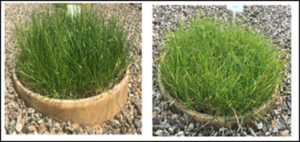
Grass showing S sufficiency (left) & S deficiency (right). Source: P. Forrestal & Claire Aspel, Teagasc, Johnstown Castle.
Sulphur Increases N Uptake & Efficiency
Adequate S is essential for the uptake and efficient use of applied N. Research from Johnstown Castle shows that the addition of S to N fertiliser increased N uptake by 38 kg N/ha (see Figure 1). This resulted in the apparent N recovery increasing from 39% to 49%. Applied S increased N uptake by 38 kg N/ha over the N-only treatment.
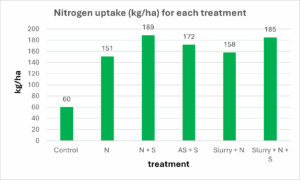
Figure 1: Nitrogen uptake for fertiliser treatments (Aspel et al., 2022).
Sulphur Reduces N Leaching
Research would show that all soils are responsive to S applications. For example, grass yield responses of ~10% are seen on heavy soils (Grange/Johnstown Castle), with up to 43% yield response on lighter soils such as Oak Park and Moorepark-type soils. Figure 2 below shows yield responses to S applications on a sandy loam soil type for fertiliser treatments of 2.6 t DM/ha and for cattle slurry and fertiliser treatments of 2.3 t DM/ha.
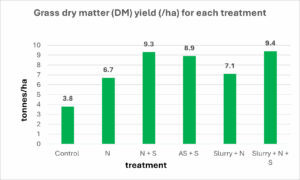
Figure 2: Effect of S on grass yield on a sandy loam (Aspel et al., 2022).
Sulphur Timing & Rates for Grass
For grazing swards, aim to apply 15 to 20 kg S/ha/year depending on the grass production requirements. Aim to apply in 2 to 3 applications on grazing fields between late March and June to coincide with increasing grass nutrient demands. For silage crops, apply 10 to 15 kg S/ha/cut depending on the grass yield potential.
Sulphur Fertilisers
Select a fertiliser with S; for example, fertiliser blends such as 18-6-12+S, 13-6-20+S, and 29-0-14+S are good options for supplying S on a little-and-often basis. For silage swards, protected urea fertilisers such as 38% N + 7% S or 39% N + 6% S are good options to supply S, as cattle slurry contains very little S, with an application of 33 m³/ha (3,000 gallons/ac) supplying ~1.0 kg of available S.
Take care not to over-apply, as it can depress the uptake of selenium (Se) and reduce the uptake of copper by animals in grazing swards.
The research clearly demonstrates the important role of adequate S, at the right rate and time, in increasing the efficiency of applied fertiliser N. This is a key step in reducing farm GHG emissions while lowering costs and improving farm profitability.