
Sustainable upland farming – lessons written on the landscape
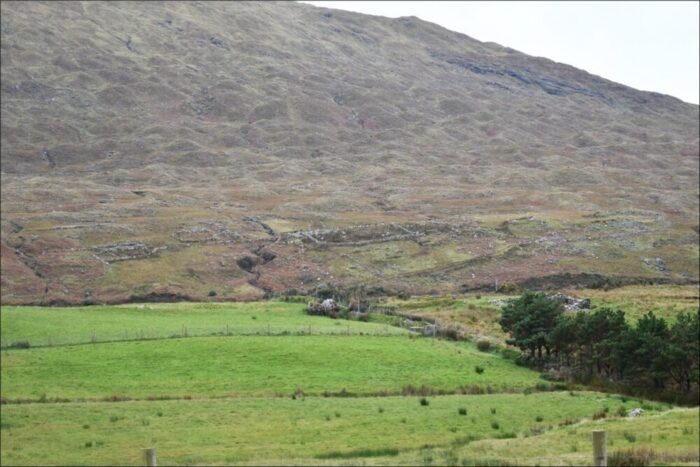
A recently published book, Seventy Years in the Wild West – The Rise and Fall of Ireland’s Largest Sheep Farm, provides a timely reflection on the evolution of upland farming and the lessons it holds for today, Dr. Catherine Keena, Countryside Management Specialist at Teagasc, and Aileen Collery ACRES Donegal shares some reflections.
Written by former Teagasc Hill Sheep Advisor Seán Cadden, who spent almost four decades working with hill farmers in West Mayo, the book charts a period of change across Ireland’s uplands.
Today, as farmers, advisors and policymakers work to develop sustainable grazing systems that meet economic, environmental and social needs, there may be lessons worth revisiting from a long, sometimes overlooked history. For generations, traditional grazing systems shaped both the ecology and the cultural fabric of upland communities.
From Wooded Slopes to Open Hills
By 1600, less than 20% of Ireland was covered in woodland. In Samuel Lewis’ Topographical Dictionary of Mayo, 1837, it was noted that the land cleared from woodland would revert to scrub unless it was browsed by cattle. There was no mention of sheep. In the early 18th century, sheep were likely to be killed by wolves. There were wild goats and deer. Before the famine, cattle were moved through summer pastures in a system of booleying – herded onto the hills where they were milked for drinking and butter-making.
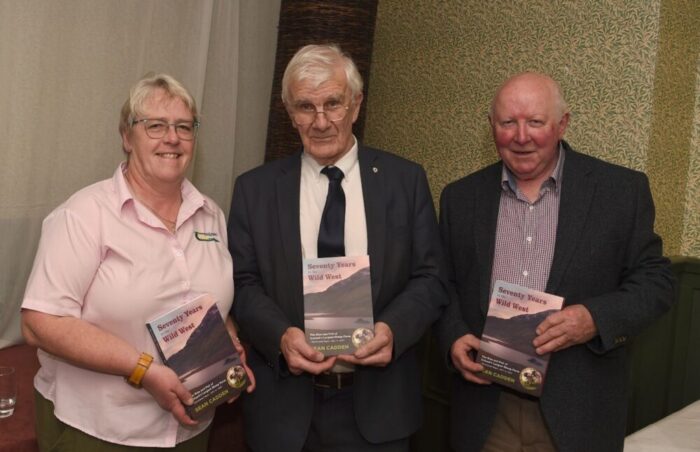
Pictured at the book launch in Westport are: Book Launch in Westport: Catherine Keena Teagasc Countryside Management Specialist, Sean Cadden former Teagasc Hill Sheep Advisor, Martin Gavin Mayo Hill Sheep Farmer
The Scottish system arrives
After the Famine, landlords abandoned the low-output, cattle-based system and instead embraced a new Scottish model, practiced in Scotland for the previous eighty years – built around the hardy Scottish Blackface sheep. From the 1850s onward, large tracts of land in Mayo and Connemara were cleared of tenant farmers and leased to graziers, while in Galway, many locals rented the holdings themselves.
This was a tough, minimalist system. Sheep grazed the hills year-round, receiving no supplementary feed. Losses were high – up to 30% in the first winter for lambs – but once sheep reached a year old, survival improved. Wether (castrated male) lambs grazed the upper slopes. Animal welfare, by modern standards, was extremely poor, and harsh winters brought significant losses.
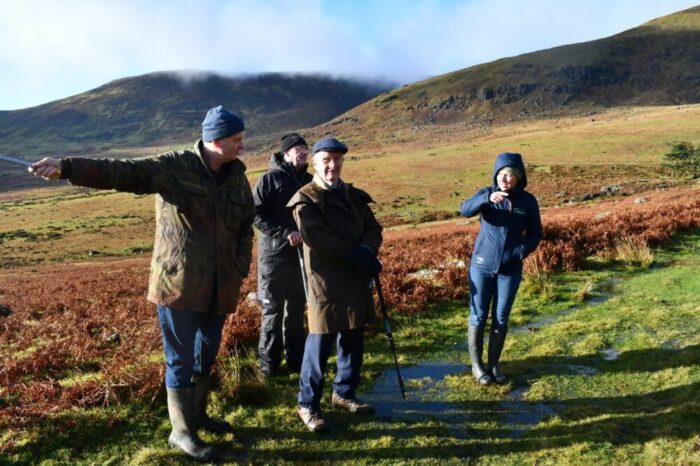
Sean Cadden recently shared his account of how upland grazing systems evolved with the Teagasc Waterford Upland Discussion Group on the Comeraghs. James Walsh, Hill Sheep farmer explaining the farming system on the Comeraghs with Seán Cadden, Catriona Foley, Teagasc Advisor and Brenda O Hanrahan, Ecologist
The system was economically and environmentally sustainable. Demand for mutton from 3-4 year old wethers was strong, and wool was a prized commodity; 700 lbs of wool could fetch £170 in 1900. The removal of 20% – 30% of each year’s growth by grazing maintained the four upland habitats: blanket bog, wet heath, dry heath and upland grassland.
For more than a century, the system persisted, essentially unchanged, as the Congested Districts Board and later the Land Commission divided estates but left most hill ground in commonage.
A turning point in the 1950s
That balance began to shift in the 1950s. Changing markets after the Second World War saw demand move from mutton to lamb, while synthetic fibres reduced the value of wool. By the 1960s, the old model was under pressure, with lambs sold earlier but often too light to meet market requirements.
The response brought rapid transformation. From the late 1950s onwards, policy supports and new technologies introduced what many hill farmers came to know as the ‘three Fs’ – fencing, feeding and fertilising. Fencing schemes enabled better control of grazing and movement to lowland areas. Concentrate feeding improved survival and supported flock expansion. Fertiliser use and land reclamation boosted inbye productivity, creating additional pasture and heavier lambs.
While these measures strengthened farm viability, they also altered long-standing ecological checks and balances. Higher stocking rates and seasonal grazing pressure contributed in some areas to vegetation loss, peat erosion and biodiversity decline – impacts that are still visible in parts of the uplands today.
The experience offers important learning as policymakers and farmers seek to design grazing systems that are economically sustainable and environmentally resilient. Sustainable grazing remains central to maintaining upland habitats, and farmers continue to play a critical role in shaping these landscapes. The past does not provide a ready-made template. However, it underscores the need to balance productivity with ecological limits.
Further insights
As part of the Upland Voices Podcast by ACRES Donegal, Sean Cadden, former Teagasc Hill Sheep Advisor, Catherine Keena, Teagasc Countryside Management Specialist, and Martin Gavin, Hill Sheep farmer Co. Mayo share their perspectives. Access the Upland Voices Podcast by ACRES Donegal here.