
14 July 2023
Take care when working with firewood
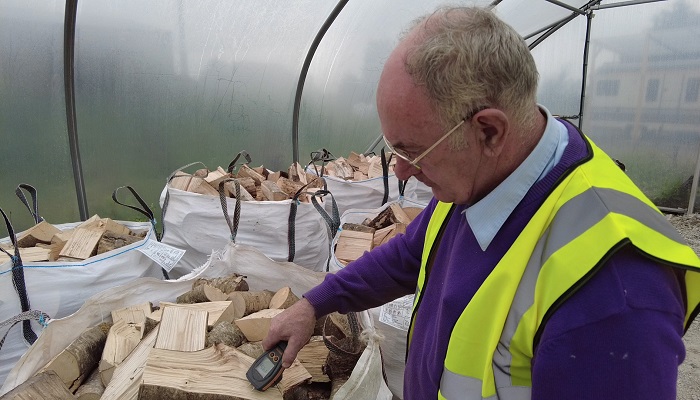
Liam Kelly, Teagasc Forestry Advisor, tells us about potential hazards when working with firewood.
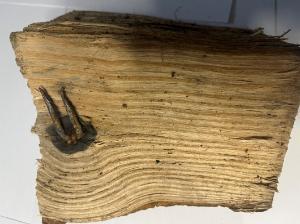
The photographs show a split firewood log of ash, taken from a hedgerow tree. I came across this when handling some firewood logs recently.

Potential hazard
I assume that the tree was from a hedgerow, because barbed wire was stapled to the tree. This got me thinking about the history of this tree.
Obviously, a number of years previously this barbed wire fence had been stapled to this tree to assist with stock fencing. The tree had continued to grow and eventually the wire and staple became imbedded within the trunk of the tree, completely hiding it from sight. The wire and staple could have created a number of health and safety risks and hazards at various stages.
Compromised tree
First of all the wire could have weakened the tree, by cutting off the nutrient supply from the roots to the crown of the tree. This could have led to the death of the tree and or increase the risk that the tree could break off and fall at any time from the point where the wire intersected with the tree.
Working with the tree and its timber
When felling or cross cutting
When felling the tree, the barbed wire could create problems if not seen on the stem of the tree, as it could have caused a risk to the chainsaw operator as the tree was falling
If the chain of the saw had hit this object:
- It could have at the very least have blunted the chainsaw chain, which would have at the very minimum necessitated the sharpening of the chain
- It could have resulted in the chain been ruined beyond repair
- It could have resulted in the chain breaking and causing possible injury to the chainsaw operator or others in the vicinity or further damage to the chainsaw itself. The importance of an effective chain catcher on each saw is important.
When splitting the timber
As the timber had been cut for firewood, the embedded wire and staple could have created a risk at the splitting stage to the operator from either an axe (if used) or a firewood splitter.
When handling the firewood
As stated earlier, I came across this piece of timber when handling some firewood. I was very lucky when I picked up this piece of firewood that this staple did not pierce by skin. If it had, I would have had to seek some immediate medical attention and a tetanus shot. As the staple had become corroded over time, it could allowed such infection into the cut. Tetanus infection can be serious, and even fatal, if not properly treated.
Good Practice
Good Farm Practice
It is not good farm practise to ever staple or attach wire to trees or hedges or any growing vegetation. Thankfully, farm owners are educated and discouraged from such practice nowadays.
Felling licence
The 2014 Forestry Act protects trees; for example, felling trees within a forest requires a felling licence. However, there are certain instances where the felling of a tree is exempted from the need to obtain a tree felling licence (e.g. within 30 metres of a building). Section 19 of the Forestry Act 2014 details the instances where the felling of a tree is exempted. In all cases, it is the responsibility of the landowner or the person felling the tree to ensure that they are acting within the law.
A Guide for landowners to managing Roadside trees
A guide for landowners to manage roadside trees (Department of Agriculture, Food and Marine in association with the Tree Council of Ireland) provides basic information on the benefits of trees and good guidance on how to assess potential risk associated with them.
This is available at https://www.gov.ie/en/publication/8fb45-a-guide-for-landowners-to-managing-roadside-trees/
Chainsaws in good working condition
Chainsaws should never be used unless they are properly serviced, fully functional; chain sharpened and have appropriate safety features in good working order.
Chainsaw Operator Competence
No one should operate a chainsaw unless competent to do so. All operators should have had appropriate training and assessment in how to use a chainsaw safely. A chainsaw should never be operated unless the operator is using the appropriate Personal Protective Equipment (PPE). Remember the PPE is the last line of defence; all other precautions should also be taken on board to ensure that the chainsaw operation is safe.
Risk analysis
All sites and trees should be checked and a risk analysis carried out before any felling or sawing takes place. Always check the tree for potential hazards. All possible dangers should be removed prior to felling or sawing. If the risk is too great, then the sawing operation should not proceed. Never take any risks when working with chainsaws.
Irish Forestry Safety Guides
- 301 – Using Petrol Driven Chainsaws
- 302 – Basic Chainsaw Felling and Manual Takedown
- 303 – Chainsaw Snedding
- 304 – Chainsaw Cross Cutting and Manual stacking
- 306 – Chainsaw Clearance of Windblow
- 307 – Chainsaw Felling of Large Trees
The Irish Forestry Safety Guides, published by the Health and Safety Authority (2018) in association with Teagasc and the Forest Industry Safety Accord, include a number of leaflets on specific operations using chainsaws.
These are available at https://www.hsa.ie/eng/publications_and_forms/publications/agriculture_and_forestry/?pageNumber=1
They also available on the Teagasc Forestry website www.teagasc.ie/forestry or from your local Teagasc Forestry Advisor.
Remember
In summary, firewood is a nice clean product when used sustainably. Always take appropriate care and follow appropriate protocols when working with trees or timber. Only trained competent operators should operate chainsaws and only when it safe to do so.