
06 August 2023
Taking action to reduce the risk of a TB breakdown in dairy herds
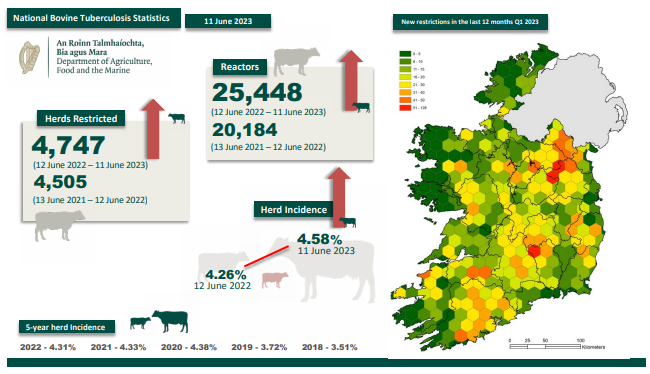
Levels of bovine TB (bTB) have been increasing since 2016. Dairy herds accounted for 35% of TB breakdowns and 58% of TB reactors in 2022. By mid-June 2023, 4.6% of herds had a breakdown in the preceding 12 months, with 25,448 reactors removed in that period.
Until recently, the overall trend was that the number of breakdowns was falling slightly, however, recently herd incidence has begun to increase and aligned with this there has been a substantial increase in reactor numbers; essentially an increasing number of herds with larger breakdowns. These figures are concerning and indicate a need for action by all stakeholders.
Actions that farmers can take to reduce the risk of TB in dairy herds
- Individual farmers can protect their herd from TB by taking steps to address the risk factors for a breakdown. These include:
- Cull any cattle, which were inconclusive at a previous test no later than the end of the current production cycle. Inconclusive cattle are 12-times more likely to be become reactors at a subsequent test.
- Likewise, cull any cattle which had bovine reactions at a previous TB test, these are 4-times more likely to become reactors at a subsequent test.
- Consider culling any older cattle, which were present at a previous restriction, particularly age cohorts of any infected cattle.
- When sourcing breeding replacements, source cattle from herds which have not been restricted in recent years and buy cattle with a recent test date. Cattle exposed to TB recently may have undetected infection and bring the disease into your herd.
- Ideally breed your own replacements to avoid the potential introduction of disease.
- If you haven’t already done so, locate all badger setts on your farm. Notify the Department of Agriculture, Food and the Marine of any setts you find.
- Fence off the setts and latrines to prevent cattle consuming any grass potentially contaminated with TB bacteria (Mycobacterium bovis).
- Raise water and feed troughs to prevent badgers accessing them.
- Do not feed concentrates on the ground, as badger saliva can contaminate the area, when they eat any leftover feed.
- When selecting bulls for breeding, choose those bulls with greater genetic resistance for TB, based on the health traits sub-index of the EBI.
- If your herd is subsequently restricted for TB, this can reduce the number of cattle exposed that become infected.
- Many bulls with historically high EBI figures have inferior TB resistance figures, so it is important that the genetic resistance to TB is improved in the national herd.
- There are still sufficient bulls with both high EBI and good TB resistance figures. Ensure you identify these bulls to increase both the genetic merit of your herd and increase the genetic resistance to TB within your herd.
- Ensure good quality testing facilities and assistance are available for TB tests to ensure the test is carried out properly. Each animal must be identified and have its skin measured on both days of the test.
- If the test is not carried out properly, infection may be missed and this may allow the infection to spread widely before the infection is detected at a later test, resulting in many more reactors than if the disease was detected early.
- Wash and disinfect any machinery and facilities which may be shared with neighbours, as the TB bacteria can survive in the environment and lead to new infections.
- Ensure boundary fences are well maintained to avoid mixing with cattle from other herds.
- If you have your young stock contract-reared, ask the rearer to take steps to reduce the risk of TB and have a contingency plan for a TB breakdown in either herd.
Freedom from TB is important from an international trade perspective, and individual farm profitability. However, the control of bovine TB remains a challenge for the dairy industry. Each TB restriction brings significant financial and emotional challenges for those involved. There can be several risk factors involved in any TB outbreak, which makes dealing with the disease more challenging. By addressing each of the risk factors the likelihood and extent of TB breakdowns can be reduced. This can be achieved by working together.
This article by Damien Barrett, David Quinn, Siobhan Finn, Rosanne Greene and Conor O’Mahony, DAFM, first appeared in the Moorepark 2023 open day book.