

Edited By
Frances McHugh
Forestry Communications and Digital Media Specialist
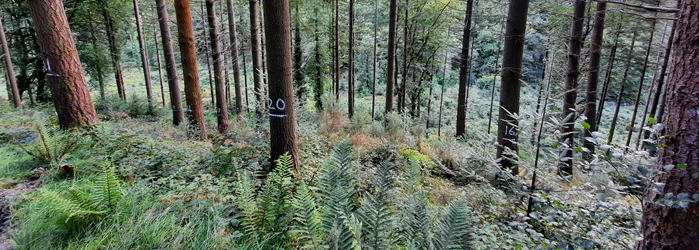
Welcome to the Teagasc March Forestry Advisory Newsletter. In this edition, Teagasc Forestry Communications and Digital Media Specialist, Frances McHugh brings you the latest on planned events, a re-cap on the recent agroforestry webinar, and provides research updates and tips for people considering commencing their forestry journey.
Reforestation after Storm Damage
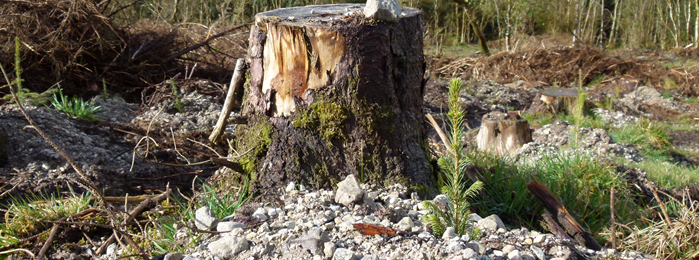
Teagasc is planning two Reforestation after Storm Damage events, following on from the successful Post Storm Timber Harvesting events in 2025.
The first event will be held on Thursday, March 26th, in Mountbellew, County Galway. This is a key event to demonstrate how to plant a new generation of trees and access the attractive supports available.
On the day, attendees will be brought through a forest undergoing replanting following storm damage and will see every stage of the process including discussions on:
- Felling licence and harvesting plans
- Ground preparation for replanting
- Planting and maintenance of new forest
- Outline of recently announced Reconstitution Scheme for Windblow 2026 (RSW)
No registration required:
- Venue: Mountbellew Agricultural College, College Rd, Mountbellew, Co Galway, H53 WE00
- Time: Arrive anytime between 10am and 12pm to be bussed out to local forest site.
- Duration: 2 hours approx. on forest site.
Reconstitution Scheme for Windblow 2026
The Department of Agriculture, Food and the Marine (DAFM) recently launched a Reconstitution Scheme for Windblow 2026 (RSW).
This provides financial support for private forest owners who had storm damage following Storm Darragh and Storm Éowyn during the winter of 2024/2025. Support can be available to applicants with eligible areas for this scheme in the form of fixed rate grants of between €3,858 and €6,744 per hectare, according to the Forest Type(s) appropriate for the reconstitution activities.
Forest owners who have forests that have experienced storm damage are encouraged to attend this event to see what is involved in replanting after storm damage.
Please note: There is another similar event planned for late April. Keep an eye on our website for updates.
Catch up on recent webinar on Agroforestry
Last Friday, February 27th, a webinar highlighting the range of opportunities offered by Agroforestry was held. Speakers included: Minister of State at the Department of Agriculture, Food and the Marine with responsibility for Forestry, Horticulture and Farm Safety, Michael Healy-Rae TD; progressive sheep and tillage farmer, Brian Nicholson; and experienced Teagasc advisors in both agriculture and forestry.
This webinar saw the launch of a video highlighting Brian Nicholson’s Agroforestry Journey, and the pathway of taking his newly established agroforestry from concept to fruition. It also provided plenty of insights on this dynamic approach to integrated farming, which can deliver multiple benefits, achieving a blend of economic, environmental and practical objectives.
The webinar covered the attractive complementary alignment between agroforestry supports and many other farm payments. It also incorporated a live panel discussion which covered many questions around the logistics of getting involved in agroforestry.
Watch the webinar below to hear more about agroforestry, which is garnering strong interest levels as an integrated land use option:
Deciding to make forestry part of your future
Forestry can do great things and bring many benefits – environmental, economic, social, practical – and beyond. However, the decision-making journey to plant is not to be taken lightly. Where this involves a family farm and the next generation, this process requires especially careful consideration, planning and foresight.
This is the journey that Fergal Keaveney and his wife Momo travelled in search of a more sustainable and diverse farming future – one that could offer a fulfilling and more secure lifestyle for them and their two young children.
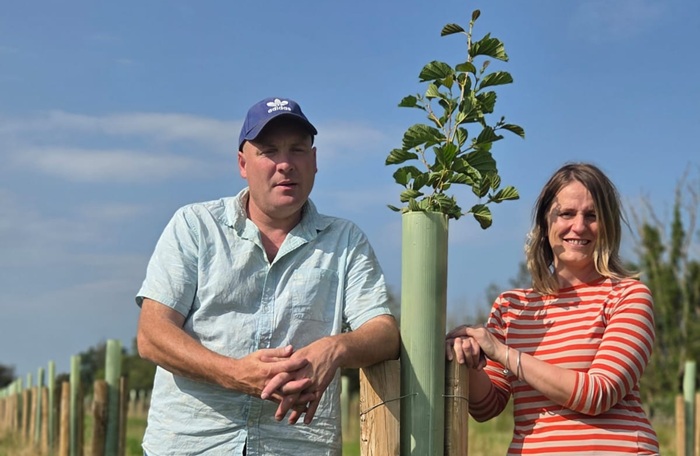
Farming an organic herd of breeding cattle on 55 acres near Athenry, Fergal was dependent on off-farm work to keep the farm viable. He began looking at alternative approaches to farming and lifestyle, and with Momo, their initial ideas about the potential for forestry began to formulate and really began in earnest three years after the birth of their first child.
“We really believed that forestry could offer us a lot – a better work-life balance, lower input costs, income security, keeping the right balance and putting our stamp on the farm,” says Fergal.
For further insights on their story, visit here: Forests for their future
Continuous cover forestry management – an alternative approach
About half of the Irish forest estate is Sitka spruce plantation, an exotic conifer species that has been the mainstay of the forest industry for the last century. These plantations are mainly managed with the clearfell rotation system (plantation is planted, managed, all trees felled at rotation end, replanted), a practice that has built the forest industry to what it is today – productive, multi-functional, sustainable.
However, there is a growing interest in alternative management approaches, such as continuous cover forestry management systems. Continuous cover forestry (CCF) management excludes clearfelling from the system, ensuring that there are always trees and a canopy remaining on the site.
Research into CCF management in Ireland first began in 1998 and much has been learned over the years.
Read more about how this research has developed in Ireland and the hope that this long-term research may continue to attract research funding and produce data and evidence to help inform policy and management guidance.
Continuous cover forestry management – an alternative approach
Sign up to our Teagasc Forestry e-Newsletter
The Teagasc Forestry e-Newsletter will keep you on top of the latest Irish forestry news, give details of all our upcoming forestry events, update you on forestry grants, give valuable forest management tips, research updates and much more via e-mail directly to your inbox.