

Edited By
Ciaran Lynch
Sheep Specialist
Welcome to the Teagasc March Sheep Advisory Newsletter. In this edition, Teagasc Sheep Specialist, Ciaran Lynch brings you timely advice on grassland management, fertiliser applications, lambing and lamb care and flock management.
Grassland
It has been a challenging start to the season and, as a result, grazing management during March will be tricker. The impact on performance will hinge on weather improving as the month progresses. Focus on working with conditions and adapting management where needed while still maintaining key performance targets for March:
- Pre-grazing covers of 1,000–1,200 kg DM/ha (7–8cm) and graze down to a residual of 3.5 to 4cm during the first rotation.
- 60% of the farm grazed by early April, with the first rotation completed by mid-April where ground conditions allow for early March lambing flocks.
Avoid grazing low covers for extended periods. Once sward height drops below 4cm, ewes will struggle to meet daily intake requirements from grass alone, making timely introduction of supplement/concentrate necessary to maintain performance.
Grass being soiled from poaching is an additional complication of the current year. Depending on the farm, it may be necessary to remove ewes from these swards earlier to allow pasture to freshen up before re-grazing.
Establishing a grazing rotation as early as possible is critical. It encourages quicker regrowth on rested paddocks, helps build covers for the second rotation and supports improved sward quality later in the season – something especially important in years when spring growth is lower. With poor grazing conditions on many farms, some may find themselves well ahead of the 60% target. Where this occurs and there are shortfalls, it’s important to introduce concentrate early to meet demand and slow up the rotation.
Fertiliser
The weather has delayed fertiliser application on the vast majority of farms, which will have a knock-on impact on grass growth. Have some fertiliser purchased and in the yard. Once conditions are suitable, aim to spread between 15kg and 25kg N/ha of protected urea (33% to 50% of a bag per acre) depending on demand.
Key considerations before spreading:
- Soil temperature should be at least 6°C and rising to ensure a response.
- Avoid spreading on wet or waterlogged soils, as this risks nitrogen loss and soil damage.
- Ensure at least 48 hours of dry weather is forecast after application.
- Prioritise:
- Driest fields first
- Fields with strong perennial ryegrass content
- Covers above 500 kg DM/ha (5cm)
Lower-cover paddocks are better suited to slurry or farmyard manure (FYM) applications where available, helping recycle nutrients while supporting early-season growth without risking wasted nitrogen.

Investigating health problems
Health issues often increase in the weeks leading up to lambing. If you notice problems such as abortion in ewes or increased mortality during this period:
- Contact your vet promptly to address the issue.
- Submit samples to your local Regional Veterinary Laboratory to identify the cause.
Although some issues may be too late to address during the current lambing season, identifying the cause can help you implement plans to reduce or eliminate its recurrence in future lambing periods.
Flock biosecurity
Every animal introduced to a flock or person working with stock poses a potential risk, particularly during the lambing period when infectious agents are more easily spread.
Important considerations:
- Avoid unnecessary purchases: While buying pet lambs to put on ewes or foster ewes to rear lambs may seem like a quick solution, it can introduce significant health risks. The health of your flock is only as good as the worst flock from which you purchase sheep.
- Protect helpers: Individuals assisting during lambing should use protective equipment (e.g., gloves) to safeguard their health and prevent bringing infectious agents from other farms.
- Maintain Hygiene: Set up proper disinfection points and ensure helpers (e.g. students) use overalls and/or waterproofs on your farm to maintain biosecurity.
Colostrum – get off to the best start
Improve lamb survival and subsequent performance by ensuring adequate colostrum intake. Colostrum serves three main functions in the newborn lamb:
- Provides a dense source of energy and nutrients,
- Source of maternally derived antibodies that provide the lambs with passive immunity
- Acts as a laxative to help clean the digestive tract.
The vast majority of lambs should be vigorous enough to suckle unaided. Where intervention is needed, it’s important that lambs receive sufficient volumes of colostrum. Lambs should receive 50ml per kg within the first 6 hours of life, combining to 200ml per kg within the first 24 hours of life. A guideline amount for lambs is summarised in Table 1. The birth weights are a guide to what the average might be for singles, twins and triplets.
Table 1: Colostrum feeding rates for newborn lambs
| Birth type | Birth weight (kg) | First feed | First 24 hours |
| Single | 6 | 300ml | 1,200ml |
| Twin | 5 | 250ml | 1,000ml |
| Triplet | 4 | 200ml | 800ml |
Where the ewe has insufficient milk, an alternative will be needed. When using this option, it’s vital to ensure that each lamb receives some of its own mother’s colostrum or that of another freshly lambed ewe within the flock. To do so, pool the sample and top it up with the alternative to facilitate transfer of passive immunity. The balance can be made up with one of the following options:
-
- Another freshly lambed ewe
- Cow colostrum (pooled from 2 or more cows at a 20% higher feed rate)
- Colostrum alternatives – follow manufacturer’s instructions
Michael Gottstein, Head of Sheep Knowledge Transfer, talks about the importance of lambs receiving colostrum within the first 6 hours of life in the below video:
Treating hypothermic lambs
When a lamb’s temperature drops below 37°C, its energy reserves are quickly depleted. Blood glucose levels drop and lambs will cease heat production. Without intervention, these lambs will enter a recumbent state, followed by coma and eventually death.
In lambs over 5 hours old that have lost the ability to suck, it is vital that their blood glucose levels are raised rapidly before entering the warming box and/or fed colostrum. If this step is skipped, fatal seizures can occur in the warming box.
Most of the equipment needed will be on hand in the lambing shed, but ensure you have the basic supplies ready: a tub of glucose or dextrose powder, a sterile 60 ml hypodermic syringe, sterile 18–20 gauge needles (1 inch long recommended), and a clean container to mix the solution.
Prepare solution:
- Sterile water – boiled water allowed to cool
- Mix 80ml boiled water with 20g glucose (four heaped teaspoons)
Administration:
- Hold the lamb by its front legs so it is upright, with the belly facing outward
- Dose rate: 10ml per kg bodyweight (e.g. 50ml for 5kg lamb)
- Inject into abdominal cavity using a sterile 18-20 gauge 1 inch needle:
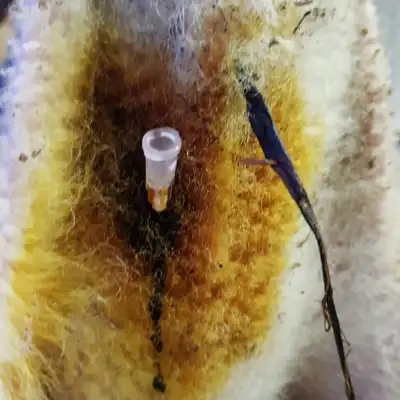
- Injection site: 1 inch below and 1 inch to the side of the navel (see figure 1 below)
- Sterilize injection site with Iodine or similar antiseptic
- Angle needle at 45° aiming towards the base of the tail
- Draw back to check for blood/urine, if present, discard and reposition
- Inject slowly once correctly placed
Aftercare:
- Warm lamb immediately (e.g. warming box/red bulb)
- Feed colostrum/milk once standing
- Investigate the cause e.g. mismothering, lack of milk etc.
Reduce the number of problem ewes in the flock
Having cull tags to hand during the lambing season can be one of the best ways to improve the efficiency of a flock and reduce the labour input. Culling problematic ewes (e.g. ewes with prolapse, poor mothering ability or bottle teats) will help develop a more productive flock long term.
Identifying replacements
For closed flocks, identifying potential replacements should begin at lambing – though for many this starts earlier at ram selection to achieve the desired cross. Choose ewe lambs from easily born litters out of problem-free dams with strong maternal traits. Mark selected lambs early using permanent or temporary management tags to track them through the season. Start early and select plenty – numbers can be refined as the season progresses.
Grass tetany
Grass tetany is a result of low magnesium levels in the blood and mainly affects ewes during early lactation in the spring. The severity of the issue can vary between farms. Bad weather conditions, especially very wet spells, affect the utilisation and intake of grass and the ability of the ewe to absorb nutrients from the grass. Under normal circumstances, ewes require around 1–2g of magnesium per day. In more challenging conditions, however, this requirement may rise to 3–5g/day. Providing extra supplementation during high-risk periods is recommended. The most commonly used methods on farms include:
- Feeding 0.5kg of concentrate containing Cal-mag at a rate of 10kg per tonne.
- Providing high magnesium mineral buckets or blocks. These must be suitable for sheep and placed in sufficient numbers throughout paddocks to allow for better access. Keep mineral buckets free of soil/faecal matter and moistened during dry weather to encourage intake.
The OviCast Podcast
The Teagasc OviCast podcast is presented by Ciaran Lynch and brings you the latest advice, insights and technical updates for the sheep industry. Listen to the latest episodes below or via Apple Podcasts or Spotify
Keep up to date with Teagasc
Teagasc offers a suite of digital products – ranging from insightful podcasts, trusted eNewsletters, social media, website and mobile app channels – to provide you with the latest news, information and knowledge.