
Edited By
Dr Joe Patton
Head of Dairy Knowledge Transfer
Welcome to the Teagasc Dairy Management notes for July. In this edition, Teagasc Head of Dairy Knowledge Transfer, Dr. Joe Patton shares his top five tips for the month ahead, key actions to reduce the number of May calvers next spring, and advice on feeding cows during the peak intake period.
Top 5 tips – July 2026
1). Keep focused on grass
Continue to walk the farm regularly to assess grass availability and quality. Target pre-grazing yield at 1,300 to 1,400 kg DM/ha. Maximising grass quality in front of the herd will maximise yield and allow for savings in concentrate usage. July is your last opportunity to correct quality issues before starting to build grass for autumn.
2). End the breeding season
Cows bred in July will not calve until mid to late April next year. Late-calving cows are less profitable – assess this year’s calving pattern and minimise the late tail on next year’s calving season by sticking to your planned end of breeding season date.
3). Identify paddocks for over sowing with clover
Now is the time to identify paddocks for over sowing with clover next year. Address any weed issues now as many herbicides have a residual effect, making them unsuitable to use shortly before over sowing. Consult soil analysis results and address any issues now. Clover is very sensitive to low pH and phosphorus levels.
4). Have you taken time off this year?
It is important to take time to recharge and spend time with family. Are there ways you can free up more time this summer such as hiring a relief milker more often or considering a more flexible milking system such as 10 in 7?
More information: Mark Treacy, Teagasc Dairy Specialist, looked at the practicalities of 10 in 7 milking in a recent Today’s Farm article (PDF).
5). Think safety
July is statistically one of the most dangerous months of the year. Make safety a priority, with special attention to child safety during the school holiday period.
When will the last cow calve in 2027?
Does any farmer really want May-calving cows? More than likely the answer is no. At the same time, you don’t want a high percentage of empty cows either. Attention should now turn to finishing the breeding season, balancing the empty rate against the length of the calving season.
Actions to reduce the length of the calving spread in 2027 include:
1). Bull power
Work out how many cows will be served by the stock bull. For example, where 100 cows were served to AI and a 50% conception rate was achieved from first service, 50 cows repeat, so 25 cows potentially.
Over a 21-day period, that’s just over one cow per day. On some days, however, 2-3 cows could be in heat. Young bulls will struggle here and cows will be missed. If there is a stock bull with heifers and breeding is around 7-8 weeks than an option could be to remove this bull and use with cows.
If concerned about bull power, another option is to continue to AI along with the stock bull. Alternatively, some farmers have gone 100% AI; however, facilities need to be in place, and the length of the breeding season needs to be short. Some herds are achieving 8 weeks only of breeding with cows and achieving low empty rates.
2). Check any remaining cows not bred
Although it’s getting late, it’s still better to scan and treat any non-cycling cows (these will more than likely be this year’s latest calving cows.) Every few days matters when it comes to decreasing the length of breeding season.
3). Mid-season pregnancy check
Some farmers will complete a mid-season scan for peace of mind. If this provides the confidence to remove the bull or stop AI earlier than normal, that’s a positive.
It may also identify issues such as a higher-than-expected empty rate; a plan can then be developed to optimise in calf rate and length of breeding.
However, whole herd scanning can put additional stress on cows, so consideration needs to be given to its value.
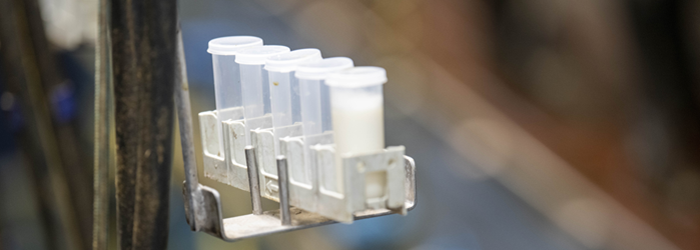
An excellent alternative option is to use July milk recording samples for a mid-season pregnancy check – speak to your milk recording company about it. This milk test is very accurate, but it is recommended to scan any empty cows identified before further treatment, just in case numbers were mixed up during recording (it can happen!).
4). Remove bull from heifers
How many weeks and opportunities have your heifers had to go in calf at this stage? If heifers were synchronised and artificially inseminated on May 1, repeats start back on May 18, June 4 and June 22. By June 22, they’ve had four opportunities to go in calf.
If confirmed in calf from the June 22 serve, the heifer will calve down on April 1, 2027. After this date, it’s getting very late for calving heifers and the opportunity to use your most fertile animals to help maintain your six-week calving rate is reduced.
The table below, based on a 283-day gestation, shows expected calving dates by date of breeding.
| Breeding date | Expected calving date |
| June 15 | March 25 |
| June 22 | April 1 |
| June 29 | April 8 |
| July 6 | April 15 |
| July 13 | April 22 |
| July 20 | April 29 |
| July 27 | May 6 |
| August 3 | May 13 |
| August 10 | May 20 |
| August 15 | May 25 |
In summary, what’s done over the next couple of weeks will dictate next year’s calving spread. Once calving spread goes past 10-11 weeks, fatigue sets in. Workload and the number of tasks increases with longer calving patterns. Pull the breeding end date back by a few days each year and, over time with good management practices, you will have a shorter calving pattern, increased days in milk per year and a more structured workload.
Potash (K) needs to be returned after bales
Good quality silage usually contains about 2.5% K in the dry matter, so a typical surplus bale will remove 5.5kg of K from the paddock. That means that every 90 bales are equivalent to 1 tonne of muriate of potash in terms of K offtakes.
The capability of grass to grow starts below the surface. If the major elements of phosphorus (P) and potassium (K) are compromised, less pasture will be grown. A lot of soils are at index 1 or 2 for K and are therefore deficient in K. This is particularly true of silage ground. However, this is now becoming more common on the grazing area. This is due to three reasons:
- Not enough compound fertiliser is being spread
- Swards harvested for bales (surplus grass) are removing K (every 4 bales/ac removes about 24 units of K)
- Soils deficient in lime will ‘lock-up’ K in the soil
However, there are no regulatory limits on the quantity (or timing) of K applications. There are now many fertiliser products available that have nitrogen (N), K and sulphur (S) with no P, such as 29:0:15+S, that will help replenish K.
Grass allowances
Cows are now well into the peak intake phase of lactation and have passed peak milk solids production. Where grass supply and quality are good on farms, there is opportunity to get more grass dry matter (DM) into cows and to reduce/remove supplement from the diet.
Looking at PastureBase Ireland (PBI) figures through June, grass intakes were set at 15.5kg with 3.5kg concentrate included. This grass intake target is lower than what cows can achieve on good swards (18kg) while still hitting residuals. Grass intakes also stayed fixed on farms, whether grass was in strong surplus or was close to demand.
Does it really matter in terms of herd management, however? A few things are important here:
- When intake is assumed to be 15kg, then 4 cows per ha is assumed to be the correct stocking rate to bring demand to about 60kg DM per ha (4 x 15). However, at an 18kg allowance, demand of 60kg DM is set at about 3.3 cows per ha. Setting a low grass intake may be leading to some farms ‘tightening up’ the rotation and pinching cow intakes as a result.
- Setting grass intake at 15kg is below the true intake capacity of the cow at this point of the year. Does it make sense to underfeed cows when grass is plentiful on the farm?
- PBI figures show that, on average, farms are adding 3.5kg of concentrate to bring intakes up to target. This means that concentrate is being used to fill a ‘grass gap’, even though there may be enough grass on the farm. The economic response will be very poor in this case.
- Some farms are concerned that they will not hit post grazing targets (4cm mid-season) at a higher grass allowance. However, pre-grazing yield and quality will have a huge effect on the capacity of cows to graze down correctly. If covers are too high (+1,500kg DM/ha) and there is more than 3kg of ration being fed, cows will not utilise a higher allowance. On the other hand, tightening cows to force clean out of heavy covers while feeding meal to balance intake is not optimal either. Take out surplus grass and/or poor quality swards for bales to correct grass quality and cows will be able to eat more grass.
The Dairy Edge Podcast
The Dairy Edge is Teagasc’s weekly dairy podcast for farmers. Presented by James Dunne and Stuart Childs, Teagasc Dairy Specialists, the podcasts will cover the latest information, insights and opinion to improve your dairy farm performance.
Listen to recent shows from the Dairy Edge podcast below:
Keep up to date with Teagasc
Teagasc offers a suite of digital products – ranging from insightful podcasts, trusted eNewsletters, social media, website and mobile app channels – to provide you with the latest news, information and knowledge.