

Edited By
Dr Joe Patton
Head of Dairy Knowledge Transfer
Welcome to the Teagasc Dairy Management Notes for June. In this edition, Teagasc Head of Dairy Knowledge Transfer, Dr Joe Patton shares his top five tips for the month ahead, offers advice to farmers on benchmarking the efficiency of milk production from grass and examines the role of and examines the role of 10-in-7 milking as a potential labour saver on farm.
Top 5 tips June 2026
- High quality pasture is vital for maintaining milk yield and maximising milk protein percentage. Aim to provide cows with 1,400 kg DM/ha leafy grass covers. Walk the farm regularly and remove heavier covers as baled silage where there is surplus grass on the farm, as soon as possible, to ensure these paddocks are available again for the next rotation.
- As we approach the halfway point in the 2026 breeding season on many farms, all eligible cows should have been submitted for breeding by week 6. Check any cows not submitted immediately and treat as needed.
- Are your liners due a change? Milking machine liners should be changed every 6 months or after 2,000 milkings (whichever comes first). If miking 6 rows or more, you will reach 2,000 milkings in less than 6 months.
- First-cut silage crops have yielded quite well this year; however, it’s usually second cut that makes the difference between being secure for winter feed or not. Complete a winter fodder budget and put a plan in place where stocks are low. Sourcing additional area for second cut silage or reducing planned winter stock numbers should be considered where there is a deficit.
- Monitor this year’s reseeds and spray with a post-emergence herbicide as soon as the sward is suitable for spraying. Grass plants should have 3 true leaves, and clover plants should be at the 3 trifoliate leaf stage. This is your best opportunity to kill seedling docks in a reseed.

Grass management targets for June
The key objective over the coming weeks will be to maintain an adequate supply of high-quality grass ahead of the herd.
Mid-season grazing targets:
- Target Rotation Length: 18-20 days
- Pre Grazing Yield: 1,400kg DM/ha
- Average Farm Cover: 650-700kg DM/ha
- Farm Cover per cow: 160-180kg DM/cow
- Post grazing height: 4cm
It is very important to keep a focus on grass quality as we come into the month of June. Grass quality in June can be poor due to increased stem content. This will decrease the digestibility of the grass. Grass stem is also difficult for the cows to graze. Therefore, the energy intake of the cow will decrease and, as a result, reduce cow performance. However, with the right approach to grazing management and using the above mid-Season grazing targets, high-quality leafy grass can be maintained throughout the season.
Clover
In the summer, where sward clover content is greater than 20-25%, nitrogen (N) fertiliser application can be reduced. If you have paddocks with high levels of clover, consider reducing N input by applying soiled water to these paddocks.

Benchmarking your efficiency of milk from grass
As we move into the main grass growing season and the weather seems to have settled to more favourable conditions, now is the time to produce your most efficient milk. We already know milk markets are depressed and the effects of international conflicts could add at least 4c/L to your cost of production in 2026. So, we need maximise our peak milk months to produce as much milk as possible from efficient use of grass.
We have seen over many years that grass utilised per hectare in combination with low costs per kilogramme of milk solids are the main drivers of profit on dairy farms, much more so than output per cow. These figures are calculated on an annual basis.
It is also useful, however, to look at measures of efficiency at a point in time to ‘check in’ on how the farm is performing on a week-to-week basis. Often it is tempting just to look at milk yield per cow. However, this can give a very misleading picture of the farm’s true economic performance if the feed input side is not also considered.
To examine efficiency in more detail, we can use a metric of imported feed per kg of solids. This tells how much imported feed is being fed to produce a kg of milk solids sold off the farm.
To do the calculation for yourself you can take your cow’s daily milk solids production (milk litres/cow/day x 1.03 x (fat % + protein %).
- So, for example a herd doing 28 litres at 3.65% protein and 4.3% fat would produce:
- ((28 x 1.03) x (3.65 + 4.3)) = 2.16 kg MS/cow/day.
- If the herd is getting 3kg meal/day, then we convert to dry matter (DM) by multiplying by 0.88:
- (3 x 0.88) = 2.64 kg imported DM/cow/day
- If we divide the imported feed by the milk solids production, it will give us how many kg imported DM/kg milk solids.
- (2.65/2.16) = 1.23 kg DM/Kg milk solids (MS).
A lower figure shows that the farm is getting more of its output from pasture, which is very positive from a cost perspective.
The most efficient farmers will, on average, produce at <1kg DM/kg MS on average over the grazing season. A low figure indicates that you are maximising the amount of grazed grass going into your herd. This can improve grass utilised per hectare and, ultimately, farm profitability.
If your figure is high, it is worth asking a few questions. Are you feeding too much supplement per day? Is this due to a grass shortage? Or is grass quality an issue on your farm? While this is not the only measure of farm performance, tracking it over a period of time can give a better indication of performance than looking at output only. Do your sums today and see how your own farm fares out.
Should you consider 10-in-7 milking?
Ten-in-seven (10-in-7) milking is an attractive option for dairy farmers looking to improve work-life balance. The system involves milking cows 10 times over seven days instead of the normal 14 milkings with twice-a-day (TAD) milking. This gives farmers two evenings off each week while still maintaining regular milking intervals. For many farms, this can greatly improve lifestyle and reduce labour pressure.
Table 1: Example of a 10-in-7 milking schedule
| Monday | Tuesday | Wednesday | Thursday | Friday | Saturday | Sunday | |
| AM | 7:00 | 9:00 | 7:00 | 9:00 | 7:00 | 9:00 | 7:00 |
| PM | 15:00 | 15:00 | 15:00 |
A Moorepark study compared cows milked TAD with cows on 10-in-7 for either the full lactation or during late lactation only. Cows on full-season 10-in-7 produced 49kg less milk solids per cow over the lactation compared with TAD cows. However, where cows changed from TAD to 10-in-7 after mid-lactation, the reduction was much smaller at only 4kg milk solids per cow.
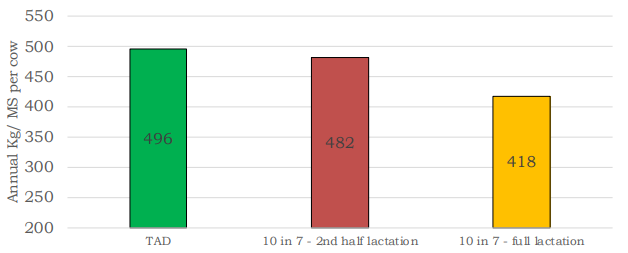
The results show that using 10-in-7 later in the season can offer major lifestyle benefits without significant production loss. Farmers who may be considering a change to 10-in-7 should only do so where herd SCC is consistently below <120,000 cells/ml.
The Dairy Edge Podcast
The Dairy Edge is Teagasc’s weekly dairy podcast for farmers. Presented by James Dunne and Stuart Childs, Teagasc Dairy Specialists, the podcasts will cover the latest information, insights and opinion to improve your dairy farm performance.
Listen to recent shows from the Dairy Edge podcast below:
Keep up to date with Teagasc
Teagasc offers a suite of digital products – ranging from insightful podcasts, trusted eNewsletters, social media, website and mobile app channels – to provide you with the latest news, information and knowledge.