

Edited By
Dr Siobhán Kavanagh
Signpost Programme Communications and Engagement Specialist
Welcome to the Teagasc May Environmental Advisory Newsletter. As summer farming activity increases across the country, June provides an important opportunity to focus on grassland management, nutrient efficiency and sustainable farming practices that deliver benefits both on the farm and for the wider environment.
In this issue, compiled by Signpost Communications Specialist, Dr Siobhán Kavanagh, we explore the importance of managing extensively grazed pastures for biodiversity, outline key water protection measures from the Better Farming for Water campaign, and highlight the value of making every opportunity count when applying lime.
Managing extensively grazed pasture
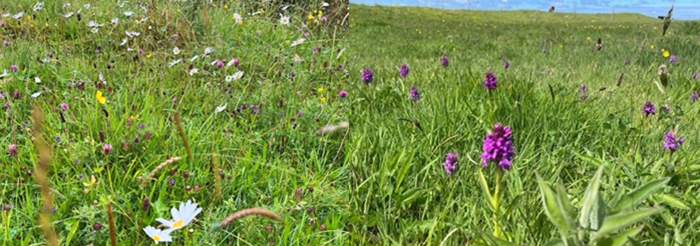
June is one of the most important months of the year for Ireland’s extensively managed grasslands. Across the country, grasses and wildflowers are now flowering and setting seed, creating valuable habitat and food sources for bees, butterflies, hoverflies and many other insects. These insects in turn support birds and wider farmland wildlife.
Why no topping before July?
Under the ACRES Extensively Grazed Pasture measure, mowing or topping is not permitted before 1 July. This short delay gives plants time to complete their natural lifecycle and helps maintain the diversity of species found in these grasslands. While fields may appear ‘untidy’ during June, they are often at their richest from a biodiversity perspective.
Different grasslands, different roles
Irish farms contain a range of grassland types, all serving different purposes.
Highly productive ryegrass and multispecies swards are essential for livestock production and high-quality feed. Alongside these, extensively grazed grasslands support a much wider variety of grasses, flowers and insects.
Both systems have an important place on Irish farms and can work successfully side by side within the same landscape.
Extensive management still needs management
Extensively managed grasslands are not ‘left alone’ areas. Active grazing management remains important to maintain their environmental value and prevent them becoming overgrown or dominated by scrub. Lower fertiliser use and limited herbicide application allow more plant species to thrive, improving habitat quality across the farm.
Farmers delivering for biodiversity
The scale of farmer participation is significant. Under ACRES, more than 210,000 hectares have been entered into the Extensively Grazed Pasture measure, while over 450,000 hectares are receiving results-based payments linked to biodiversity value. This reflects the growing role farmers are playing in supporting biodiversity while continuing to produce food.
Delaying topping or cutting until July may require a little patience, but the benefits for pollinators, wildlife and the farming environment are substantial.
Better Farming for Water – 5 Top Tips
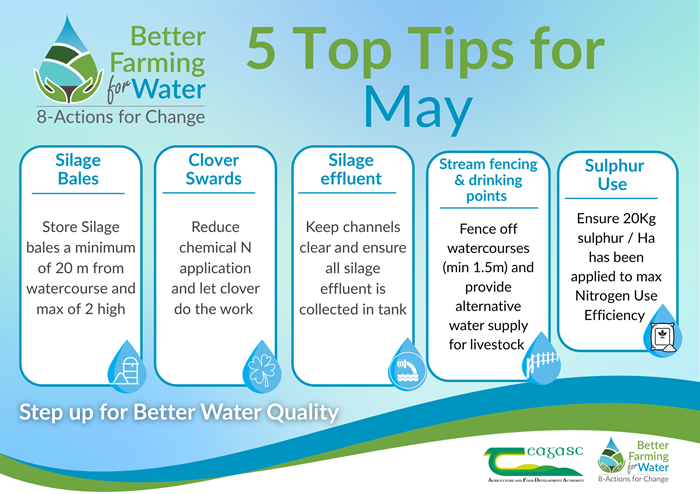
Improving water quality is a key priority for Irish agriculture, and the Better Farming for Water Campaign highlights simple, practical steps that farmers can take to protect rivers and streams. The ‘5 Top Tips’ focus on everyday farm management actions that can significantly reduce pollution risks while maintaining productivity.
1). Correct storage of silage bales
One important measure is the correct storage of silage bales. Bales should be stored at least 20 metres away from any watercourse. This reduces the risk of leachate entering nearby streams or rivers, particularly during heavy rainfall. Wilt to reduce effluent production, store max of 2 high and all effluent produced must be collected and stored. Poorly located bales can release harmful runoff, which can quickly impact water quality.
2). Clover swards
Another key recommendation is the use of clover swards. By incorporating clover into grassland, farmers can reduce their reliance on chemical nitrogen fertilisers.
Clover naturally fixes nitrogen from the atmosphere, improving soil fertility in a more sustainable way. This not only lowers input costs but also reduces the risk of excess nitrogen being washed into waterways. Once clover is established, farmers should adjust and reduce chemical nitrogen applications, particularly in the main growing season (late spring to summer), because clover contributes biologically fixed nitrogen to the sward.
3). Managing silage effluent
Managing silage effluent is also critical. Silage effluent is highly polluting and must be carefully controlled. Farmers are advised to keep channels clear and ensure that all effluent is properly collected in storage tanks. Any overflow or leakage can have serious consequences for aquatic ecosystems, leading to oxygen depletion and harm to fish and other organisms.
Ensure grass is kept inside the channels when being ensiled. Ensure tanks are emptied so that there is sufficient storage for the effluent. Also, it is critical that you check the silage base for its structural soundness, silage pits must be leakproof and fit for purpose
4). Stream fencing and proper drinking points
Protecting watercourses through stream fencing and proper drinking points is another effective step. Fencing off streams with a minimum buffer of 1.5 metres prevents livestock from entering the water, which reduces bank erosion and direct contamination from animal waste. Providing alternative drinking points ensures animals still have access to water without damaging the stream environment.
5). Use sulphur
Finally, the correct use of sulphur is essential for improving nitrogen use efficiency. Applying 20kg of sulphur per hectare helps crops utilise nitrogen more effectively, reducing the likelihood of excess nutrients being lost to waterways. Efficient nutrient use is a key part of sustainable farming and water protection.
In conclusion, these five practical actions show how small changes in farm management can make a big difference. By carefully managing nutrients, protecting watercourses and handling silage responsibly, farmers can play a vital role in improving and maintaining water quality across the country.
Silage cut, stock moved, seed sown — spread lime before moving on
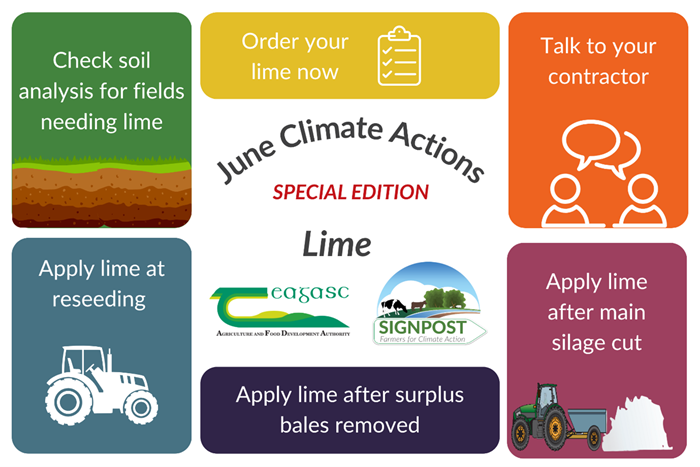
Each month, the Teagasc Signpost Programme shares six climate action tips for the month ahead. This month, the focus is on lime, you should:
- Check your soil analysis and identify the fields that need lime.
- Order your lime now to be ready for the season ahead.
- Talk to your contractor early to plan lime application.
- Apply lime when reseeding to improve soil fertility and grass growth.
- Apply lime after the main silage cut to maximise nutrient availability.
- Apply lime after surplus bales are removed to make the most of every opportunity.
In the below video from Grolime, Teagasc Soil and Plant Nutrition Specialist, Dr. Veronica Nyhan answers some of the frequently asked questions on lime:
Diary dates
Farming for a Better Future 2026
Join us on Wednesday, 10th June at Teagasc, Johnstown Castle, Co. Wexford for a Farming for a Better Future 2026 event.
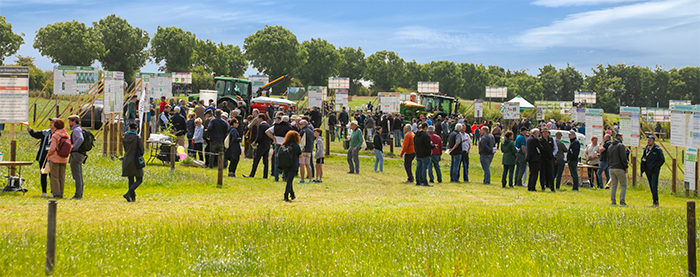
The theme of this year’s open day is‘Innovating for Healthy Soils and Clean Water’ and will focus on protecting soil health and improving water quality at the farm systems level. The Open Day will demonstrate how to build resilient soils and improve water quality across dairy-beef, organic, spring and winter milk and tillage farming systems.
For further details, visit here.
A Somers Evening Farm Walk
Join us on Wednesday, 17 June at 6:30pm for a Somers Evening Farm Walk – Tillage Farming and Nature Working Together in Oylgate, Co. Wexford, Y21 TR80.

Hosted by Don Somers, from Oylegate, Co. Wexford – overall winner of the Teagasc FBD Environmental Sustainability Award 2025 and winner of the water quality category – this event offers a behind-the-scenes look at a working tillage farm leading the way in sustainability.