
Teagasc Forestry Supporting Transferring the Family Farm Clinic Series

Next week, Teagasc commences its annual series of Transferring the Family Farm clinics. These highly popular events are invaluable for gaining insights into the process of family farm transfer and key aspects that need to be considered. Tom Houlihan tells us more on supports that will be available, including those addressing forestry queries.
The Transferring the Family Farm clinic series will build on the recent highly successful Generational Renewal Week, organised by Teagasc in early September. Farming families are strongly encouraged to participate and make the most of these current free clinics where they will get the opportunity to talk to a diverse range of experts. The series kicks off in the Ardboyne Hotel, Navan, Co. Meath, next Tuesday, October 6, commencing at 10.00am. Further events are being held around the country up to November 4th.
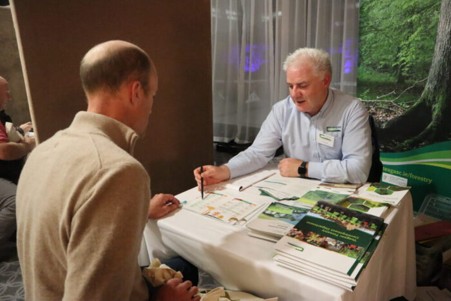
For example, each Transferring the Family Farm clinic will be supported by a team of local solicitors, accountants, mediators and Teagasc advisors who will be very happy to answer one-to-one queries of attendees in confidence. The Citizens Information Board will provide information on topics such as pensions, the Fair Deal Scheme and state entitlements. The Department of Agriculture Food and the Marine will support queries on important areas such as registered farm partnerships.
Forestry queries
Teagasc Forestry Advisors will also be on hand to address queries on a range of forestry related issues. These may include questions on forestry taxation or indeed supports available for land use planning on inherited lands.
The transfer of a growing crop of trees can be very favourable from a tax efficiency perspective. For example, while commercial woodlands in the State are subject to Capital Acquisition Tax (on inheritance or gifts), they can also qualify for very significant reliefs e.g. Agricultural Relief as Agricultural Property. Subject to meeting relevant criteria, Agricultural Relief can allow a 90% write down in the value for eligible applicants. Business Relief may be a consideration in some cases.
In terms of Stamp Duty, trees are not deemed liable for stamp duty if they are ‘growing on a substantial part of the land which is deemed as 75% of that land i.e. 75% under trees. In some cases, a separate deed containing forestry may be an option/required. This is an important issue that should be considered.
With Capital taxes, you are generally splitting the cost between the land and the trees, and it is important, when involved in forest valuation, to go to a qualified practitioner who is familiar with this and who specialises in it.
Supports for new forests
With the new tree planting season imminent, it is well worth investigating the Department of Agriculture, Food and the Marine’s Forestry Programme. This includes strong financial incentives for the variety of forest options available (known as Forest Types), each with its own silvicultural, environmental and practical objectives. There are planting options suitable for all farms and holdings, regardless of enterprise or scale. These include native woodland, agroforestry (combining farming and trees in the same fields) and the more commercially focused conifer and broadleaf options. There are also attractive options for planting smaller areas under the new Native Tree Area (NTA) Scheme.
The Transferring the Family Farm clinics series provide a great opportunity to avail of comprehensive, objective and up-to-date information for farm families, including those planning to navigate the complexities of succession. With a range of diverse supports available, your local clinic is certainly not to be missed!