
15 February 2023
Teagasc Grange suckler research herd management notes February 2023
The suckler beef research herd at Teagasc Grange comprises of 170 spring-calving cows made up of 2 cow breed types; Simmental x Limousin and Limousin x Holstein-Friesian (½ beef, ½ dairy).
This herd of cows is assigned to two experiments; the Derrypatrick study and the Maternal study. In 2023 the current phases of each study is coming to an end. This week’s notes will focus on the yearling performance of the final phase of the current Derrypatrick Herd study and will introduce the new suckler calf-to-beef clover experiment which is commencing this spring.
Derrypatrick Herd
- The Derrypatrick suckler to beef research herd has a land area of 162 acres (65 ha).
- The previous study which is coming to completion in 2023 focussed on a comparison of the progeny of sires divergent in maternal traits. This study was predominantly based on Limousin x Holstein-Friesian and Simmental x Limousin cows.
- The Derrypatrick male and heifer weanlings were housed on the 22nd November 2022
- The steers were housed at 354 kg (average daily gain of 1.16 kg from birth to housing).
- The heifers were housed at 318 kg (average daily gain of 1.04 kg from birth to housing).
- During the winter period all the yearling animals received 78% DMD silage ab-lib along with 1.5 kg of concentrates per day.
- After a 64 day winter housing period the Derrypatrick heifers were turn out to grass on the 25th January 2023.
- On average each heifer consumed 96 kg of concentrates over the 64 days.
- The short winter will decrease feed and slurry handling costs.
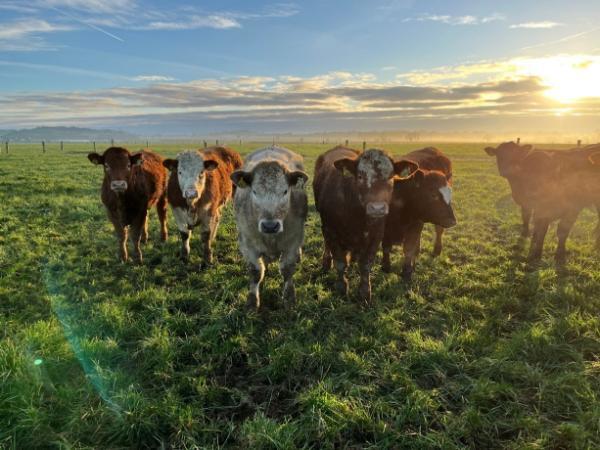
Derrypatrick heifers at grass after only 64 days of a winter housing period
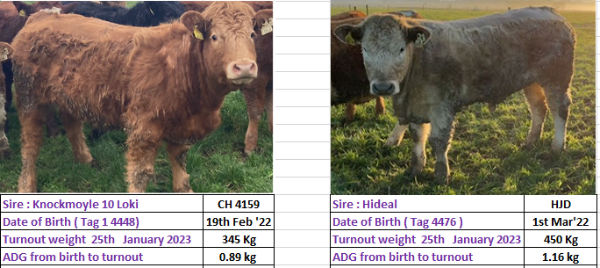
Derrypatrick slaughter performance
Forty-two heifers were slaughtered between 4th October and 16th January. Forty-six steers have been drafted for slaughtered since 25th October, with the remaining six steers going for slaughter next week. The 2022/2023 slaughter performance to date is outlined in the below table.
| 2022 / 2023 Slaughter Results | ||
| Heifers | Steers | |
| Average age at slaughter |
21.0 months |
22.1 months |
| Slaughter weight | 608 kg | 685 kg |
| Carcass weight | 343 kg | 388 kg |
| Kill-out | 55 % | 57 % |
| Conformation | U – | R + |
| Fat | 3 + | 3 + |
| Average price | €5.40/kg | €5.40/kg |
| Average carcass value | €1,850 | €2,094 |
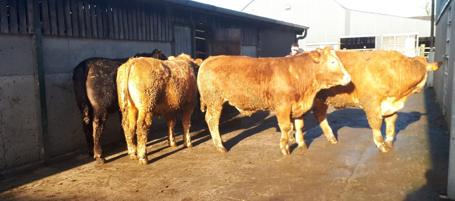
Steer during the indoor finishing winter
General overview of the 2023 research experiment (Suckler calf-to-beef clover experiment)
- The new research suckler systems study will operate at a stocking rate of 2.2 LU/ha (170 kg organic N/ha).
- It will comprise of a spring calving calf-to-beef system with heifers slaughtered off grass at 20 months of age and steers slaughtered at 20-22 months of age.
The objective of the study is:
- To develop a low nitrogen (N) input (< 75 kg N/ha or 60 units/acre), high clover system.
- Reduce age of slaughter and concentrates input
- Encourage clover uptake nationally
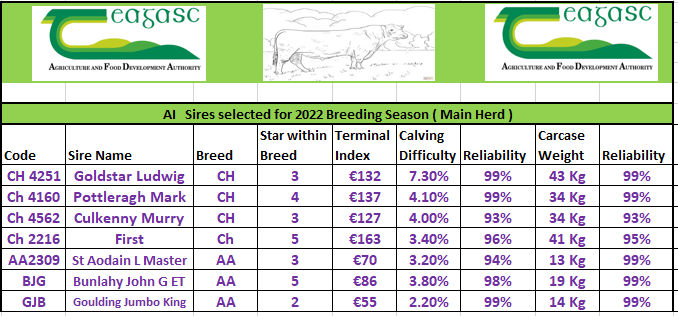
- There are 80 cows (including heifers) to calve down this year on the research study and all of the cows are in-calf to Charolais and Angus sire breeds.
- Bulls were selected primarily on their “fleshing ability” i.e. fat cover
- The below table is the list of sire used for the breeding season in spring 2022.

- The farm has just commenced the 2023 calving season:
- All in-calf cows are in good health and body condition and have received their Rotavec Corona vaccination.
- 93% of the herd is expected to calve within the first 6 weeks of the calving season
- All the cows are receiving their pre-calving minerals through the water trough drinke
- All cows have access to 65 % DMD silage which is restricted at night
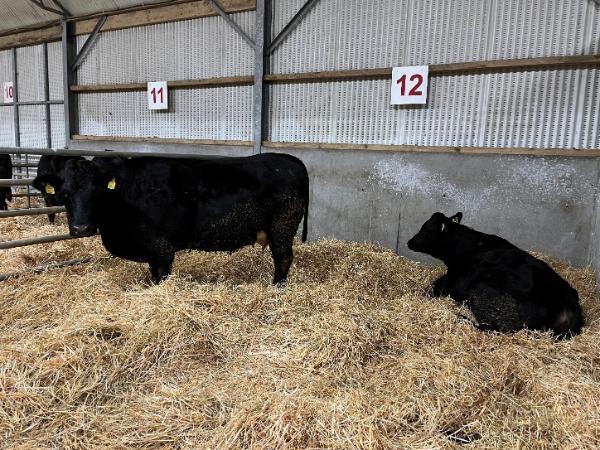
A selection of maiden in-calf heifers also on 65% DMD silage
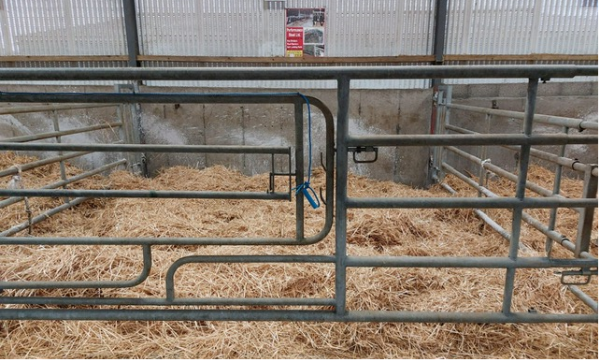
Calving pens disinfected and bedded prior to calving
- All the calving sheds and holding pens have been washed and disinfected (Omnicox).
- All the calving material and equipment has been set up alongside the calving pens.
- To date 10 calves have been born between cows and heifers with no calving difficulty to report
- There was 1 pre-mature calf on 25th January (born 2 ½ weeks early), but the calf is doing fine now.
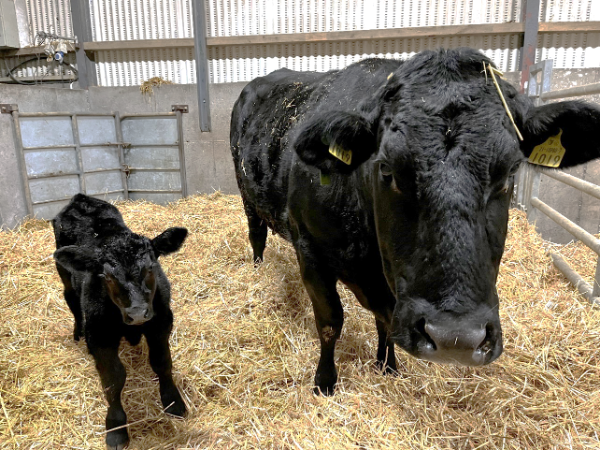
First calf on the farm (GJB sire). The mother is an 8thcalver. Photo taken when calf was just a few hours old.
Grassland management update
| Suckler calf-to-beef clover experiment | |
| Average farm cover | 886 kg/DM/Ha |
| Over winter growth (kg/DM/Ha) | 4 kg DM/Ha |
Cover taken on the 01/02/2023
- The farm will be spreading half a bag of protected urea/acre (22 units/acre) towards the end of February (if conditions allow).
- Soil samples were sent off for testing at the start of January.
- Cows and calves will be turned out to paddocks surrounding the farmyard for ease of access and shelter. First calving heifers will be prioritised at turnout.
- Weanling heifers are currently grazing silage swards which are due to be cut in mid-late May. The aim is to graze any medium to heavy covers (700 – 1500 kg DM/ha) on these ‘early-cut’ silage fields and close them off as soon as possible. 2500 gallons/acre of slurry will be applied to these fields post-grazing.