
17 January 2025
Teagasc – supporting decision making on forestry options in 2025
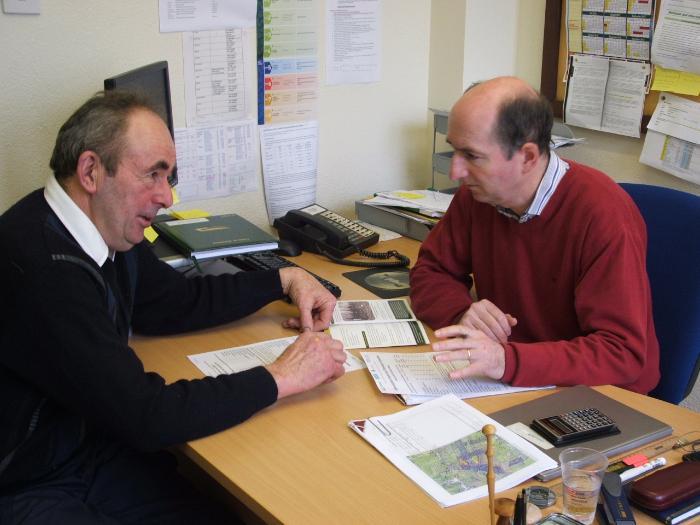
Well planned forestry can provide financial, environmental and social benefits for farmers and landowners.
In this article, Teagasc Forestry Specialist, Tom Houlihan looks at an example of the financial supports available for one of the attractive “Forest Types” under the Department of Agriculture, Food and the Marine’s Afforestation Scheme.
He also reminds readers of excellent decision support opportunities to be availed of at the upcoming series of forestry one-to-one clinics.
Under the current Forestry Programme, a range of planting options and forestry support measures are available. Farmers and landowners considering such options can sit down with their local forestry advisor and consider how a forest enterprise, large or small, can fit in on the farm, its interaction with other farm enterprises and schemes, its potential to create a resource and legacy, to generate returns and contribute significantly to farm income, not just today, but into the future as well.
Teagasc’s FIVE (Forest Investment Valuation Estimator) is a useful tool that advisors can use, during engagement with the farmer/landowner, to support informed decisions on land use and forestry options, particularly regarding what returns can potentially be available from a future forest enterprise. FIVE can be used to look at indicative financial returns from new forest creation and selected management options (e.g. forest thinning). Potential timber revenues are generated by FIVE through the selection of relevant forest inputs. Important inputs will include appropriate tree species, the productivity of the planting area, the forest rotation length, the relevant premium payments, establishment and on-going management costs as well as potential thinning and clearfell timber volumes and revenues.
Once inputs are selected, FIVE generates future costs and income streams. These are then discounted (brought back) to present day values and presented as the Net Present Values (NPV). The NPV simply refers to the net returns to forestry, in today’s value, over one (or more) forest rotation(s). From an agricultural land use perspective, agricultural income streams are reported on an annual basis. Therefore, in order to compare forestry with other farm enterprise options (at an indicative level), the FIVE tool can also express different forest crop rotations on an annual per hectare basis by generating the Annual Equivalent Value (AEV) for each forest scenario. The AEV expresses the NPV as a series of hypothetical equal cash flows over the lifetime of the forest.
Figure 1 presents indicative financial returns for one hectare of Forest Type 12 (FT12). This is an important commercial forestry option comprising mixed high forest consisting of 65% spruce, 20% broadleaves (e.g. birch), with 15% of the area retained as area for biodiversity enhancement (ABE). ABEs can include open spaces, retained habitat, hedgerows and environmental setbacks. The annual 20-year premium available for Forest Type 12 is €746 per hectare per year for applicants qualifying as farmers. Other assumptions include a forest rotation of 35 years, 3 thinning interventions, employing a discount rate of 4.5% and using 10 year average timber prices.
Figure 1: Indicative Cash flow over 35 years for Forest Type 12 – 65% Sitka spruce (Yield Class 24), 20% broadleaf species e.g. birch, 15% Area for Biodiversity Enhancement (ABE = open spaces, retained habitat, hedgerows, environmental setbacks)
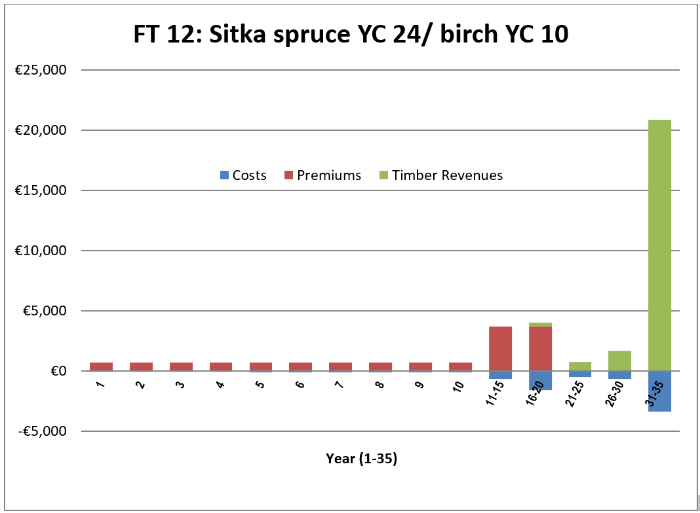
Table 1 presents a summary of key financial outputs for Forest Type 12. Total income, from premiums and timber sales exceeds €38,500 over the 35 year rotation. The Net Present Value (overall net revenue generated and expressed in today’s terms) is €12,917 while the indicative Annual Equivalent Value (NPV expressed as a series of equal cash flows over the rotation) is €740 per hectare each year, for 35 years.
Table 1: Per Hectare Financial Outputs (€) – Forest Type 12
| FIVE Financial Outputs | Forest Type 12 |
|---|---|
| Premium Income (€/ha) | 14,920 |
| Timber Income (€/ha) | 23,655 |
| Total costs (€/ha) | 7,391 |
| Net Present Value (€/ha) | 12,917 |
| Annual Equivalent Value (AEV) (€/ha/year) | 740 |
Source: Teagasc 2025
If all costs and revenues associated with forestry land use are compared with all costs and revenues associated with agricultural land use (after adjusting to present values and the one-year cycle per annum basis) then the per hectare Forestry AEV and agricultural family farm income can be considered conceptually equivalent. With an AEV of €740 per hectare per year, it is evident that forestry returns, based on proposed new premia levels in the Forestry Programme 2023-2027, can be very competitive when compared to many agricultural enterprises.
It should be borne in mind that this analysis compares observed agricultural incomes with projected future forestry income flows discounted to today’s values and converted to annual equivalent. This allows an indicative rather than absolute comparison. The analysis involving FIVE does not take into account the capacity for eligible forestry parcels to draw down the new Basic Income Support for Sustainability Scheme (BISS), CRISS and Eco Scheme payments as well as the forestry premia. It also does not factor in the potential income-tax free returns and relative efficiencies of the forestry option in terms of potential reduced labour inputs when compared to other enterprises.
Multiple Potential Forestry Benefits
People plant trees and forests for a host of very different reasons and considerations. These may include financial returns, timber production, biodiversity and landscape enhancement, recreation provision, climate change mitigation or simply leaving a valuable legacy. While forests take time to mature, they gradually deliver more and more such ecosystem services which can be experienced and enjoyed by the owner, his/her family, community and wider society.
As part of its comprehensive support services, the Teagasc Forestry Development Department is organising a nationwide series of 37 forestry clinics between January 20 and February 12, 2025. These clinics will provide great opportunity for a confidential, one-to-one consultation with your local Teagasc forestry advisor. Availing of independent and objective advice will help empower you to make informed decisions. For further details, log onto the Teagasc Forestry webpage or contact your local Teagasc forestry staff.