
The advantages of electronic sow feeding
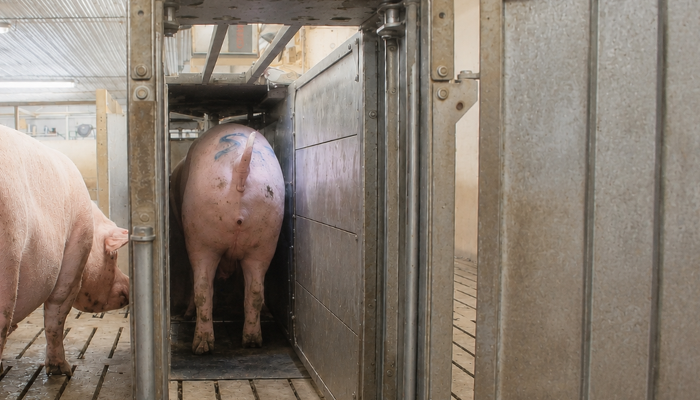
Electronic sow feeding (ESF) is one of the main systems used to manage group-housed gestating sows, allowing each animal be fed according to individual requirements. Mario Ornelas, Teagasc Postdoctoral Researcher, tells us more.
By enabling control over feed intake, ESF optimises conditioning for reproductive performance.
Another very useful function of most ESF systems is the automatic sorting of specific sows to a separate pen through a sorting gate, for interventions like pregnancy scanning, moving sows due to farrow, vaccination, treatment and culling. In the absence of a sorting pen, selected sows can be colour marked as they go through feeding stations.
Perhaps the most valuable aspect of ESF systems is their ability to provide individual animal monitoring. Every time a sow visits a feeding station, the system generates a series of records regarding individual feeding behaviour as well as body weight. This information can be used to identify animals in need of special attention allowing early interventions such as the detection of sows with reduced feed intake. These functions are carried out automatically with no human intervention beyond using the ESF software.
In order to use feeding records as a monitoring tool, however, it is necessary to understand how animals interact with ESF stations, and how feeding patterns are associated with age, gestation stage and health status.
A recent study at Teagasc looked at ESF records from a dynamic group of approximately 120 sows over a one-year period. While sows consumed their daily allotment on a single visit to feeding stations, most animals returned to the stations in an attempt to obtain more feed. Interestingly, the number of non-nutritive visits made was higher in younger sows and decreased across gestation, which may reflect animals learning over time that feeding level is restricted. It was also observed that each sow had a strong preference for a specific feeding station and that animals displayed a relatively stable feeding order during gestation. Older sows were the first to feed while younger animals fed later.
The study is also a reminder of a common issue associated with ESF systems: competition over access to feeding stations. Being a sequential feeding system where up to 80 sows are fed through a single station, according to manufacturer’s recommendations, ESF naturally gives rise to a certain level of competition, especially considering that animals are feed restricted. Competition is higher around the starting time of each feeding cycle, when sows queue at the entrance of feeding stations. Sows with a high social rank often displace other group members from the feeders and aggressive interactions are common.
Despite this, several management strategies have been proposed to mitigate feeding competition. While increasing the number of feeding stations available is also an option, it has limited feasibility given the costs associated.
The most effective measure is the physical separation between animals that have already fed and those still waiting. There should be physical barriers in place that prevent sows leaving a feeding station from promptly accessing its entrance, where other animals are waiting to feed. Ideally, this should be taken into account when designing the gestation pen.
Unpublished results have shown that if station exit gates lead to an area of the pen other than the feeding area, dominant sows will not return to feeding stations, allowing other group members to feed.
Another measure is to increase the time available to feed by reducing the amount of feed dropped per minute. The objective is to promote satiety so that animals abandon feeding stations voluntarily, rather than forced by a sow attempting to enter. It has been shown that in the absence of a time limit to feed, animals consume their allotment more slowly.
Other strategies to reduce competition include setting feeding cycles to start late in the evening.