
04 April 2025
The benefits of AI in suckler herds
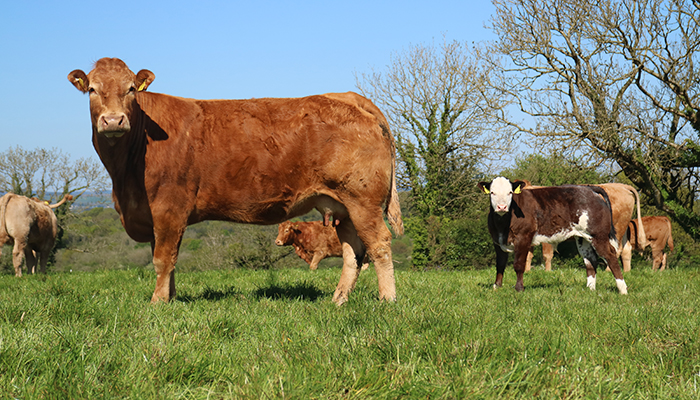
With less than 20% of calves in Irish suckler herds bred from artificial insemination, Catherine Egan, Beef Specialist, and Prof. David Kenny, Head of the Teagasc Animal and Bioscience Research Department, look at some of the potential benefits of AI usage.
Reproductive efficiency is a major factor determining production and ultimately the profitability of beef cow enterprises. In Ireland, there is evidence that less than 22% of heifers first calve at 24 months of age and the calving-to-calving interval is currently 397 days. Collectively, these statistics do not bode well for the continued genetic progress, or indeed economic or environmental sustainability of the national suckler herd.
Such low usage of AI most likely reflects the difficulty and labour requirements for heat detection, assembly of cows for insemination and land fragmentation in beef herds. Use of AI offers access to a vast range of sires across a variety of breeds, as well as potential to access the best genetics across both replacement and terminal traits.
In many cases, depending on herd size, using AI can be more cost effective than natural service and it also reduces the safety risk of having a stock bull.
AI enables you to selectively match the trait of specific sires to individual cows in your herd in order to improve, for example, maternal qualities of daughters or to pass on good terminal traits, thus increasing the performance and value of calves intended to be sold for beef.
Use of AI in Irish suckler beef herds
In 2024, 154,547 suckler beef calves were born from AI sires. The three most popular breeds included Limousin, Aberdeen Angus and Charolais, as outlined in Figure 1.
Figure 1: Breed distribution of suckler beef calves sired by an AI sire, born in 2024

Bull fertility
In some herds, AI is used to breed replacements of high genetic merit and a stock bull is used with high terminal traits on the remaining cows. In natural service herds, bull fertility is key to maintaining a compact calving period and overall herd profitability. While the reported incidence of infertility in stock bulls is generally low (3-5%), subfertility is much more common (20-25%), with significant differences among individual bulls.
Subfertility may be caused by low libido, sperm quality/quantity, defects or physical factors affecting bull mobility or mating ability. Frequently, sub-fertile bulls go undetected and farmers may be unaware of the problem until much of the breeding season has elapsed or until pregnancy scanning.
Furthermore, there is no guarantee that a bull will retain his fertility from season to season or even within a season. Thus, farmers must be continually vigilant for potential fertility problems so that corrective action can be taken.
Bull Breeding Soundness Evaluation (BBSE) is widely recommended to aid the identification of potential fertility and other related health issues in advance of the onset of the breeding season. Ideally, a BBSE should be conducted annually by a veterinary surgeon at least 60 days prior to the start of the breeding season. This will facilitate re-testing and timely replacement of bulls that may fail the examination.
While these evaluations identify bulls with substantial deficits in fertility, and principally semen quantity and quality, they do not consistently identify sub-fertile bulls. Therefore, farmers should monitor and record heats during the breeding season to identify potential problems.
The above is part of a series of articles from Catherine Egan and Prof. David Kenny that will appear on Teagasc Daily over the coming weeks. Other topics to be discussed include heat detection, synchronisation programmes and tips on how to get suckler cows bulling earlier in the breeding season.
Also read: Getting suckler cows bulling earlier