
04 May 2025
The Benefits of White Clover
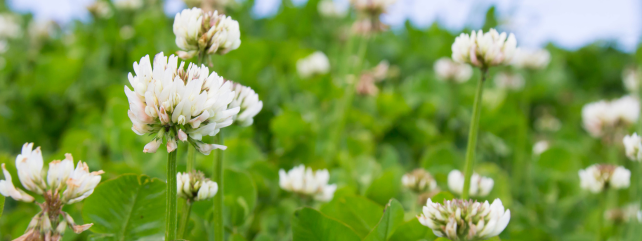
White clover is the most widely sown legume species in temperate grasslands and is highly compatible with perennial ryegrass. Its ability to thrive in a range of climatic conditions and tolerate intensive grazing makes it an ideal companion in mixed swards across Irish farms.
White clover can increase animal performance as it is a higher quality feed, and it can reduce the need for chemical nitrogen. Recognition of the high forage quality and the nitrogen (N) fixation benefits of grass-white clover pastures has led to a resurgence of interest in its use as a means of reducing the economic and environmental costs in livestock agriculture.
Research is being undertaken at Teagasc Moorepark, Curtins, Clonakilty and Athenry research farms on the role of white clover in our production systems. The research programme to date has delivered very promising results including:
- high N use efficiency (NUE) of close to 60%
- lower N surplus
- higher animal performance.
There is, however, a challenge to ensure that grass-white clover swards are established and persist on commercial grassland farms.
Benefits
The benefits of white clover tend to occur from May onwards as sward white clover content increases. The main benefits of white clover inclusion in grass swards are:
- Increased herbage quality compared to grass-only swards in the summer months.
- Increased dry matter (DM) intake in summer and autumn.
- Higher milk production and liveweight gain.
- Nitrogen fixation – white clover fixes N from the atmosphere making it available for plant growth.
- Lower requirement for N fertiliser application in summer.
Nitrogen fixation
Nitrogen fixation is the process whereby white clover can fix N from the atmosphere and make it available for plant growth through a process called biological N fixation (BNF). This N is then available for uptake by white clover and other plants, mainly perennial ryegrass, in the sward. The quantity of N fixed by a grass white-clover sward depends on a number of factors including:
- Sward white clover content – N fixation increases as clover content increases.
- N fertiliser application rate – N fixation declines with increasing N application.
- Soil temperature – N fixation increases as soil temperature increases.
- Solar radiation (sun light) – more sunlight, more fixation.
Typically as N fertiliser application rate increases, N fixation decreases, as there is adequate N available for grass and white clover growth.
Quantity of N fixed at different N application rates
| N fertiliser application rate – kg N/ha | Quantity of N fixed in grass white clover swards – kg N/ha |
|---|---|
| 100 | 100-150 |
| 150 | 90-130 |
| 200 | 70-100 |
| 250 | 0-40 |
Establishing a grass-white clover sward
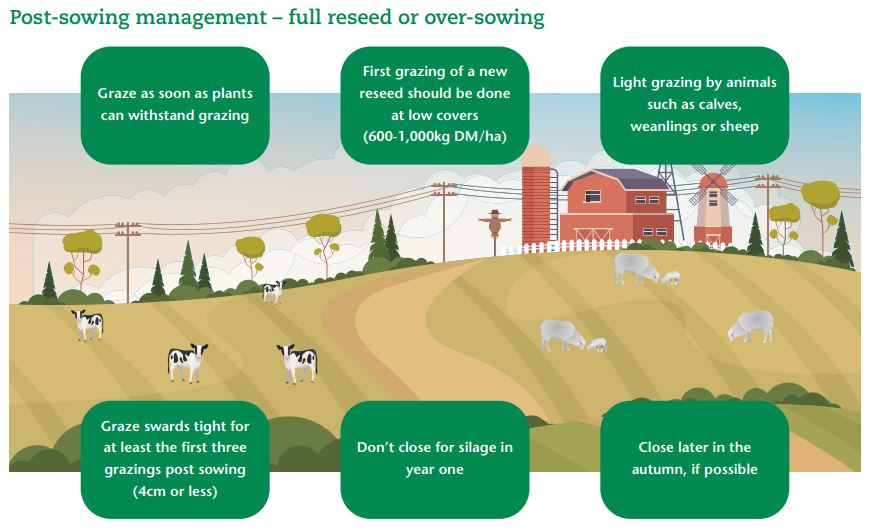
Establishing white clover on farm will take a number of years using a combination of reseeding and over-sowing. Incorporating white clover in a full reseed is the most reliable method of establishing white clover and provides the best opportunity for weed control.
Over-sowing is a simple and low cost method of introducing white clover into swards. Success is very much dependent on soil fertility, weather conditions at sowing, soil moisture, post-sowing grazing management and competition from the existing sward. Suitable paddocks for over-sowing are those with good soil fertility, high perennial ryegrass content and low weed content.
Dr. Michael Egan shares his key tips on establishing grass/white clover swards.
Grazing management
Best practice grazing management is similar for grass-white clover swards and grass-only swards. Flexibility and willingness to adapt to the conditions are important when managing grass- white clover swards. Good grazing management is also important for increased persistence and production of white clover in grazed swards.
Mid-season (April to July)
- Maintain pre-grazing herbage mass between 1,300 and 1,600 kg DM/ha (8 to 10 cm)
- Target post-grazing sward height of 4 cm
- Chemical N fertiliser may be reduced on swards with good white clover content (≥ 25%)
Dr. Áine Murray, Teagasc Moorepark details the key variables required to maintain white clover in grassland swards.
An average annual sward white clover content of approx. 20 – 25% is desirable for animal and sward production benefits. Sward white clover content increases through the spring, into summer and generally peaks in August/September. Good grazing management is key to maintaining sward white clover content.
Variety Selection
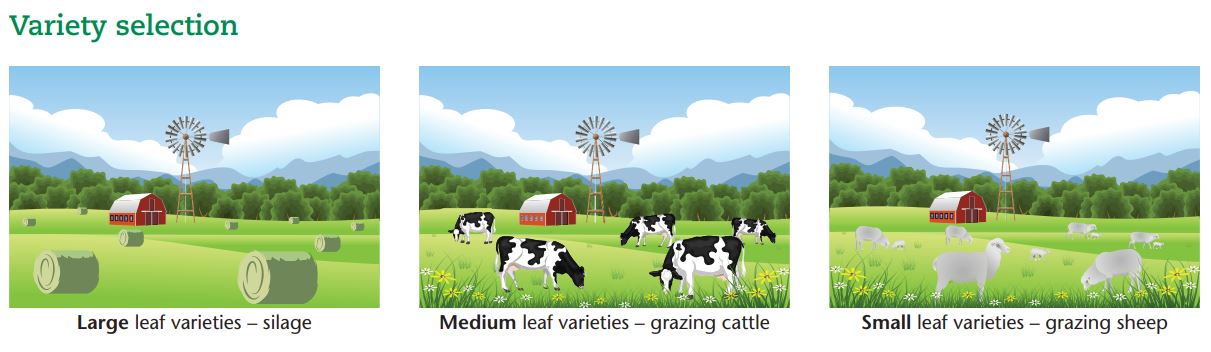
Grass and white clover varieties should be selected from the Irish Grass and White Clover Recommended List Varieties published annually by the Department of Agriculture, Food and the Marine. The Pasture Profit Index (PPI) should also be used to select in conjunction for the selection of grass cultivars.
Read more about White Clover here