
18 December 2024
The correct feed to the right animal
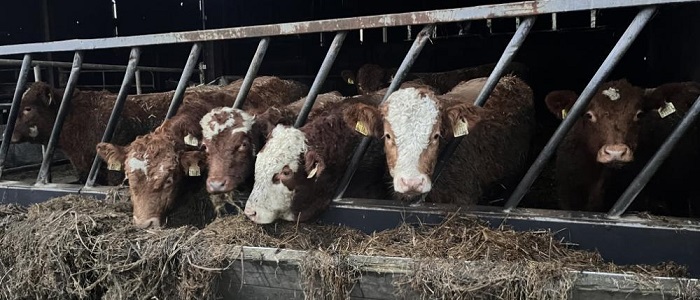
John Pringle’s efforts to make excellent quality silage earlier in the year have borne fruit, allowing for flexibility and ensuring all animals on the farm are offered the most appropriate diet over the winter months.
Having recently visited the farm in Aughrim, Co. Wicklow, Manager of the Future Beef Programme, Martina Harrington fills us in on the farm’s winter feeding plan.
John has succeeded in making excellent quality silage – the cornerstone of efficient winter feed management on beef farms. Results of silage testing show that the first-cut silage is 74.9% DMD with 14.65% crude protein at 26.8% dry matter; second-cut silage is 72.6% DMD with 13.8% crude protein at 20.63% dry matter; and the red clover silage tested at 75.3% DMD with 14.49% crude protein at 33.35% dry matter.
Suckler cow diets
Feeding the dry suckler cow on John’s farm revolves around having cows in sufficient body condition score (BCS of ~3.0) come calving. Where cows are over conditioned, their diet can be restricted to counteract any negatives, such as an increased risk of difficult calvings. The inverse is also true, where animals – such as in-calf heifers or first-calvers – require additional attention, they receive it. Both can only be achieved when body condition score is monitored carefully and regularly.
For more information on body condition score, view the Future Beef Programme’s guide here (PDF).
Discussing his winter feed plan for suckler cows, John explained: “The suckler cows are on a diet of silage and rye. The rye was sown to try and bulk up the winter fodder. It has a similar feeding value to straw, so it’s only suitable up until Christmas, as the protein level is so low that it’s not conducive to milk production in suckler cows.
“The in-calf heifers and second calvers are on silage only. They are in good condition and the silage is very good, so I will monitor condition and may have to restrict feeding.
“There is a fine line with younger animals when restricting, as they are still growing. I don’t want them to lose condition, as they may not go back in calf. However, if they gain too much, they could have a hard calving and also fail to go back in calf anyway.”
Minerals
With calving to start in mid-February, John has formulated a plan for pre-calving mineral feeding, which will start just after Christmas and allows a six week window for the minerals to build up in the cows. Cows will be offered 120g/day of a pre-calving mineral, split between the morning and evening, and dusted over the silage to ensure all cows get the required amount.
On his reasons for feeding pre-calving minerals, John explained: “I don’t compromise here, as the correct minerals help cows calve easier, produce vigorous calves, and return to calf successfully.
“I use a powdered mineral high in magnesium (17%), phosphorus (4.0%), and sodium (13%). I avoid calcium in the mix, but would tolerate up to 2.0%. With recent lime applications, high molybdenum can be an issue, so I ensure the minerals contain protected (chelated or organic) copper and zinc.”
Young stock
Bulls
As highlighted above, the red clover silage is the best quality feed John has available on farm, being at 75.3% DMD and 14.49% crude protein and, as a result, this will be offered to the young bulls. These animals are currently on 3kg/head/day of concentrate and ad-lib silage.
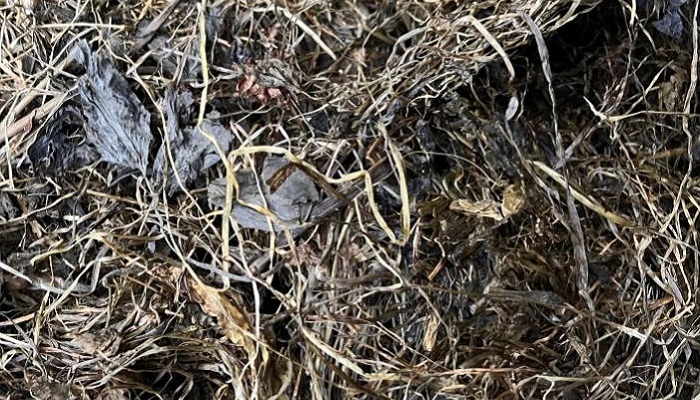
Red clover silage
On his experiences of feeding red clover silage and his targets for the bulls, John said: “The intake of red clover silage is higher than that of pit silage, despite it being drier. This is expected based on research at Teagasc Grange. The bulls’ dung is looser on it, but this was also expected. When they change over to pit silage, it should firm up. Their target weight gain is 1.3kg/head/day to reach a minimum of 500kg on their first birthdays.”
Heifers
For the heifers, John is aiming for an average daily gain of 0.6kg/head/day. To achieve this, these animals are being offered pit silage (almost 75% DMD) and 1kg/head/day of concentrate.
To ensure these heifers are actually hitting the target, they will be weighed again over Christmas. Weighing is a tool John finds quite useful, as it informs him of the success of his nutrition strategies and also allows for performance to be compared from year to year. For instance, in the case of the weanling heifers this year, if an underperformance is identified, additional feed will be offered to rectify.
Apart from nutrition, two of the reasons why animals fail to deliver the desired weight gains over the winter months are health issues and space. John follows a stringent health plan, which includes vaccination and strategic dosing, but space had been tight for the heifers in previous years. To rectify this, John is in the process of constructing a new slatted shed, which should be ready by Christmas or shortly after, and will allow him to offer the heifers more space over the winter months.
On his plans for the heifers, John said: “My plan is to get them to grass as soon as possible in the spring to ensure they are on track to bull in May and calve at 24 months.”
For more information on the health plan being implemented on John Pringle’s farm, click here.