
The Farm of 2050: what’s on the horizon?
Artificial intelligence, robotics and connected data systems have the potential to transform Irish farming over the next 25 years. But their success should be measured not by the sophistication of the technology, but by whether they help create more viable, sustainable and resilient farms.
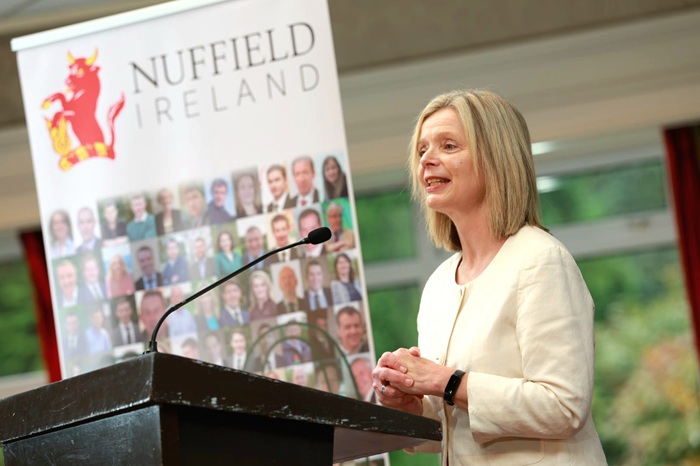
That was a central message delivered by Dr. Siobhán Jordan, Head of Technology Transfer and Commercialisation at Teagasc, in her keynote address at the Nuffield Ireland 30th Anniversary Conference on 6 November.
Looking ahead to 2050, she asked: “Will the farm of 2050 be a better place to work, a more viable business, a healthier environment, and something the next generation genuinely wants to be part of?”
Assessing the potential of new technologies starts with people, she said. Understanding the challenges farmers face, namely market uncertainty, environmental pressures, labour shortages and the growing need to feed a future population of approximately 10 billion people, will be critical.
“We sometimes speak about technological revolutions as though they sweep away the old problems. More often, they change the tools we have for addressing them. And sometimes they create new problems as well,” she explained.
Dr. Jordan argued that the farm of 2050 must be environmentally sustainable, a more viable business, and a better place to work. Better information could help farmers identify patterns, while automation could ease the burden of repetitive work. However, she cautioned that technology could also add complexity.
Artificial intelligence
In agriculture, she said, artificial intelligence could help identify changes in an animal’s behaviour before a problem is obvious, improve the timing of decisions using weather, soil and crop information, and help farmers compare the likely economic and environmental consequences of different management choices. The greatest benefit in this regard, she explained, will come when artificial intelligence moves from describing what has happened to predicting what may happen and helping someone decide what to do.
As one example, she highlighted emerging smart-glasses technology that could provide livestock information at the point of decision, alongside AI-enabled camera systems being developed to identify changes in cattle movement and support earlier detection of potential lameness. Such technologies, she stressed, need independent validation in Irish farming conditions.
“There is a crucial distinction between a recommendation and an actual decision. A system may recommend an intervention; it does not carry the same responsibility or deal with the consequences for the animal, the business, or the family.”
“We should be excited about what AI can do. But we should also insist that it earns our trust.”
Robotics
Examples of robotics are already visible on Irish farms, including automated milking, precision field operations and crop monitoring. Significant further transformation is possible.
“The question is not whether robots are good or bad, but whether they solve the right problem. Reducing repetitive work or improving safety is valuable; transferring costs and dependency to the farmer is not,” Dr. Jordan explained.
Data
Connected farm data was another focus of the keynote. Dr. Jordan noted that farms already generate considerable information, but it is often held in separate systems, making it difficult to use together.
“AgNav, a partnership between Teagasc, Bord Bia, and ICBF, provides a useful Irish example of the direction of travel.”
“It brings together proven scientific models and farm information to support sustainability assessment, forecasting, and action planning. It is a partnership approach, and that is significant. The value is not simply in generating an emissions figure or a nutrient balance. It is in connecting the information to practical decisions and, over time, to actions that can be assessed and improved,” Dr. Jordan explained.
Resilience
In a week when a substantial security event challenged many retailers across Europe, Dr. Jordan also flagged the importance of strengthened cybersecurity, contingency plans and safeguards:
“The challenge for 2050 is not simply to connect everything. It is to connect what is useful, in ways that respect farmer choice and keep the farmer in control.”
Dr. Jordan explained how improved forecasting, precision nutrient management, early disease detection, and more efficient resource use could benefit farmers. However, resilience should be tested as an outcome, rather than treated as a label attached to a product.
“The farm of 2050 does not need to be the most technologically sophisticated farm. It needs to be the farm best equipped to thrive.”
The importance of providing a rewarding career, centred on viable incomes, manageable workloads and opportunities for the next generation to lead, was also outlined. She said young people may be attracted by the opportunities created by digital technologies, but they also need to see viable businesses, rewarding work and communities in which they want to live.
Dr. Jordan also emphasised the importance of long-term investment in agricultural research, innovation, and skills. Areas such as soil science, animal breeding, climate resilience, and digital infrastructure require sustained investment, often long before their full benefits become apparent. “We cannot predict every challenge, but we can invest now in the capabilities to respond,” she said.
She also emphasised the importance of leadership and collaboration between farmers, researchers, industry, and policymakers: “Technology can connect our systems. Leadership connects people, knowledge, and opportunities. And we will need both to build the farm of 2050.”
“But I hope the things we value most will still be recognisable: a farmer who knows the land and the animals, a viable business, healthy soils, good food, and a community with a future.”
“The future of farming is not about replacing farmers with technology. It is about giving farmers better tools, better information, and a better future,” Dr. Siobhán Jordan concluded.