
The latest from Dairy Systems Research at Johnstown Castle Open Day
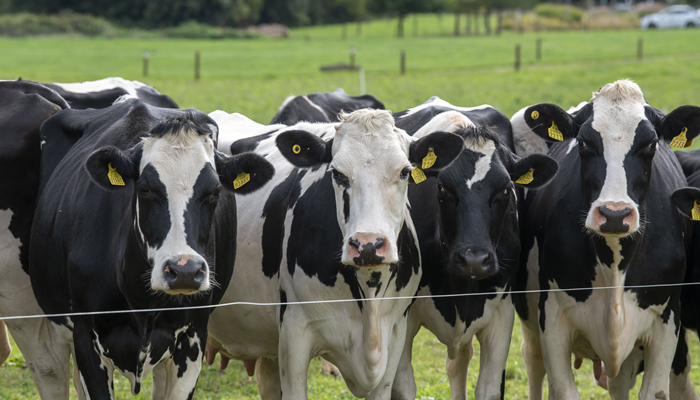
Visitors to the Farming for a Better Future Open, taking place at Teagasc, Johnstown Castle on June 10, will learn about the latest research to increase resilience and reduce environmental impact of both the spring and winter milk production systems.
With a central focus on healthy soils and clean water, farmers interested in the Johnstown Castle Dairy Unit, comprising of a 90 cow Autumn calving herd and up to 50 cow spring calving herd, will have an opportunity to learn more about the research trials ongoing in the areas of multispecies swards for dairy production.
Multispecies swards for dairy production
Grassland farmers have become increasingly interested (and curious) about the utilisation of multispecies swards (MSS) on their farms to reduce chemical fertiliser nitrogen (N) input and environmental impact and potentially improve animal performance.
A comparison of perennial ryegrass with ~10% white clover with a 6-species MSS has been undertaken at Johnstown Castle Dairy unit in the spring calving herd since 2020.
In the first three years of the study, there were marginal benefits of the MSS sward compared to the perennial ryegrass white clover sward on cumulative milk yield and milk solids production, which was largely observed in early and late lactation with sward type being in different in mid lactation.
The multispecies sward received 66 kg chemical N / ha/ year on average over the first three years which was ~110 kg N/ha less than the perennial ryegrass-clover farmlet. The swards were not oversown in the first 3 years.
In 2024 and 2025, the perennial ryegrass-white clover and multispecies swards received 120 and 60 kg chemical N/ha, respectively, however there was a reduction in herbage and milk production in the multispecies sward system. The clover component across both sward systems ranged 13-15%, thus a focus on clover composition (target >20%) is required in low chemical nitrogen systems to support herbage and milk production.
Sward diversity and urine patches
To build on the production study, research is currently being undertaken evaluating multispecies swards across soils with contrasting drainage, following autumn urine deposition.
Provisional analysis is showing that multispecies reduced nitrous oxide emissions across the different soil types, with the greatest reductions observed in poorly drained soils (-64%) where emissions were highest.
Multispecies swards also reduced cumulative nitrate leaching across all soil types by an average of 51%, with the greatest reduction occurring in moderately drained soils. These findings highlight the potential of multispecies to reduce environmental losses, although improving plantain persistence requires further work.
For more from the Farming for a Better Future Open Day, visit here.